Estimate simple financing cost while an invoice remains unpaid.
The interactive form requires JavaScript. The worked example, formulas and source links below remain available.
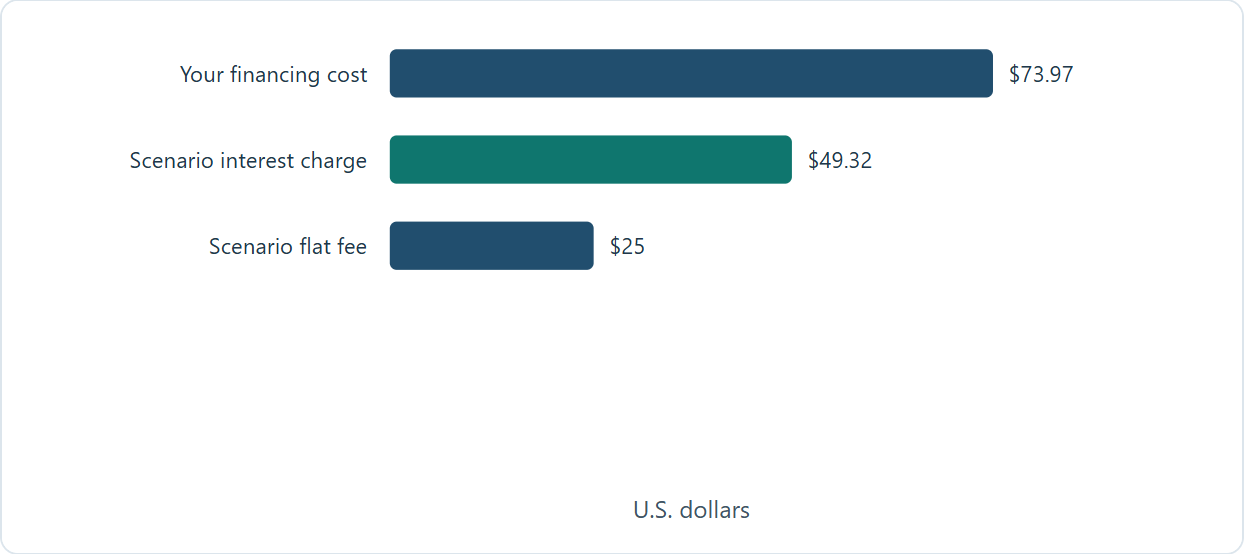
Invoice delay cost calculator: default example chart
On this page
Invoice delay cost: estimate the financing effect of a late invoice
This calculator estimates simple interest on money used to bridge a delayed customer payment. It separately illustrates a customer late-charge amount using a rate and flat fee you enter. These are two different cash flows: the cost your business may incur and an amount it might seek from a customer under applicable agreed terms.
The tool doesn’t decide whether a late charge is lawful, agreed, enforceable, or collectible. It doesn’t assess a contract or apply the rules of every U.S. state. The late-charge calculation is a hypothetical arithmetic scenario. Don’t send a demand based solely on the result.
The financing estimate uses simple interest with actual entered days divided by 365. It assumes the financed balance stays constant for those days. It excludes lender fees, compounding, changing balances, administrative time, and any broader commercial consequences of the delayed payment.
Separate the invoice from the amount you actually finance
Unpaid invoice: enter the amount still unpaid after any credits or partial payments. This is the customer receivable used for the hypothetical late-charge calculation. Don’t use the original invoice amount if a substantial portion has already been collected.
Financed amount: enter the cash you actually need to borrow or otherwise fund because the payment is delayed. It may be less than the invoice. If a $5,000 receivable is late but you need only $2,000 to cover an immediate supplier payment, using $5,000 as a borrowing balance would overstate that specific financing scenario.
Annual financing rate: enter the rate associated with the modeled borrowing cost. Use an annual percentage, such as 12 for 12%. A monthly rate must be interpreted carefully; entering 1% as though it were a 1% annual rate would materially understate a 1%-per-month arrangement.
Days delayed: enter the days relevant to the scenario. Days after the contractual due date are different from days since the invoice was issued. For a financing estimate, also consider when the borrowing actually began. The tool uses one day count for simplicity, so label the scenario accordingly.
Hypothetical customer charge: enter an annual simple-interest rate and any flat fee only to explore the arithmetic. These fields don’t supply permission to impose either charge.
How the two estimates are calculated
Financing cost equals financed amount multiplied by the annual rate as a decimal, multiplied by delayed days, divided by 365. With a constant balance and no compounding, each additional day adds the same amount of modeled interest.
The hypothetical customer interest charge equals unpaid invoice multiplied by the entered annual customer rate, multiplied by days, divided by 365. The flat fee is then added. This formula describes a scenario, not a universal late-payment rule or a substitute for the agreed payment terms.
The calculator shows both numbers separately. It doesn’t automatically subtract an uncollected customer charge from financing cost. Until payment is received, a possible charge isn’t cash available to pay your lender. Keeping the figures distinct also avoids implying that the customer legally owes every cost the business incurs.
Invoice delay cost example: a $5,000 invoice delayed 45 days
Assume a hypothetical $5,000 invoice remains unpaid and the business finances the full $5,000 for 45 days at a 12% annual rate. Under simple interest with a 365-day basis, financing cost is $5,000 × 0.12 × 45 ÷ 365, or approximately $73.97.
| Item | Assumption | Result |
|---|---|---|
| Financing cost | $5,000 at 12% for 45 days | $73.97 |
| Hypothetical customer interest | $5,000 at 8% for 45 days | $49.32 |
| Hypothetical flat charge | Entered scenario amount | $25.00 |
| Combined hypothetical customer charge | Interest plus flat charge | $74.32 |
The customer-charge scenario uses an illustrative 8% rate and $25 fee. Their presence in the example doesn’t establish that either charge can be imposed on a real invoice. The small difference between $73.97 and $74.32 also doesn’t mean the business has been made whole: collection, lender fees, staff time, and other effects remain outside the calculation.
The unpaid $5,000 is still a receivable in this illustration. A delay doesn’t automatically mean the entire amount is permanently lost. Distinguish delayed cash from a bad debt or write-off, which involves a different assessment.
Compare different delays and funded amounts
At the same $5,000 financed balance and 12% annual rate, each day costs approximately $1.64 before rounding. A 30-day delay costs about $49.32; a 60-day delay costs about $98.63. Doubling the days doubles simple interest when principal and rate remain unchanged.
If only $2,000 needs to be financed for 45 days, the cost is approximately $29.59 at 12%. This highlights why the financed-amount field is separate from invoice face value. A business using existing cash might instead examine an opportunity-cost scenario, but it should label that as a chosen assumption rather than actual interest paid.
If a customer makes a partial payment during the delay, calculate separate segments for each outstanding financed balance. For example, one constant balance may apply before the partial payment and a smaller one afterward. A single unchanged balance over the whole period would overstate the second segment’s financing cost.
Use the actual contract and applicable rules for charges
Payment terms should identify when the invoice is due and how any agreed charge is determined. Different contracts can use different rates, day-count conventions, grace periods, caps, or fee structures. This calculator doesn’t interpret those documents or validate the terms against applicable law.
Government payment programs can also use specific methods. The Treasury’s Prompt Payment interest page describes its own day-count and compounding rules. This tool’s 45-day, actual/365, simple-interest example isn’t that federal program’s calculation and shouldn’t be presented as one.
If the right method is unclear, obtain an interpretation of the actual agreement and relevant rules before adding charges. The purpose here’s to make the financial assumptions inspectable, not to provide an automatically valid collection amount.
Check whether the funding product uses simple interest
A loan, revolving credit line, credit card, or invoice-financing product can have different pricing. Origination fees, draw fees, minimum interest, factor fees, and compounding can make the real cost differ from principal multiplied by a nominal annual rate and time.
The CFPB’s explanation of simple and precomputed interest illustrates why the interest method matters. Although that guidance concerns auto loans, the mathematical distinction is relevant when deciding whether a simple-interest model describes the product you’re entering. It doesn’t establish terms for a business-financing contract.
Use the simple interest calculator to compare day-count assumptions, or the loan payment calculator for a fixed monthly amortizing loan. Neither replaces a lender’s fee schedule or a cash-flow model for a complex financing agreement.
Record timing separately from sales profitability
An invoice can represent a sale while the business is still waiting for cash. Meanwhile, wages, suppliers, rent, and taxes may require payment. The SEC’s financial-statement guide distinguishes revenue and expenses from cash entering and leaving a business.
Keep a dated forecast of expected collections and required payments. If several invoices are late, don’t assume each one requires a separate full borrowing balance throughout the same period. Shared cash and overlapping obligations can change the funding need. A consolidated cash forecast gives a better basis for the financed-amount input.
The business break-even calculator answers how much sales contribution covers entered costs. This invoice tool answers a narrower timing question. A business can meet its sales target and still face a temporary cash shortfall.
Use the estimate to improve the collection process
Check that the invoice identifies the correct customer, purchase order, delivery evidence, amount, and due date. A dispute or missing document is different from a customer simply taking longer to pay. Record the reason for a delay so the response addresses the actual obstacle.
After collection, compare the actual financing days and costs with the estimate. Use that history to improve future cash forecasts and customer payment assumptions. Don’t treat one late invoice as proof that every future invoice from that customer will follow the same pattern.
Distinguish invoice age from overdue days
Suppose an invoice is issued April 1, is contractually due May 1, and is paid May 16. It’s 45 days old on payment, but only 15 days past the stated due date. At $5,000 and a hypothetical 12% annual simple rate, 15 days produce approximately $24.66 on a 365-day basis, while 45 days produce $73.97.
The correct funding period may differ again if the business borrowed before or after the due date. Record the invoice date, due date, borrowing date, and collection date separately. Use the interval relevant to the specific result instead of treating every date difference as the same delay.
Invoice delay cost questions
Is the displayed customer charge legally owed?
The calculator can’t determine that. It applies entered numbers to a simple formula. Contract terms, applicable law, and the facts of the transaction determine whether a charge may be imposed or collected. Verify those matters before using the estimate on a real invoice.
Is the full invoice amount my financial loss?
Not necessarily. This model assumes delayed collection, not permanent nonpayment. It estimates a financing cost during the delay. A write-off, settlement, or collection loss is a different event and isn’t inferred from the number of days entered.
What if I did not borrow money?
There may be no actual loan interest to enter. You can examine an explicitly labeled opportunity-cost scenario, but don’t call it an interest expense paid to a lender. Keep actual cash costs and hypothetical alternatives separate.
Does this compound interest?
No. Interest is calculated on a constant principal using entered days divided by 365. Products or contracts with compounding, changing balances, or another basis need a different schedule. The simple estimate shouldn’t be presented as their exact cost.
Questions or corrections?
Send a question or report an issue with a published page.