Mortgage Charge Questions: Choose the Record That Answers Them
Match a questionable mortgage charge to account detail, service records or adjustments with a worked property-inspection example and a two-part index.
Estimated reading time: 8 minutes
Mortgage charge records serve different purposes. This exercise asks which document can answer the particular question you have about an amount or account entry.
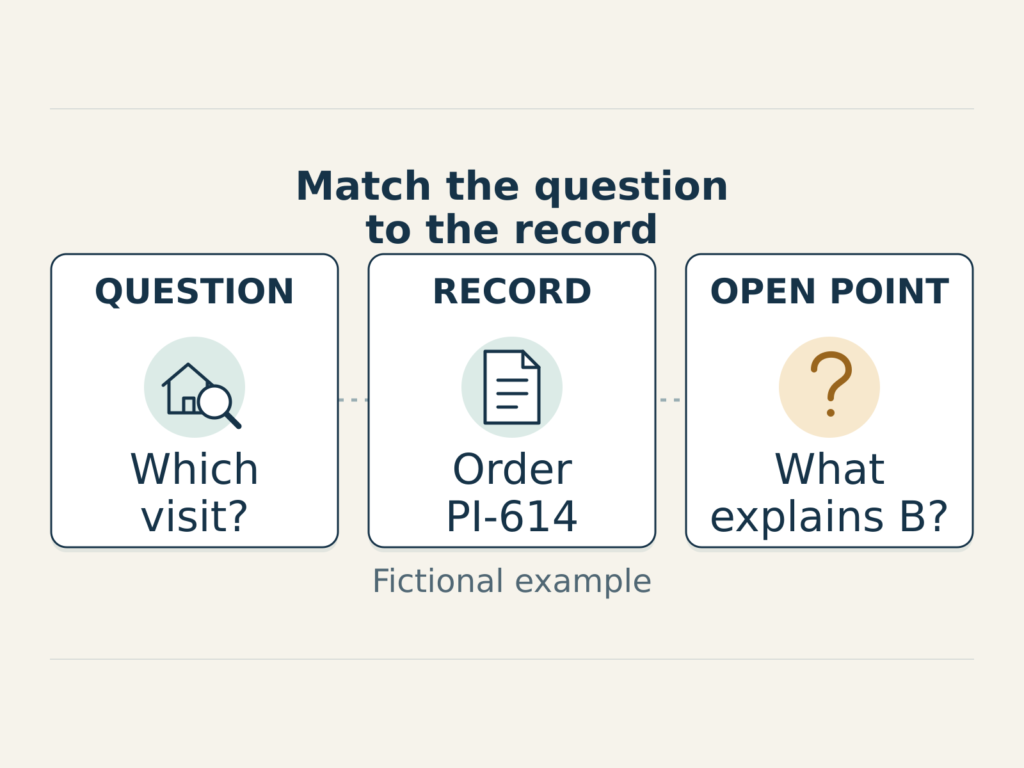
When a mortgage charge looks wrong, the useful question is often specific: which account entry, service event or adjustment would explain it? The selector below connects each question to a bounded record. A worked property-inspection example shows how to keep an unanswered factual question beside a clearly stated concern.
You can request information and allege an error together, without a prior records request or complete proof.
This example assumes a covered U.S. mortgage. These procedures exclude HELOCs and have other coverage limits. Check the scope, definitions and exclusions.
This is general education, not a conclusion about your contract, a particular fee or your legal rights. All names, dates, references and amounts below are fictional. Keep real account details private.
Mortgage charge records: match the question to evidence
Start with the row that matches the missing fact. You don’t need to send every row. If your statement already answers a question, write its page number in your notes and spend your attention on the unresolved point.
| Your question | A focused record to identify | What to compare | What remains open |
|---|---|---|---|
| Which entries make up the charge total? | The account-entry detail for the statement period in question. For example: September 1–30, entries A and B, both labeled property inspection. | Entry identifiers, posting dates, amounts and full descriptions. Keep a posting date separate from the date the inspection reportedly occurred. | Two entries show two postings. They do not, by themselves, show two inspections. |
| What work does each entry represent? | Existing charge detail connecting A and B to their inspection dates and order references, plus any available account-specific invoice or work-order detail for PI-614. | Does each line point to the same visit, a separate visit or another component of the work? Record the explanation beside each entry. | A shared amount or abbreviated label cannot settle that question. Even a shared reference needs context. |
| Has a correction already reached the account? | The adjustment or reversal history connected to A or B from September 1 through October 3, the date of your account snapshot. | The original entry, adjustment identifier, amount and effective date. Match a credit to its target before subtracting it. | A letter promising a correction and an account showing that correction are different observations. A credit is also different from money returned. |
| What supports the no-error finding? | For October 12 response NE-22, request materials actually relied upon for A/B, subject to permitted withholding or omissions. | Match its reason to the material. | Does it explain B? |
This is your organizer; it doesn’t require the servicer to create a custom table or produce every imagined document. See the information rule.
Mortgage charge records: two inspection entries
The September statement shows entry A, posted September 8, and entry B, posted September 9. Each is $45, labeled property inspection, with the service date September 4 and the reference PI-614. The borrower has the statement but no work-order detail. The October 3 account snapshot shows no identifiable adjustment linked to either entry.
That’s a reason to question the second entry. It’s still unclear whether the underlying record describes one visit, two visits or different work under one reference. In the example, the borrower chooses the service-detail row and the adjustment row. Asking for another copy of a statement already in hand would add little.
Keep a two-part index with the same entry references
The labels below are a way to keep your own notes readable. They connect the same A/B references across the question, the concern and any later answer.
Identify yourself and the mortgage account in writing; state the information sought and any believed error.
Part A: Information questions
- Q1. Which visit or work does each line describe?
- For entries A and B on the September statement, identify the existing charge detail showing the service date, inspection-order reference and work associated with each. The reference printed on both lines is PI-614; the service date shown is September 4.
- Q2. Is there a separate underlying charge for B?
- Identify any available invoice or work-order detail connecting entry B to work distinct from the work behind A. The missing fact is the relationship between these entries, not a list of every inspection ever performed on the property.
- Q3. Is a correction already recorded?
- Identify any adjustment or reversal linked to A or B during September 1–October 3, including its entry reference, amount and effective date. Keep October 3 as the snapshot date so a later change is recognizable.
Part B: Believed error
E1: I believe B duplicates A: both show September 4 and PI-614. Please investigate and correct B.
E1 can be stated while Q1 and Q2 remain open.
The uncertainty is precise: the borrower suspects that B repeats A but lacks the detail explaining B. If the reply identifies distinct work, record that explanation next to Q2 and compare it with E1. If the reply only supplies a list of the two postings, it answers a narrower question than the one about the underlying work.
Mortgage charge records: check the arithmetic
The two entries total $90. If later evidence establishes one $45 duplicate and no correction has already been applied, removing that duplicate leaves $45 of these entries. Equal amounts alone don’t establish duplication. The remaining $45 isn’t a finding that the fee is valid, an amount-to-pay instruction or a cash-refund calculation.
Mortgage charge records: reconcile a partial adjustment
Extend the fictional A/B example with one new assumption: a later account record shows a $20 credit specifically linked to entry B. The original two charges still total $90. The combined net of those entries is now $70, provided the record confirms that the credit belongs to this pair and no other change applies.
That arithmetic doesn’t by itself resolve the duplication concern. If the investigation establishes that B’s entire $45 should be removed, and the $20 credit is already part of that correction, the remaining adjustment is $25. Crediting another full $45 would remove $65 against the original $45 B entry. Reconcile what has already happened before calculating what remains.
Keep the branches separate. If the $20 credit is unrelated, don’t assign it to B merely because it appeared near the same date. If the reply establishes a different amount should be corrected, use that supported amount rather than retaining the assumed $45 target. If the response doesn’t explain the credit’s relationship to B, record that relationship as unknown.
Add three fields to your mortgage charge records index: adjustment reference, original entry it targets and amount already reflected in the chosen snapshot. Record the credit-effective date separately from the date you noticed it. A later snapshot may show a change that was absent on October 3; preserve both views instead of rewriting the earlier record.
The $70 net balance in this limited example isn’t an amount-to-pay instruction, a finding that A is lawful or evidence that cash was refunded. It only reconciles the stated entries. Likewise, an adjustment appearing on the account doesn’t explain whether the separate information questions received a complete answer.
Close each question independently. Mark Q1 or Q2 answered only when the record actually identifies the work or relationship requested. Mark an adjustment verified only when its target and effect can be traced. This keeps a partial response or partial credit from being mistaken for resolution of every concern, while giving the next conversation a precise unresolved point.
Track the replies
Use any required designated address or the servicer’s designated online intake, if offered. A payment address or ordinary portal message may be the wrong route. Check the routing provisions and its written instructions.
Keep a copy of the exact submission, attachments and delivery evidence. In your private index, add the sent date, destination, delivery or receipt evidence, response reference and the specific row each answer addresses. Leave a date unknown when your record doesn’t establish it.
An information response may supply information or explain unavailability after reasonable search. Exceptions apply. See § 1024.36(d)–(f).
An error response may report correction or explain a no-error determination following reasonable investigation; exceptions apply. See § 1024.35(e)–(g).
- Work detail arrives: record what it says about A and B beside Q1 and Q2. Then check whether the separate concern about B has been addressed.
- A record can’t be located: keep the stated reason beside the corresponding question. That missing record alone doesn’t establish either that B repeats A or that B is proper.
- An adjustment appears: connect it to B before reducing the unresolved amount. If the snapshot already includes the credit, don’t subtract it again.
- The reply leaves a gap: write the gap specifically, such as “The packet lists A and B but does not identify the work behind B.” This is more usable than “Nothing was answered.”
Keep making required mortgage payments. For foreclosure or legal papers, seek prompt qualified help rather than waiting on this worksheet. The CFPB guidance links assistance options.
Neither route is a general foreclosure stop.
The useful finish is a record you can read: which question was answered, what the answer shows, what remains uncertain, and whether a correction is actually visible. Keep those conclusions tied to A, B and the dated snapshot instead of treating any reply or any credit as the end of the matter.
Related reading
For a related question, read Mortgage Paid Off: Where Did the Remaining Escrow Money Go? and California Supplemental Property Tax: Check the Bill, Payment and Cash.

One Mortgage Form, Two Borrowers
Match each person’s share.