New York Card Surcharges: Check Price and Card Type
Check a New York card surcharge against the displayed total, actual card type, and applicable network terms. Keep the receipt and price evidence needed to question a difference.
Estimated reading time: 8 minutes
New York surcharges require checks of both the displayed price and the card used. Keep the state disclosure question separate from card-network restrictions.
For a New York store purchase, state price-disclosure law and card-network surcharge rules answer different questions. Check both before accepting an unexplained card fee.
New York surcharges: check the posted card total
New York General Business Law §518 requires a seller imposing a credit-card surcharge to clearly post the total credit-card price, including that surcharge. The final price can’t exceed the posted price. The surcharge can’t exceed the business’s applicable credit-card charge.
NYC311’s guidance says a separate sign announcing a card-fee percentage is insufficient. Businesses can display both cash and credit-card prices, or the higher credit-card price with a cash discount. The displayed total excludes sales tax.
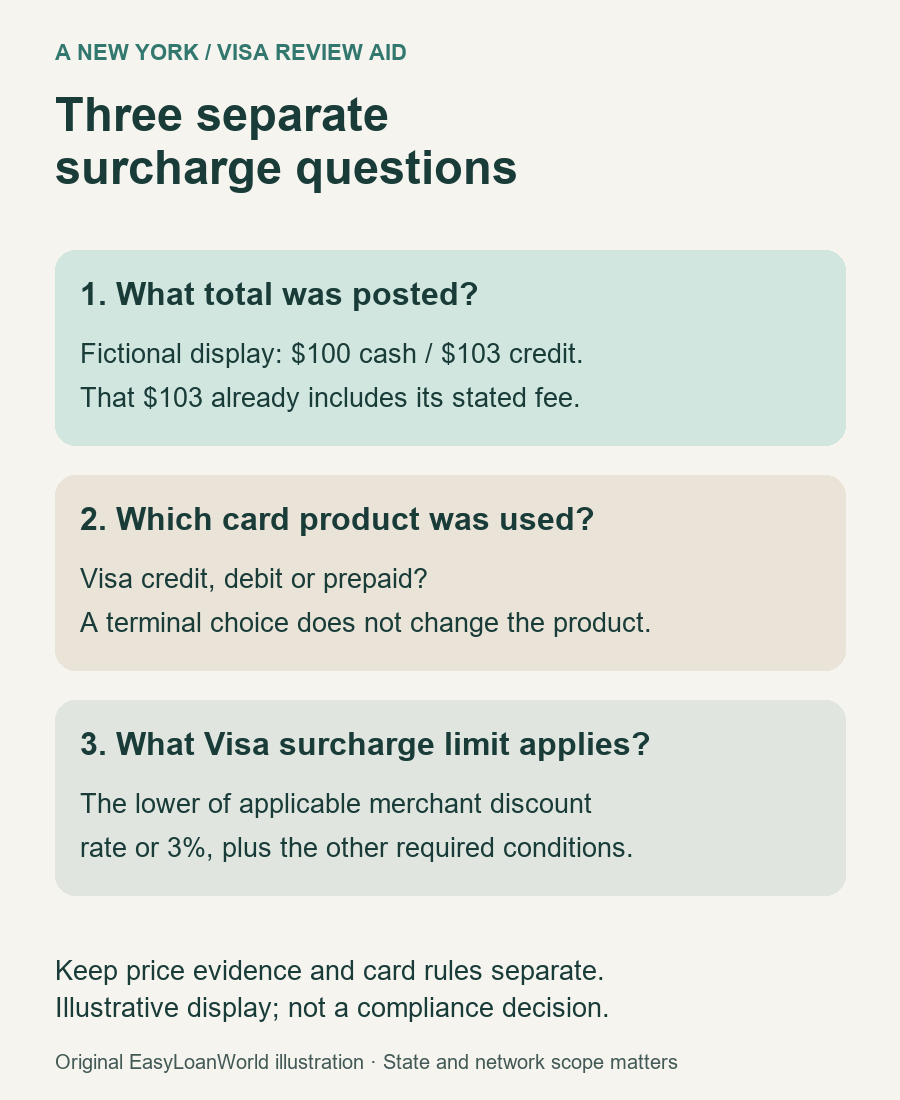
Illustration: a $100 shelf price plus a separate “3% card fee” notice doesn’t display the $103 credit-card price. Posting “$103 credit / $100 cash” does. This example concerns price disclosure, not whether every other requirement is satisfied.
Identify the card and the fee
Visa’s U.S. surcharge Q&A prohibits surcharges on Visa debit and prepaid cards, even when the customer selects “credit” at the terminal. Its credit-card surcharge ceiling is the lower of the applicable merchant discount rate or 3%.
NYC311 says the state credit-card surcharge law doesn’t apply to debit cards. That statement doesn’t determine whether a separate card-network rule permits a fee.
Visa’s Rules and Policy FAQ separately permits certain convenience and service fees. Ask what the charge is for; don’t assume every payment-related fee is a surcharge or that relabeling settles its classification.
For a specific posted Visa transaction, contact your card issuer using the number on your statement or card. Visa also provides a rules-inquiry route.
New York surcharges: keep the price record complete
The original $100 and 3% example distinguishes a posted total from a separate percentage notice. It doesn’t calculate tax or determine every other requirement. Keep the item, advertised prices, fee notice and actual receipt together when asking about a transaction.
For a single $100 item, a 3% addition is $3 and the selected pre-tax card total is $103. A display of $103 credit and $100 cash makes those two amounts visible in the original disclosure example.
A separate percentage sign still requires the customer to calculate the total. That’s why the original NYC311 guidance distinguishes it from displaying the credit-card price itself.
Don’t compare a shelf price for one item with a receipt containing extra items or tax and label the full difference a surcharge. First identify the same purchase and separate each component.
New York surcharges: calculate the lower Visa limit
For an independent hypothetical Visa credit-card case, assume the applicable merchant discount rate is 2.4%. Under the cited Visa ceiling, compare that rate with 3% and use the lower 2.4% for this limit calculation.
On an assumed $100 base, 2.4% is $2.40. A $3 surcharge would be $0.60 above that calculated limit even though it equals 3% of the base. The network’s 3% figure isn’t automatically the applicable maximum in every case.
For a separate merchant discount rate of 3.5%, the lower of that rate and 3% is 3%. On the same assumed base, the corresponding ceiling calculation gives $3.
The merchant discount rates are invented inputs, not actual costs at a particular store. These calculations don’t establish complete compliance with state law, network disclosures or every applicable contractual condition.
Check the base before multiplying a percentage
Use a separate fictional two-item purchase: $100 and $50 before tax or any other charge. The selected base is $150. At an assumed 2.4% surcharge, the amount is $3.60 and the selected pre-tax total $153.60.
At 3%, the corresponding arithmetic is $4.50 and $154.50. The $0.90 difference follows from the rate difference applied to the same $150 base.
This is a mathematical sensitivity, not permission to select either percentage. The applicable actual charge limits and disclosure rules still need to be satisfied for the real transaction.
If the base or included items differ between the receipt and the advertised comparison, preserve that difference and ask for an explanation. Correct multiplication can’t settle an unclear starting amount.
Don’t add a surcharge again to an inclusive price
Return to the original posted $103 credit and $100 cash example. The $103 credit price already includes the example’s $3 surcharge. Adding the same percentage a second time wouldn’t reproduce the supplied price.
Multiplying $103 by 1.03 gives $106.09. That is $3.09 above the posted $103 credit total. Adding a flat $3 again would instead produce $106. Both operations add another amount to a price already described as inclusive.
These are double-count illustrations, not an explanation of any actual receipt. A real transaction may contain separately identified tax or other items outside this narrow example, so reconcile those records before attributing the entire difference.
Write inclusive or separate beside each line in a private checking sheet. That label helps distinguish a final price from a base awaiting an addition.
New York surcharges: identify the actual card product
A Visa credit card, Visa debit card and Visa prepaid card are different products for the cited surcharge rules. A terminal button labeled credit doesn’t turn the latter two products into credit cards for that rule.
The original Visa guidance prohibits surcharges on debit and prepaid cards, including when a customer selects credit. Keep that rule separate from NYC311’s statement about the scope of the state credit-card surcharge law.
A state-law scope answer doesn’t establish that the card network permits the charge. Likewise, identifying a Visa rule doesn’t resolve every state price-disclosure question.
For a specific transaction, identify the card product through genuine account information and contact the issuer privately if needed. Don’t post full card numbers, security codes or identity records in public comments to obtain a general explanation.
Ask what a differently named fee actually covers
The original guide notes that Visa has separate provisions for certain convenience and service fees. A charge’s label shouldn’t replace its actual purpose, conditions and applicable rule.
If a receipt says service fee, ask what event or service triggers it and which policy the merchant says applies. Don’t assume that changing a surcharge’s name settles classification or that every service fee is necessarily the same kind of charge.
Keep the merchant’s explanation and the receipt together. A generic policy sign may not identify why a particular transaction received the amount shown.
This article doesn’t evaluate every possible fee program. Its examples concern the specified New York and Visa surcharge questions and the arithmetic needed to compare the records accurately.
Separate a complaint question from a promised recovery
For a record packet, retain the advertised cash and card prices, fee signage, purchase details, card type and receipt. Identify the precise mismatch, such as an extra amount beyond a stated inclusive price, without altering the original evidence.
Ask the merchant to explain the difference and retain its response. If using the issuer or NYC311 routes described in the guide, follow the genuine channel and actual instructions for that particular issue.
Submitting a complaint or inquiry isn’t proof that a charge will be refunded. A receipt correction, account credit and final resolution should each retain their own confirmation if they occur.
Likewise, this article doesn’t instruct a reader to withhold payment or determine an individual legal remedy. The evidence helps the appropriate party evaluate the actual transaction.
Finish the comparison with its scope intact
A complete worksheet identifies the same item set, stated prices, surcharge base, amount, card product and actual explanation. Keep tax and other excluded components separately identified so the selected arithmetic isn’t mistaken for the whole receipt.
If a purchase occurred elsewhere or used another card network, obtain the applicable rules instead of importing the New York and Visa examples unchanged. A familiar three-percent figure isn’t a universal rule.
A useful New York surcharges review checks both the posted-price evidence and applicable card restrictions. Its purpose is to make an unexplained fee reviewable, while keeping hypothetical rates and calculations distinct from actual merchant costs and a promised outcome.
Date the price evidence as well as the receipt. A photograph taken after a store changed its display may describe a different price record. Preserve what was actually observed at the relevant transaction and label any uncertainty about timing instead of presenting a later image as contemporaneous proof.
Keep evidence of the difference
Save the advertised price, fee signage and receipt, and identify the payment type. Ask the store to explain any difference. For a New York City store complaint about this disclosure rule, NYC311 directs consumers to its Store Complaint service.
This guide is limited to New York purchases and the stated Visa rules, not every state or network. Checked October 24, 2026; educational information, not a promised refund.
If you need to question a card charge, see our credit card billing-error record guide. For a separate fee decision while traveling, compare paying in local currency or U.S. dollars.
Roth Conversion and Account Clocks
Separate five-year tests.
ABLE Distributions Across Month-End
Separate retained purposes.