Texas Claims: Deductible or Depreciation?
Separate your Texas insurance deductible, depreciation, and possible later reimbursement. Worked examples show both the final cost and the cash needed before repairs are reimbursed.

Estimated reading time: 8 minutes
For Texas insurance claims, separate the deductible from depreciation before comparing what the insurer pays and what you must fund.
Read the Texas insurance claims example
In Texas, verify covered damage, valuation, deductible and limits in your policy first.
The Texas Department of Insurance illustrates a covered storm requiring replacement of a ten-year-old roof whose replacement costs $10,000 today. With a $2,000 deductible, replacement cost coverage pays $8,000; actual cash value coverage, assuming a $7,000 depreciated value, pays $5,000. You fund $2,000 versus $5,000 respectively. Depreciation reflects age and wear; under actual cash value coverage, that shortfall stays yours.
Most replacement cost insurers initially subtract both depreciation and your deductible from repair estimates after inspection. They reimburse withheld depreciation after receiving the finished repair bill, subject to your policy’s repair deadline. Your deductible remains your share. Ask your agent to confirm that deadline and coverage limits; costs exceeding limits remain yours.
Follow the replacement-cost example through three stages
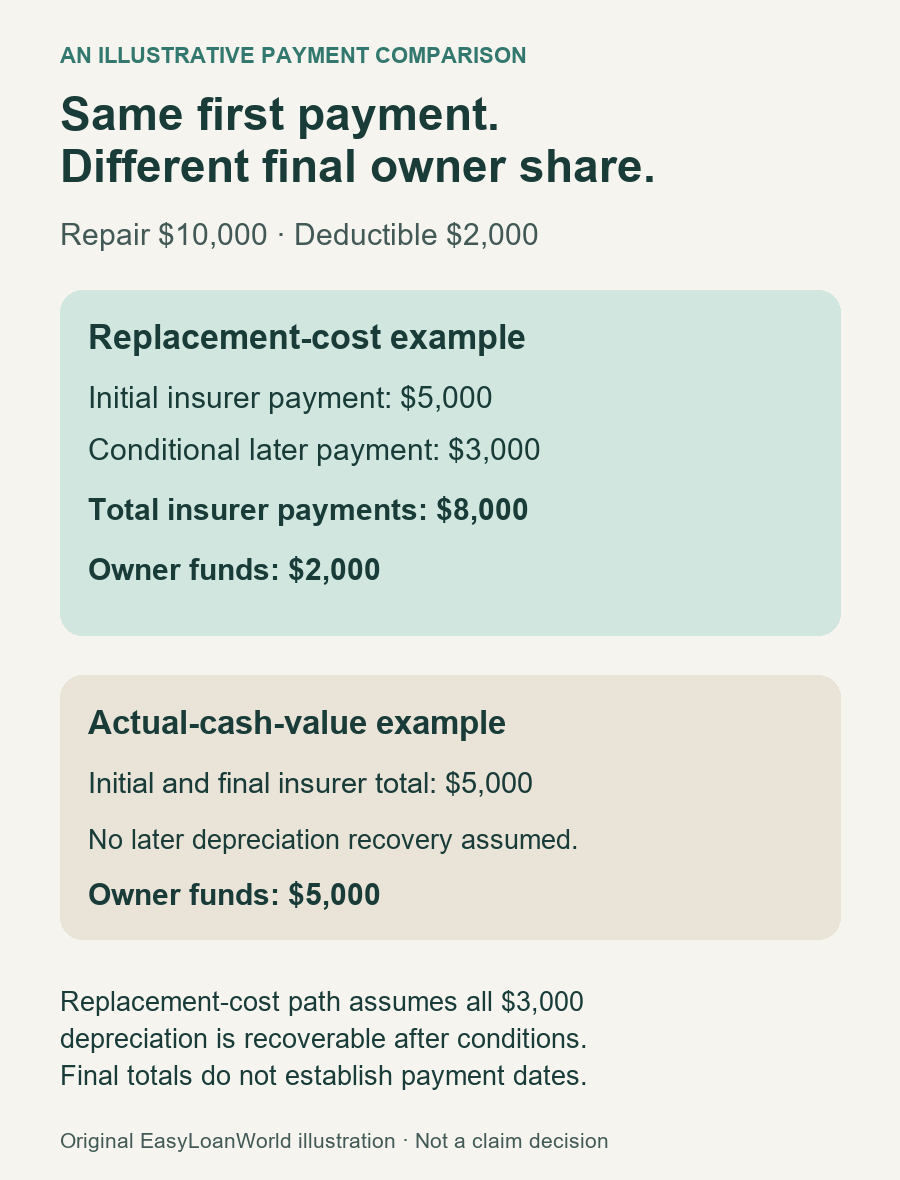
For this illustration, use the same $10,000 covered repair, $3,000 depreciation and $2,000 deductible. Assume the policy permits recovery of all $3,000 after the repair and its other requirements are met. These are example conditions, not a promise about your policy.
| Stage | Calculation | What the amount means |
|---|---|---|
| Initial insurer payment | $10,000 − $3,000 − $2,000 = $5,000 | Payment after both deductions, before the assumed depreciation recovery |
| Conditional later payment | $3,000 | Withheld depreciation, payable only after the applicable requirements are satisfied |
| Total insurer payments | $5,000 + $3,000 = $8,000 | The final insurer total under these assumptions; the $2,000 deductible still remains yours |
The actual-cash-value version of the original example also starts with $5,000 paid, but doesn’t include that assumed $3,000 later recovery. Equal initial payments therefore don’t establish equal final coverage.
Separate final cost from payment timing
A possible later payment isn’t cash available today. Put the contractor’s actual payment dates beside the insurer’s payment conditions and the funds you can currently use. Ask how any amount due before the later payment will be handled. The answer depends on the repair agreement and claim process; this example doesn’t assume that you must borrow or prepay the entire repair.
Organize your Texas insurance claims questions
Put the policy, repair estimate and claim explanation beside one another. Identify the replacement-cost figure, any depreciation deduction, your deductible and the amount currently available. Keep these entries separate rather than treating every reduction as the same charge.
Ask the insurer which amount is final and which depends on completing repairs. Record the deadline and the document that explains it. If the estimate and payment explanation don’t match, ask for the specific line to be clarified before using the total in your repair budget.
- Confirm the basis of the claim. Is this item covered on replacement cost or actual cash value terms, and which deductible and limit apply?
- Identify each reduction. Which amount is depreciation, which is the deductible, and is any other reduction being applied?
- Confirm the recovery conditions. What repair evidence and deadline apply to any withheld depreciation?
- Confirm usable funds. Who receives or controls each payment, and what must happen before you can use it for the repair?
Texas insurance claims: equal first payments can lead to different totals
Keep the original covered repair at $10,000, depreciation at $3,000 and deductible at $2,000. Both the stated actual-cash-value version and the replacement-cost sequence initially produce $5,000, but their supplied later-payment assumptions differ.
In the replacement-cost version, assumed recovery of the entire $3,000 brings insurer payments to $8,000 and leaves $2,000 of the stipulated repair cost with the owner. In the actual-cash-value version, the original $5,000 remains the insurer total in this example.
The latter leaves $5,000 of the $10,000 repair cost with the owner. That consists of the $2,000 deductible and the $3,000 valuation difference. Don’t label the entire $5,000 a deductible.
Likewise, the $3,000 later replacement-cost payment isn’t repayment of the deductible. It’s the assumed withheld depreciation recovery. The owner still funds the stated $2,000 deductible after all conditions are met.
The amounts concern these supplied examples only. Real coverage, settlement conditions and limits must be confirmed. An identical first check isn’t enough information to identify the final owner share.
Texas insurance claims: use a second independent repair example
For a separate fictional case, assume an $8,000 covered repair, $2,000 depreciation and $1,000 deductible, with no other reduction. Assume the policy permits recovery of all $2,000 depreciation after the stated requirements are satisfied.
The initial amount is $8,000 minus $2,000 minus $1,000, or $5,000. With the assumed $2,000 later recovery, insurer payments total $7,000, leaving $1,000 of the stipulated repair cost with the owner.
An independent actual-cash-value version with no later recovery would leave insurer payments at $5,000 and owner funding at $3,000. Once again, the first amount matches while the final amounts differ.
Don’t add this case to the original $10,000 example. It replaces the repair, depreciation and deductible inputs. Its figures are invented and don’t quote a Texas policy or imply that all policies allow recovery on these terms.
Each complete model should reconcile repair cost to insurer payments plus owner funding. That check can catch a duplicated deductible, but it can’t establish that the coverage assumptions are correct.
Change the recovery assumption without changing the deductible
Return to the original $10,000 example. For a new independent sensitivity, suppose the insurer confirms only $1,500 of later payment under the actual conditions supplied for that case, while the initial $5,000 remains unchanged.
Total insurer payments would be $6,500, and owner funding $3,500. The $2,000 deductible did not change. The difference from the full-recovery version comes from receiving $1,500 less later.
This is a stipulated partial-recovery scenario, not an explanation of why a real insurer would limit recovery. Ask which provision, expense or condition supports an actual amount rather than inventing a reason.
For a separate scope variation, restore the full $8,000 insurer total but assume the contractor’s agreed work includes a further $500 that’s expressly not covered in this exercise. Total work is $10,500, so owner funding becomes $2,500.
That additional $500 isn’t another deductible. It’s a separately assumed uncovered cost. A complete repair budget must identify it instead of continuing to use the original $10,000 total after scope changes.
Keep the final share separate from a temporary cash gap
Use the original full-recovery replacement-cost case and add a fictional contractor schedule: $6,000 before work and $4,000 when work is complete. Assume the $3,000 depreciation recovery arrives only after that final contractor payment.
Assume the homeowner starts with $2,000 separate cash and has already received the $5,000 initial insurance payment. Available funds are $7,000. Paying the first $6,000 leaves $1,000.
Before the later insurance recovery, the $4,000 final payment has a $3,000 gap. The ultimate owner share is still $2,000 under the stipulated full-recovery model, but it doesn’t describe every earlier cash requirement.
If the $3,000 recovery were independently confirmed available before the final payment, the remaining $1,000 plus $3,000 would cover it. That’s a different timing assumption, not money to count while recovery is still conditional.
The example doesn’t require borrowing or establish a contractor’s right to that schedule. Resolve actual release and payment terms before accepting non-emergency commitments. If the mortgage servicer controls funds, its process is another cash-availability question.
Trace every reduction and condition to a record
Put the policy’s valuation basis, estimate, deductible, depreciation, other adjustments, initial payment and possible later amount on separate lines. Identify which document supports each amount and date.
Keep completed repairs, submitted evidence, insurer acceptance and released payment separately identified. A finished invoice is relevant evidence but doesn’t alone establish every coverage condition or confirm money is spendable.
Ask about an actual deadline using the policy and claim record. This article supplies no personalized repair deadline or rule extending one. Don’t substitute a generic period from another policy.
When an estimate changes, preserve both versions and reconcile the difference. A revised scope, valuation or payment can change the owner funding required even if the deductible remains fixed.
The final worksheet should explain what is permanently yours to fund, what may be recoverable and when money is actually available. It’s a preparation tool, not a claim decision or a promise that every reduction will later be reimbursed.
A Texas insurance claims worksheet should label whether an entry is an estimate, a confirmed payment or a condition-dependent amount. Use the claim’s current explanation for each category. Moving a possible later recovery into the received-cash line would change the funding conclusion without establishing that the money had arrived or the recovery conditions had been met.
Related reading
For a related question, read Mortgage Company on Your Insurance Check? Clarify Repair Payments and Flood Insurance Quote: Test Two Deductibles Against Your Cash Reserve.
Roth Conversion and Account Clocks
Separate five-year tests.
ABLE Distributions Across Month-End
Separate retained purposes.