
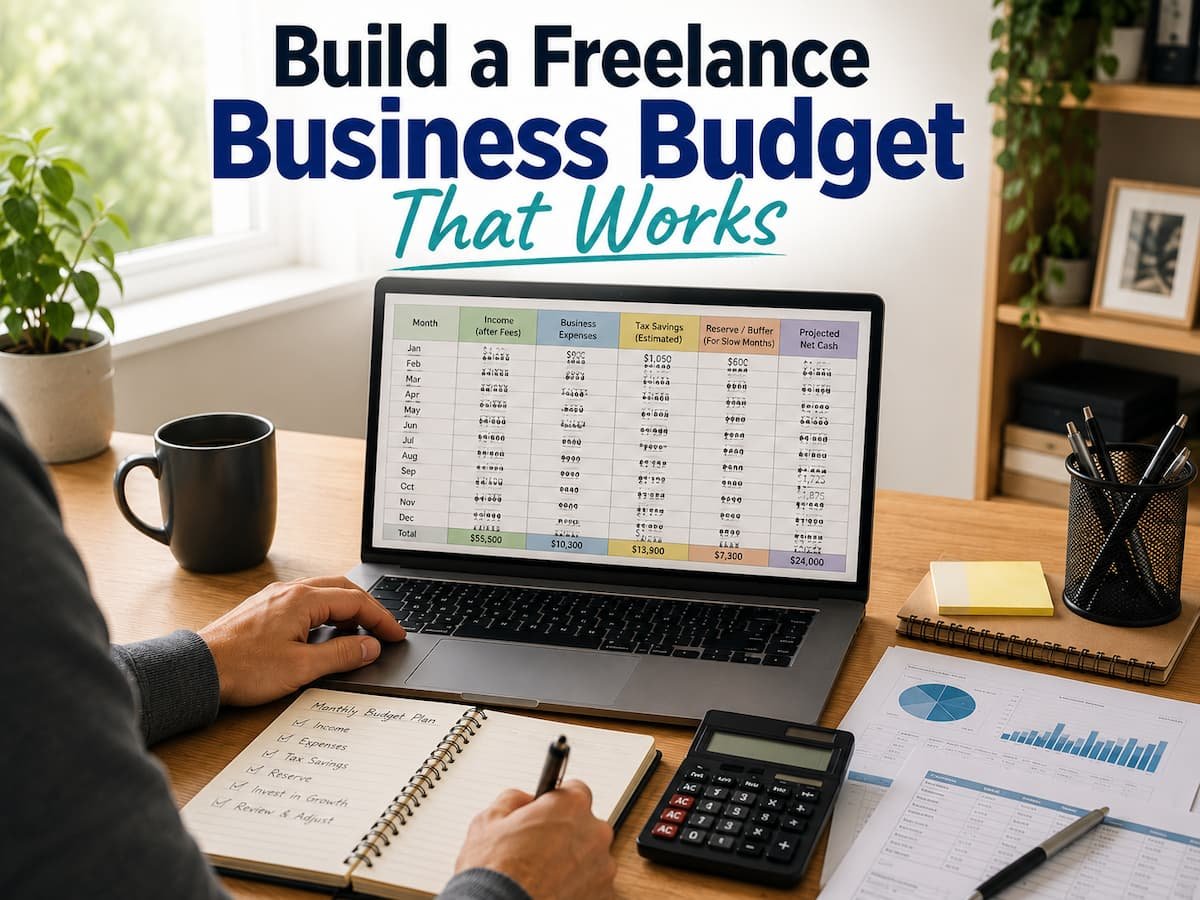
Build a Freelance Business Budget That Works
A freelance business budget is completely unique. It is based on your current income, known expenses, taxes, anticipated quiet periods, and the resources needed to keep the business running. The goal is to help you make decisions without needing to predict the future perfectly. This article will help you create such a budget and—more importantly—ensure it is flexible enough to handle the unpredictable situations that arise in freelancing.
Good Months can be misleading.
Imagine you’re a freelance web designer. In March, you completed several projects and earned $6,000. You normally earn around $3,500 a month, but March was an exceptionally remarkable one. You can easily pay your bills, replace an old laptop, renew your software subscriptions, or even plan a short trip. Individually, these decisions all seem reasonable. The problem is that April is coming up fast.
One project is delayed. Another client needs more time to approve the final invoice. Your income is only $2,400, yet your daily expenses are roughly the same. The laptop you bought in March is outdated, and you now have to pay additional subscription fees every month. This is a major pitfall when budgeting as a freelancer. Earning a lot in a particular month can give you the impression that your income is more stable than it actually is.
To create a better budget, start with a question that might seem less exciting: how much revenue does my business typically generate when operating at a normal or slightly below-average level?
This figure is often more valuable than your highest-earning month. Once you have this information, look back at the past six to twelve months. Identify your lowest-earning month, your highest-earning month, and the month that seemed most typical. You aren’t trying to calculate a perfect revenue figure; rather, you want to gain insight into the actual range of income your business can generate. Suppose your income figures are €2,500, €3,100, €4,800, €2,200, €3,600, and €5,000. Using €5,000 as your total living budget is risky. When your income falls at the lower end of that range, your budget needs to be much more realistic.
Find the Figures Your Business Really Needs
Before setting monthly spending limits, you first need to determine how much it costs to keep your freelance business running. Everyone has different expenses. A freelance writer working from home might have almost no business costs. A photographer might need equipment, storage space, insurance, transportation, post-processing software, and studio rental. A consultant might need to spend money on travel, professional services, research tools, and client meetings. The first step is to review your business expenses from the past few months. Instead of trying to categorize every single expense right away, focus on identifying the recurring costs.
You might encounter the following expenses:
- Internet and mobile phone costs
- Software subscriptions
- Cloud storage fees
- Accounting fees
- Business insurance premiums
- Website and domain costs
- Marketing and advertising expenses
- Professional association membership fees
- Equipment maintenance costs
- Payment processing and banking fees
Understanding these expenses allows you to calculate how much money your business needs each month before you set aside funds for yourself. Suppose your basic business expenses total €700 per month. This doesn’t mean your budget is €700 a month; it simply means your business must generate enough revenue to cover these costs before you consider taxes, savings, or your personal income. This is important because some freelancers view their total income as money available to spend freely. In reality, a portion of that money is already earmarked for other purposes.
Separate Business Money From Personal Money
Mixing all your expenses together is one of the easiest ways for your freelance budget to spiral out of control. Client payments, meals, software purchases, savings, new monitors—everything comes out of the same bank account. At the end of the month, you know how much is left, but you don’t know where it all went. Separating your business and personal accounts makes things much clearer. The specific banking arrangements depend on your country and business structure, but the concept is simple: business income should first be treated as business funds.
You can then allocate that money to other purposes, such as paying business expenses and taxes or setting aside a portion as a business reserve. After that, you can transfer funds for personal use, depending on your strategy. This separation also makes it easier to spot practical issues. For instance, can the business afford a new computer? Have you inadvertently spent too much on subscriptions? Is that due to improved business performance and higher revenue, or simply because you landed a big project? If all transactions come from the same account, the answers are harder to find.
Easily Uncover Hidden Costs you Might have Overlooked
Most freelancers are aware of the obvious costs. They know about internet charges, software subscriptions, and perhaps office rent. Hidden costs, however, are expenses that occur only occasionally. Think of expenses that aren’t paid monthly but still need to be covered eventually. Your laptop will eventually need replacing. Your website domain needs annual renewal. You might pay annual insurance premiums. You may need professional licenses or memberships. Your printer might break down. Your camera might break. Your hard drive could fail at the worst possible moment. These expenses might make your monthly budget look reasonable, but they could cause problems later on without you noticing.
| Expense | How Often It May Occur | How to Budget for It |
|---|---|---|
| Software subscriptions | Monthly or annually | Please record the actual renewal schedule. |
| Equipment replacement | Every few years | Set aside money gradually. |
| Insurance | Monthly or annually | Include the full expected payment. |
| Professional fees | Occasionally | Review previous years for patterns. |
| Training | Occasionally | Create a flexible learning budget. |
A simple way to find these expenses is to review twelve months of bank statements. Look for large transactions that happened once or twice. Those payments may not deserve a permanent monthly line item, but they should still be part of your annual financial plan. This is where a budget becomes more useful than simply checking your bank balance. Your bank balance tells you what you have today. A budget helps you remember what that money may need to cover later.
Build Your Budget Around Realistic Income
Once you know your costs, consider income. This distinguishes freelance budgeting from home budgeting. You can’t constantly say, “I earn $4,000 every month.” Your better question is, “How much can I reasonably expect my business to produce, and how certain is that income?” Consider your expected income as three categories: secured, likely but not guaranteed, and possible.
Consider a freelance copywriter with a $2,000 monthly fee, a signed $1,500 project, and an unapproved $3,000 proposal. The first two amounts are more supported. The client’s interest in the $3,000 proposal does not guarantee income. This budgeting habit matters. Budget for realistic income, not hypothetical income. That doesn’t mean to be negative. It means your basic expenses shouldn’t depend on future projects. New work brings extra money, which you can spend. This approach is safer than committing to expenses first and hoping subsequent projects cover them.
Choose Your Paying Method
Because company and personal income are linked, many freelancers struggle with this arrangement. Complete a project and you will receive $2,500. You can spend how much? The answer may not be $2,500.
That money may be required to cover business expenses. Set aside some for taxes. They may need to stay in business for future expenses or slower months. Local professional guidance can help you determine your tax and legal treatment based on your location and business structure. For budgeting, the idea is simple: create a predictable way to transfer money from business to personal.
Some freelancers transfer similar amounts monthly. Due to income fluctuations, others use a percentage-based approach. Not everyone suits either method. If your income is unpredictable, a fixed personal transfer may be difficult to maintain. A steady monthly income may simplify household budgeting. Make sure not to count every customer payment as personal income.
Make Taxes Their Own Budget Line
When money starts coming in, taxes are easiest to ignore. When paid well, a freelancer may think, “I finally made $5,000 this month.” The concern is that they may not own the full amount. Depending on geography, business structure, and tax obligations, some of such income may be taxed.
Avoid generic budgeting articles’ random percentages. Tax laws vary by country, business structure, and income. When you need personalized advice, consult your local tax authority or a qualified professional. Tax money should be budgeted as future money. Account for upcoming taxes before deciding how much extra money to spend. An identifiable savings account or reserve helps prevent unintentional spending.
Important: A high-income month does not guarantee high disposable cash. Always consider future taxes before spending more.
Budget for a Slow Month
Business booms are not the real test of a freelance budget. When work slows, this happens. Each freelancer’s slow period is unique. Seasonal demand, a major client leaving, personal circumstances, economic conditions, or project gaps may cause it. Make these risks less disruptive, but not eliminate them.
Determine your minimum monthly operating cost. How much does the company need to spend to survive? Which subscriptions matter? What services can be stopped? What personal income is necessary for basic living expenses? This creates a “minimum month” budget.
Make a typical budget based on your income. Finally, during good business months, you can have a more comfortable version. Benefits are psychological and financial. No longer must you base every spending decision on the month’s money balance. You know what the business needs in tough times. If your minimal monthly requirement is $2,500 and your reserve is $10,000, you have several months before making significant changes. Your minimal reserve amount depends on your situation, but understanding it makes the debate more clear.
A Realistic Freelance Budget Example
Consider a fictional freelance graphic designer named Maya. Her monthly income changes, but over the past year she has usually earned between $3,000 and $6,000. Her essential business expenses average $800 per month. She also wants to set aside money for taxes and build a reserve because her income is not guaranteed. Instead of assuming that she will earn $6,000 every month, Maya creates a budget based on a more conservative income level. When she earns more than that amount, the additional income is not automatically added to her lifestyle.
| Budget Area | Monthly Planning Amount |
|---|---|
| Essential business costs | $800 |
| Tax reserve | Based on local tax obligations |
| Business reserve | Flexible amount during stronger months |
| Personal income | Planned after business priorities |
| Optional spending | Only after core needs are covered |
In a $3,000 month, Maya may have to keep her personal spending lower. In a $6,000 month, she has more flexibility. The important difference is that the $6,000 month does not automatically redefine what she considers normal. Over time, this approach allows her to build reserves during stronger periods. Those reserves can then help support the business during weaker periods. The budget works because it adapts to the reality of her income instead of pretending that every month will look the same.
Know When Your Budget Needs to Change
A budget should not be treated like a permanent rulebook. Your freelance business may look completely unique six months from now. You may gain a long-term client, raise your prices, outsource some work, move into an office, or decide to specialize in a new service. Any of these changes can affect your budget.
Review your numbers when something meaningful changes. If your income has increased steadily for six months, examine whether the change is reliable or temporary. If your expenses have risen, determine whether the increase is helping the business produce more income. Watch for warning signs such as repeatedly using savings to cover normal expenses, relying on future projects to pay current bills, or discovering that taxes are difficult to pay when they become due. These signs do not necessarily mean your freelance business is failing. They may simply indicate that your budget no longer matches reality. A sensible budget changes when the business changes.
Keep the System Simple Enough to Maintain
You do not need an expensive financial system to build a useful freelance budget. A spreadsheet can be enough. So can a basic budgeting application or accounting platform, depending on the complexity of your work. The important thing is that you can quickly answer a few basic questions:
- How much money does the business have available right now?
- What payments are expected to arrive?
- What bills are coming up?
- How much money is reserved for taxes?
- How much can I safely take for personal use?
- How long could the business operate if income slowed?
If your system makes those answers easy to find, it is doing its job. Set aside a regular time to review your numbers. For some freelancers, a quick weekly check is enough. Others may prefer a more detailed monthly review. What matters is consistency. Do not spend hours building a beautifully formatted budget that you never update. A simple spreadsheet that reflects current information is far more useful.
The Budgeting Habits That Cause Trouble
Complex financial errors rarely cause budget problems for freelancers; issues usually stem from recurring, fundamental habits. First, basing spending on projected rather than actual income—such as buying goods today because a client is expected to sign a contract next week, even though project delays are common—can lead to financial difficulties. mon. Second, increasing recurring expenses after just a few months of success; celebrating a win once is very different from committing to higher ongoing costs.
Third, failing to budget for one-off expenses. Even when freelancers anticipate annual insurance premiums, they often treat them like emergencies. Another issue is the inability to distinguish between business and personal funds. Regularly moving all available money between business and personal accounts makes it difficult to assess the health of your business. Finally, some freelancers overcomplicate their budgets by creating dozens of categories and tracking every single expense, only to eventually abandon the system altogether.
Conclusion
Your freelance budget doesn’t need to predict every penny you’ll earn next year; striving for such precision only makes budgeting harder. A better budget reflects the reality of freelancing: fluctuating income, varying payment schedules across clients, and months of unexpectedly high earnings versus frustratingly low ones. Unexpected expenses always arise when you least expect them, so your budget needs to account for these factors.
Start with operating expenses. Always keep business and personal expenses separate. Don’t base your budget on your highest-earning month; instead, plan major expenses around your actual income. Be sure to factor in taxes and one-off costs. If your income exceeds expectations, set aside a portion of the money for future planning rather than increasing your spending. It is important to review your budget regularly as your freelance business grows. A budget suitable for two clients may not be appropriate for ten. When you outsource work, you need to adjust your ideal budgeting system for freelance work. A concise freelance budget is the most effective; it gives you a clear picture of where your money goes, helps you prepare for months with lower income, and alleviates financial anxiety when making decisions.