Subsidized vs Unsubsidized Loans Explained Simply
When a college financial aid offer includes both subsidized and unsubsidized student loans, the names can make the choice seem more complicated than it really is. Both are federal student loans, and both can help cover the cost of college or career school. The major difference is what happens to the interest while the student is enrolled and during certain other periods. That difference can affect how much the student ultimately repays.
For a student who needs to borrow, understanding that distinction before accepting a loan is more useful than simply looking at the amount offered. A subsidized loan can provide a significant interest advantage for eligible undergraduate students, while an unsubsidized loan is available more broadly but begins accumulating interest from the time it is first disbursed. Federal Student Aid recommends accepting a Direct Subsidized Loan before a Direct Unsubsidized Loan when a student is eligible for both.
The Difference in One Sentence
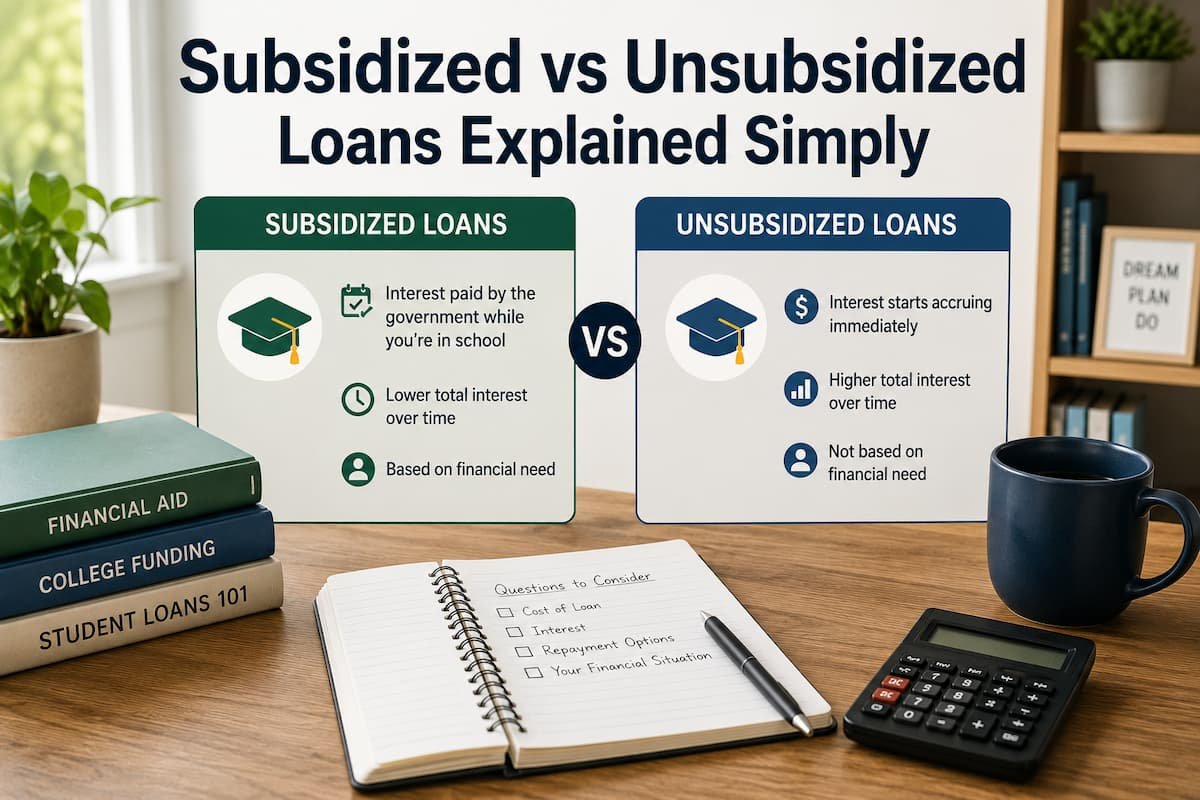
A Direct Subsidized Loan is available to eligible students with financial need, and the federal government covers the interest during certain qualifying periods. A Direct Unsubsidized Loan does not require demonstrated financial need, but the borrower is responsible for the interest that accumulates from the date the loan is first disbursed.
That single difference can have a meaningful effect over several years. Both loans can appear together on the same financial aid offer, have federal protections, and generally require repayment after the applicable grace period. But the cost of carrying an unsubsidized balance can grow while the student is still in school, even if the student is not yet making regular payments.
How Subsidized Loans Work
Direct Subsidized Loans are designed for eligible undergraduate students who demonstrate financial need. The school determines eligibility and the amount the student can receive based on factors that include financial need, cost of attendance, and other financial aid. The student must also meet the applicable federal eligibility requirements.
The biggest advantage is the treatment of interest. For qualifying subsidized loans, the federal government pays the interest while the student is enrolled at least half-time, during the six-month grace period after leaving school, and during certain eligible deferment periods. This does not mean the loan is interest-free forever; once the applicable interest benefit ends, interest can begin accruing under the loan’s terms.
How Unsubsidized Loans Work
Direct Unsubsidized Loans are federal student loans available to undergraduate, graduate, and professional students who meet the applicable requirements. Unlike subsidized loans, eligibility is not based on demonstrating financial need. That makes unsubsidized loans useful when a student’s remaining education costs are greater than the amount covered by grants, scholarships, work-study, and subsidized borrowing.
The trade-off is that interest begins accumulating from the first loan disbursement. A student can choose to make interest payments while in school, but if the interest is not paid as it accrues, the amount owed can grow. Federal Student Aid emphasizes that the borrower is responsible for the interest on an unsubsidized loan during all periods.
A Side-by-Side Comparison
| Feature | Direct Subsidized Loan | Direct Unsubsidized Loan |
|---|---|---|
| Federal student loan | Yes | Yes |
| Available to undergraduate students | Yes, if eligible | Yes, if eligible |
| Available to graduate students | No | Yes |
| Based on financial need | Yes | No |
| Interest while enrolled at least half-time | Federal government generally pays qualifying interest | Borrower is responsible |
| Interest during six-month grace period | Federal government generally pays qualifying interest | Borrower is responsible |
| Can interest accumulate while in school? | The federal government generally covers qualifying interest during the applicable benefit period | Yes |
| Repayment required | Yes | Yes |
| Best starting point when both are offered | Usually first choice | Usually considered after subsidized eligibility |
The table shows why the word “subsidized” matters. The loans are similar in many respects, but the treatment of interest can make subsidized borrowing less expensive when the student qualifies. Federal Student Aid specifically recommends accepting a Direct Subsidized Loan first when both types are available.
Why Interest Makes Such a Difference
Interest is the extra cost of borrowing money. With a federal Direct Loan, interest accrues according to the loan’s fixed interest rate and outstanding principal balance. An unsubsidized loan can therefore become more expensive before the student even reaches regular repayment because interest starts accumulating while the student is in school.
For loans first disbursed during the 2026–27 award year, the fixed interest rate for undergraduate Direct Subsidized and Direct Unsubsidized Loans is 6.52%. The rate itself is the same for these two undergraduate loan types during that award year; the important difference is who is responsible for qualifying interest during periods when a subsidized loan receives its interest benefit.
A Simple Interest Example
Imagine two undergraduate students each borrow $5,000 at a hypothetical fixed rate of 6.52%. The subsidized loan receives the applicable federal interest benefit while the student is in school and during the qualifying grace period. The unsubsidized loan does not receive that same benefit, so interest begins accumulating from disbursement.
At a simple annualized rate of 6.52%, $5,000 would generate roughly $326 of interest over one year before considering the daily accrual method and any payments. The actual amount will depend on the timing of disbursements, outstanding principal, and payments. The example is not a prediction of a student’s final balance; it simply illustrates why allowing interest to accumulate on an unsubsidized loan can increase the eventual cost of borrowing.
What Happens to Unpaid Unsubsidized Interest?
A student does not necessarily have to make monthly payments while enrolled in school at least half-time simply because an unsubsidized loan is accumulating interest. However, the interest does not disappear. If it remains unpaid, it can affect the amount the borrower owes and may eventually be capitalized under applicable rules.
Capitalization means unpaid interest can be added to the principal balance, after which future interest can be calculated on the larger amount. The exact circumstances under which capitalization occurs depend on the loan and federal rules in effect at the time. This is why students should not assume that postponing interest payments makes the interest disappear.
Who Usually Qualifies for a Subsidized Loan?
Direct Subsidized Loans are generally available to eligible undergraduate students who demonstrate financial need. The school determines the student’s eligibility and loan amount after considering the student’s financial aid information and applicable federal limits.
Graduate and professional students are not eligible for new Direct Subsidized Loans. They may instead qualify for Direct Unsubsidized Loans and other forms of federal student aid for which they meet the requirements. This is one reason the word “subsidized” should not be interpreted as simply meaning “the cheaper loan for everyone.” Eligibility depends on the student’s education level and financial circumstances.
Who Can Get an Unsubsidized Loan?
Direct Unsubsidized Loans can be available to eligible undergraduate, graduate, and professional students. Demonstrating financial need is not required in the same way it is for a subsidized loan, although the student still has to meet federal student-aid eligibility requirements.
For some students, the unsubsidized loan becomes relevant after grants, scholarships, savings, work-study earnings, and subsidized borrowing do not cover the remaining cost. That does not mean a student should automatically accept the full amount offered. Federal Student Aid specifically points out that students do not have to accept all the loans offered and can request a lower amount.
The Amount Offered Is Not the Amount You Must Borrow
A financial aid offer can show a student that they are eligible to borrow a certain amount, but eligibility is not an obligation. If a student needs only $3,000 to cover a genuine remaining gap, accepting $5,000 simply because it is available can create unnecessary debt.
This is particularly important with unsubsidized loans because interest begins accumulating after disbursement. Borrowing less can reduce both the principal balance and the amount of interest that can accumulate over time. A student who is unsure about the amount needed should compare the actual college costs with grants, scholarships, savings, expected work-study earnings, and other resources before accepting the loan.
Why You Should Usually Take Subsidized First
If a student is offered both types and needs to borrow, the subsidized loan generally deserves priority. The reason is straightforward: qualifying interest is covered by the federal government during certain periods, whereas the borrower remains responsible for interest on an unsubsidized loan during all periods.
Consider a student who has $4,000 of remaining education costs and is offered $2,500 in subsidized loans and $3,000 in unsubsidized loans. If the student genuinely needs $2,500, taking the subsidized amount may be more economical than using the same amount from the unsubsidized offer. If the student needs more than $2,500, the unsubsidized loan can then be considered for the remaining gap.
Loan Limits Put a Ceiling on Borrowing
Students cannot simply borrow any amount they want through Direct Subsidized and Unsubsidized Loans. Annual and aggregate loan limits apply, and the amount a student can borrow depends on factors such as the student’s year in school and dependency status.
For example, Federal Student Aid currently lists a combined annual limit of $5,500 for a first-year dependent undergraduate, with no more than $3,500 of that amount available as subsidized borrowing. The combined limit increases for later years, and independent students can have higher limits. These limits are important because the maximum loan amount is not necessarily the amount a student needs or should borrow.
Subsidized Does Not Mean You Never Pay Interest
The subsidized benefit has limits. It does not mean the federal government pays interest forever. The benefit applies during specific qualifying periods, including enrollment at least half-time, the six-month grace period, and certain deferments.
Once the applicable benefit period ends, interest can accrue according to the loan’s terms. A borrower therefore still needs to understand the interest rate, repayment schedule, balance, and available repayment options. Subsidized borrowing is generally more favorable than comparable unsubsidized borrowing during the interest-benefit period, but it remains a loan that must eventually be repaid.
What Both Loans Have in Common
It is easy to focus so heavily on the interest difference that the similarities get overlooked. Both Direct Subsidized and Direct Unsubsidized Loans are federal student loans. Both can help eligible students pay for college or career school, and both are subject to federal loan rules rather than the terms of a private bank’s student loan.
Both also require repayment. Federal Student Aid explains that eligible students generally need to be enrolled at least half-time for these Direct Loans and that a six-month grace period generally applies before regular repayment begins after leaving school or dropping below half-time enrollment. Students should still check their specific loan information because federal rules and individual circumstances can affect repayment.
What If You Need More Than the Subsidized Amount?
Needing more than the available subsidized amount does not automatically mean a private student loan is the next step. An eligible student may first consider an unsubsidized federal loan if there is still a legitimate funding gap and borrowing fits within a reasonable education budget.
Federal loans can offer protections and repayment options that differ from private loans. However, federal loan rules and repayment programs can change, and borrowers should check their current eligibility and options through StudentAid.gov rather than relying on older explanations of repayment plans. The important borrowing principle remains the same: use only the amount needed rather than treating the maximum offered as a target.
A Practical Borrowing Order
A student’s financing decision is usually easier when borrowing comes after other available resources have been considered. Grants and scholarships generally do not create the same repayment obligation as loans, while work-study provides earnings through employment. If a remaining gap still exists, federal student loans can be considered.
For a student eligible for both subsidized and unsubsidized Direct Loans, the usual order is to consider the subsidized amount first, then use unsubsidized borrowing only if additional funds are genuinely needed. Federal Student Aid gives the same basic recommendation and reminds students that they can accept a lower loan amount than the school offered.
Should You Pay Unsubsidized Interest While in School?
A student with an unsubsidized loan can choose to make interest payments while in school rather than simply allowing the interest to accumulate. Whether that is practical depends on the student’s cash flow and other financial obligations.
For example, a student with a part-time job may be able to make small interest payments without affecting rent, food, tuition, or emergency savings. Another student may have no realistic room in the budget and may need to prioritize essential costs. Paying interest while in school can reduce the amount that remains unpaid, but students should not sacrifice necessary living or education expenses simply to make optional early payments.
What If Your Financial Situation Changes?
Financial circumstances can change during college. A student might receive a scholarship, reduce living expenses, increase work hours, or discover that the original amount borrowed was more than necessary. In those situations, the student should review the loan information rather than assuming the original borrowing decision can never be changed.
Students should also communicate with their school’s financial aid office if they believe their aid package no longer reflects their circumstances. A school may be able to explain available options, including whether the student can adjust an offered loan amount before accepting or disbursing it. The exact procedure depends on the school and timing of the request.
A Quick Decision Framework
A simple way to approach the choice is to ask three questions. First, do you actually need to borrow? Second, if you need to borrow, have you used the available subsidized eligibility before taking additional unsubsidized debt? Third, how much do you genuinely need rather than how much the financial aid offer says you can borrow?
This framework keeps the decision focused on cost rather than availability. A loan being offered does not make it free, and a higher borrowing limit does not mean a larger loan is financially sensible. For students who have both options, the interest treatment makes subsidized borrowing the natural first choice when the student is eligible and needs the funds.
A Few Details Students Often Miss
The interest rate is only one part of the cost of borrowing. Students should also pay attention to the amount borrowed, the timing of disbursements, loan fees that may apply, and the repayment terms attached to the loan. The amount shown on an aid offer can also differ from the amount that ultimately reaches the student’s account because of applicable fees.
Another overlooked point is that the interest rate for a federal Direct Loan is fixed for that particular loan once it is set. Different loans taken out in different award years can therefore have different fixed rates. For 2026–27, undergraduate Direct Subsidized and Direct Unsubsidized Loans have a fixed rate of 6.52%, while graduate/professional Direct Unsubsidized Loans have a different rate.
Conclusion
Direct Subsidized and Direct Unsubsidized Loans are both federal student loans, but the treatment of interest makes them meaningfully different. A qualifying subsidized loan receives an interest benefit during certain periods, while interest on an unsubsidized loan begins accumulating from the first disbursement. That difference can affect the total cost of borrowing over time.
If both types appear on a student’s financial aid offer, the usual approach is to consider the subsidized loan first and then use an unsubsidized loan only for an additional amount that is actually needed. Students should also remember that they do not have to accept the maximum offered. Borrowing less today can mean a smaller balance and less interest to manage later.
FAQs
Can I reject part of the loan offered by my college?
Yes. Students do not have to accept the entire loan amount shown on a financial aid offer. A student can request a lower amount if less borrowing is sufficient to cover the remaining costs.
What is the current undergraduate Direct Loan interest rate?
For loans first disbursed from July 1, 2026 through June 30, 2027, the fixed interest rate for undergraduate Direct Subsidized and Direct Unsubsidized Loans is 6.52%. Future award years can have different rates because federal student loan rates are set annually.
Should I pay the interest on an unsubsidized loan while I am in school?
If you can comfortably afford it without neglecting essential expenses, making interest payments can prevent that unpaid interest from accumulating. However, students should first make sure tuition, housing, food, transportation, and other necessary expenses are covered.
Official Resources
Students should use Federal Student Aid’s current information when making borrowing decisions because federal loan rules can change. The official Direct Subsidized vs. Unsubsidized Loans guide explains the interest difference, eligibility, borrowing limits, and recommended order when both loan types are available.
The current federal interest-rate information should also be checked before comparing loan costs. For the 2026–27 award year, undergraduate Direct Subsidized and Direct Unsubsidized Loans carry a fixed 6.52% rate, while rates for graduate/professional Direct Unsubsidized Loans differ.