How to Compare Loan Estimates: A Line-by-Line Worksheet
Compare mortgage Loan Estimates by matching loan terms, checking lender fees and credits, and separating real savings from different cost estimates.

Compare Loan Estimates in three passes: match the loan assumptions, compare fees and credits, and reconcile estimates that differ. Do not select a mortgage simply because one form shows the smallest cash-to-close number. A different down payment or a lower insurance placeholder can change that number without making the borrowing less expensive.
The Loan Estimate is a standardized three-page form generally provided within three business days after a lender receives your mortgage application. It is an estimate, not an approval. Some products, including HELOCs and reverse mortgages, use other disclosures. See the CFPB’s explanation of the form and its coverage.
This U.S. educational guide uses fictional fee examples, not actual mortgage offers or individualized advice.
1. Make a matching-offer header
Before comparing dollars, write down the property, purchase price, loan amount, down payment, term, loan type, and product for each offer. Record the issue date and whether the rate is locked, including its expiration. Ask lenders to price the same scenario over a similar timeframe; mismatched dates or terms can obscure the comparison. The CFPB’s comparison guide recommends checking these differences.
Use a simple status label beside each assumption: “matched,” “different,” or “verify.” Do not erase a mismatch just to make the spreadsheet tidy. If one lender has assumed a larger down payment, ask for the offer you actually want before calling its payment more attractive.
Keep separate versions when deliberately comparing different strategies. A 15-year loan and a 30-year loan can both deserve consideration, but their different repayment schedules answer a different question from which lender offers better terms for the same mortgage.
2. Read page 1 as a payment checklist
Check the loan amount, rate, principal-and-interest payment, potential increases, prepayment penalty, and balloon payment. In Projected Payments, distinguish principal and interest from mortgage insurance and escrow. Estimated Taxes, Insurance & Assessments can include amounts you must pay directly. The CFPB Loan Estimate explainer identifies these fields.
Next to the total monthly payment, make two notes: “included here” and “paid separately.” Put each relevant expense in one place. If taxes are already collected through escrow, adding the entire tax estimate again would inflate your worksheet. If association dues are paid separately, omitting them would make the home look artificially affordable.
Read every payment period displayed, rather than only the first column. Ask the loan officer to explain any change you cannot reproduce. A comfortable opening payment is not enough if a later required payment would exceed your budget.
Keep your household repair and utility budget nearby. The form helps compare financing, but it is not a complete spending plan for living in the property.
3. Map page 2 before comparing totals
The closing-cost sections organize different kinds of charges:
- A: Origination Charges, including points.
- B: Services You Cannot Shop For.
- C: Services You Can Shop For.
- D: Total Loan Costs, combining A, B, and C.
- E: Taxes and Other Government Fees.
- F: Prepaids.
- G: Initial Escrow Payment at Closing.
- H: Other.
- I: Total Other Costs, combining E through H.
- J: Total Closing Costs, reflecting lender credits.
These section labels and relationships follow Regulation Z’s Loan Estimate requirements.
Compare the totals and the actual descriptions. Two lenders can group origination work differently, so a missing “processing” line does not establish that one lender waived the same amount. It may be included under another charge.
For Section C, use the lender’s written provider list and ask about any provider you choose outside it. “Can shop” does not mean every provider is automatically acceptable. Keep each written quote with its scope so you are comparing the same service.
4. Separate selected lender fees from unresolved estimates
A useful first comparison is Section A plus Section B, less lender credits. Then reconcile Section C and the remaining costs. Lower estimated taxes, prepaids, or escrow funding are not necessarily savings negotiated by a lender. Ask what evidence supports the difference.
Fictional selected-fee comparison
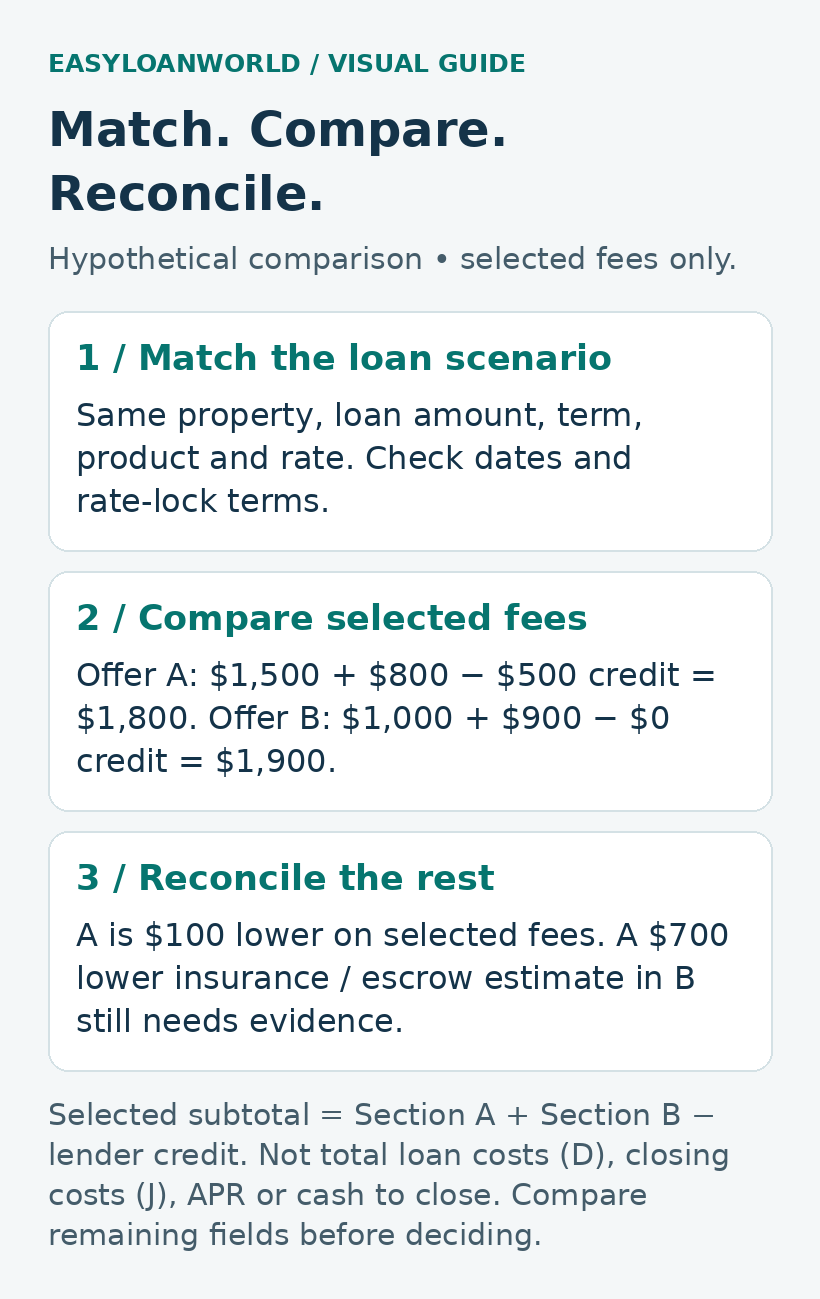
Assume the property, loan amount, term, product, and interest rate match, and both offers have zero points. These are selected fee fields only, not complete Loan Estimates.
- Offer A: $1,500 in A + $800 in B − $500 lender credit = $1,800.
- Offer B: $1,000 in A + $900 in B − $0 lender credit = $1,900.
Offer A is $100 lower on this limited subtotal. The subtotal is not Total Loan Costs in D, Total Closing Costs in J, APR, or cash to close. Other fields still need review before choosing.
Now suppose B’s insurance/prepaid escrow estimates are $700 below A’s, but nobody has supplied a supporting quote or explained the periods covered. Mark that difference “verify.” Do not combine it with the $100 fee comparison and announce a winner.
Ask: “Are these the same insurance coverage and payment periods? Which estimate reflects a current property-specific quote?” Once the answer arrives, update both columns consistently. The goal is to understand the underlying transaction, not to reward an optimistic placeholder.
5. Build a worksheet that preserves the evidence
Use one row per item and five columns: item, Offer A, Offer B, same assumption, and question or evidence. Start with these row groups:
- Offer identity: date, lock status, loan amount, product, type, term, and rate.
- Selected charges: points, other A charges, B charges, C quotes, and lender credits.
- Monthly spending: principal and interest, mortgage insurance, escrow, and directly paid housing costs.
- Other upfront amounts: government charges, prepaid periods, initial escrow months, and other applicable items.
- Results: total closing costs, cash to close, five-year total paid, and five-year principal paid.
Enter “verify” for an omitted or unexplained number, not zero. Add the document date and source beside insurance, title, and tax estimates. When an answer changes a number, preserve the earlier version rather than silently overwriting the history.
This makes a follow-up conversation specific: “Your estimate uses this amount; the insurance quote shows that amount. Which one belongs in the next version?” It also helps prevent comparing a corrected offer against a superseded one.
6. Use page 3 without confusing the metrics
For the five-year borrowing-cost comparison, subtract principal paid off from the cumulative amount paid in the “In 5 years” section. For an ARM, the comparison’s assumptions are not a prediction of future rates.
Separate fictional arithmetic practice: $112,000 cumulative paid minus $21,000 principal paid equals $91,000. These figures illustrate subtraction only; they are not calibrated loan terms or connected to the earlier fee example. The result is not home equity or an all-in homeownership budget.
APR includes interest and certain charges; it is not the note rate or every ownership expense. Total Interest Percentage expresses scheduled interest relative to the loan amount, rather than an annual rate. Use the page’s comparisons alongside monthly affordability and available closing funds.
Keep your intended ownership period visible. A five-year field is a common comparison horizon, not a prediction that you will move or refinance then. Ask for an explanation of cost tradeoffs over the period you actually expect to keep the mortgage.
7. Resolve changes before choosing
Ask for a refreshed, matched offer when assumptions change. Get the reason for differences in writing, and confirm the lock requirements and proposed closing timetable.
Cost-change rules vary by charge and circumstances; valid revisions can apply. There is no universal rule allowing every fee, or the entire closing bill, to rise by 10%. The CFPB explains the different treatment of cost changes.
Your final check: can you explain why the offers differ, afford the ongoing payment, and fund the upfront amount without losing the savings you intend to retain? If a key field still says “verify,” turn it into a direct question before treating the comparison as finished.
Featured photo: Photo by Mikhail Nilov on Pexels. Used under the Pexels license. Illustrative stock photograph of organized paperwork; not an official Loan Estimate or an actual borrower file.
California Supplemental Property Tax: Check the Bill, Payment and Cash
Organize one California supplemental property tax bill, its payment evidence and the cash earmarked for it. A fictional example shows why a funding gap…
Title Insurance Quotes: Compare Policies, Services and Payers
Compare fictional $2,150 and $2,275 title packages using matched coverage, complete service charges and a separate payer worksheet.

Flood Insurance Quote: Test Two Deductibles Against Your Cash Reserve
Test fictional flood quotes against a $6,000 reserve: $180 in annual savings comes with $3,000 more building deductible exposure.