Closing Costs vs. Cash to Close: A Homebuyer Worksheet
Learn why closing costs differ from cash to close. Track your down payment, deposit, lender and seller credits, and retained savings with a worked example.

Closing costs and cash to close answer different questions. Closing costs are the upfront loan and transaction costs, excluding your down payment. Cash to close is the amount still due at closing after the relevant costs, down payment, deposits, credits, and adjustments are reconciled.
Neither figure tells you how much savings you should keep afterward. Make that a separate household decision, then check whether the purchase still fits.
This U.S. educational guide uses a fictional home purchase. The amounts are not a quote, down-payment recommendation, eligibility standard, or individualized financial or legal advice.
Keep four numbers separate
- Down payment: the purchase-price portion you contribute rather than cover with the mortgage in a straightforward purchase.
- Closing costs: upfront loan and property-transfer costs.
- Cash to close: the remaining amount you must provide at closing.
- Retained cash: money left for your household after the purchase and other planned spending.
The CFPB Closing Disclosure explainer distinguishes the transaction’s costs from the amount due at closing. Your separate retained-cash target is not another fee payable to the lender.
Write all four numbers on your planning sheet. If somebody says “you need $35,500,” ask which number they mean and whether earlier payments have already been credited. That question prevents a surprisingly common budgeting error: comparing a total purchase allocation with only the remaining closing payment.
Find the calculation on the right documents
The Loan Estimate summarizes Costs at Closing on page 1 and details the cash calculation on page 2. Use the CFPB Loan Estimate explainer to locate those fields.
For covered mortgages, the five-page Closing Disclosure provides final loan details and must be received at least three business days before closing. The CFPB explains this disclosure and timing. Do not convert business days into a simple 72-hour countdown.
On the Closing Disclosure, page 1 summarizes costs, page 2 itemizes them, and page 3 reconciles cash to close and changes from the Loan Estimate. Keep the latest forms together. A preliminary fee worksheet or an email with a single total is not a substitute for tracing the actual disclosure lines.
Understand prepaid expenses and initial escrow
Closing costs can include loan charges, third-party services, government charges, prepaid expenses, initial escrow funding, and other applicable items. Prepaid insurance pays for a coverage period; initial escrow funding establishes a balance for later bills. Similar labels do not automatically mean duplicate charges.
Ask what period each insurance or tax amount covers and whether it has already been paid. Some closing costs are paid before the appointment. The final form distinguishes payment timing and parties, as specified in Regulation Z’s Closing Disclosure requirements.
Keep receipts next to the corresponding line rather than relying on memory. If a payment appears to be requested twice, ask the closing team to identify exactly where the earlier payment is reflected before sending more money.
Follow a fictional $35,500 cash-to-close calculation
Assume a $300,000 purchase, a $270,000 mortgage, and a $30,000 down payment. For simplicity, no costs are financed, no funds go back to the borrower, and there are no other adjustments. The only money paid before closing is the $3,000 earnest-money deposit shown below.
Step 1: Build total closing costs
- Loan costs, Section D: $5,000
- Other costs, Section I: +$7,000
- Subtotal: $12,000
- Lender credit reflected in Section J: −$1,000
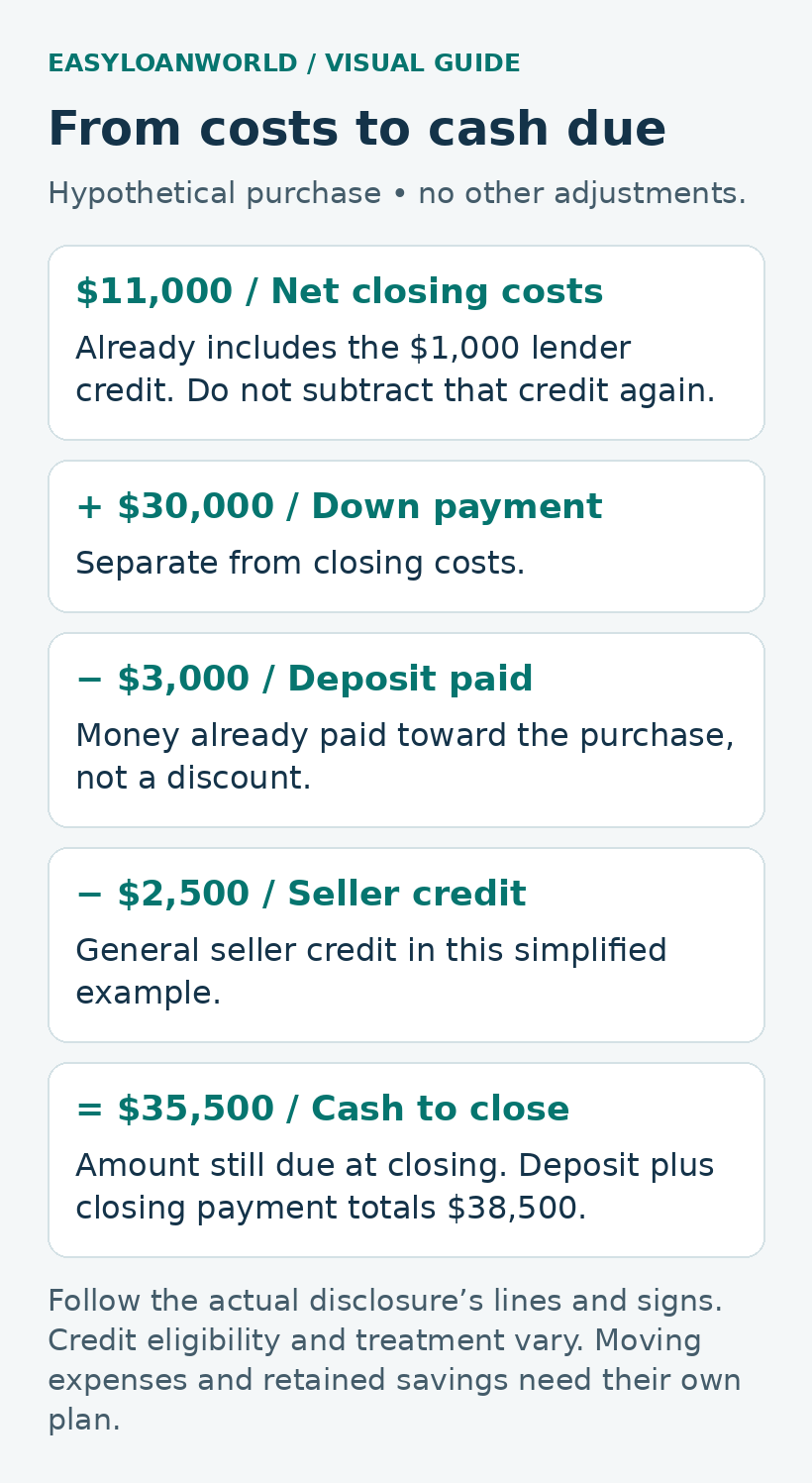
- Total closing costs, Section J: $11,000
The lender credit is already included in the $11,000 result. Carry that net figure into the next step without deducting the same credit again.
Step 2: Calculate what remains due
- Total closing costs, already net of lender credit: $11,000
- Down payment: +$30,000
- Earnest-money deposit already paid: −$3,000
- General seller credit: −$2,500
- Other adjustments and financed costs: $0
- Estimated cash to close: $35,500
The earlier $3,000 deposit plus the $35,500 closing payment equals $38,500 of buyer money in this simplified transaction. The deposit reduced the amount still due; it was not a discount. Closing costs are $11,000, not $35,500 or $38,500.
Subtracting the $1,000 lender credit a second time would incorrectly produce $34,500. That mistake would leave the buyer $1,000 short. Showing the intermediate calculation makes the error visible.
Reconcile the before, at, and after timeline
Suppose this household had $55,000 before paying its deposit. After the $3,000 payment, its current balance is $52,000. Paying $35,500 at closing leaves $16,500. Earmarking another $4,000 for moving and initial needs leaves a $12,500 emergency and repair cushion.
Do not subtract the deposit again from the $52,000 balance: that balance is already after the payment. Likewise, do not treat the $4,000 move-in allocation as another closing charge. It is a separate household use of cash.
Make your own timeline from the balance you actually have today:
- Current available liquid funds, with the balance date.
- Remaining preclosing invoices not otherwise included.
- Verified cash to close from the current disclosure.
- Moving and immediate-work spending.
- Cash retained afterward.
For each item, mark “already paid,” “still due,” or “set aside.” Attach the deposit receipt, invoices, and credit documentation. These simple labels prevent a paid inspection from disappearing from your overall purchase budget or being deducted twice from your remaining money.
Ask the lender which funds and documentation satisfy any reserve requirements. The fictional $12,500 cushion does not establish eligibility, and a personal savings target is not automatically a separate additional lender requirement.
Use a line-by-line change worksheet
Create columns for the latest Loan Estimate, Closing Disclosure, explanation, and verification status. Include rows for:
- Total closing costs in J
- Closing costs paid before closing
- Closing costs financed
- Down payment or funds from borrower
- Deposit
- Funds for borrower, if applicable
- Seller credits
- Adjustments and other credits
- Cash to close
Follow the signs on your actual form. Do not force every purchase, refinance, or alternative form into the simplified example above. Specific seller-paid charges and general credits can appear differently; do not subtract every credit mentioned in correspondence again.
If cash to close changes, ask which line moved. A changed down payment or missing credit can matter even when fees stayed the same. Fee-change rules depend on the charge and circumstances; the 10% category is not a universal ceiling for the whole bill. See the CFPB’s cost-change guidance.
Verify the payment instructions independently
Confirm the amount, recipient, payment method, and instructions with your closing professional using a previously established trusted telephone number or in person. Do not rely on a last-minute email changing the receiving account. The CFPB’s closing-fraud guidance explains this verification step.
Quick answers before closing
Does my deposit count toward the purchase?
Check that the documented deposit appears in the final reconciliation. It generally reduces what remains due; it does not mean you avoided spending those dollars.
Are lender or seller credits cash back?
Do not assume so. Permitted uses, limits, and treatment of excess credits depend on the loan program and transaction. Ask how each approved credit is applied.
Can every closing cost be added to the mortgage?
No blanket assumption is safe. Ask which costs, if any, may be financed in your transaction. Financing a cost changes borrowing; it does not waive the expense.
Does lower cash to close mean a better loan?
Not by itself. Compare the loan terms and total borrowing costs as well as the upfront payment. Then confirm that your remaining cash supports the life you need to fund after move-in.
Featured photo: Photo by Jakub Zerdzicki on Pexels. Used under the Pexels license. Illustrative stock photograph of keys and model homes; not an actual closing or promise of ownership.
California Supplemental Property Tax: Check the Bill, Payment and Cash
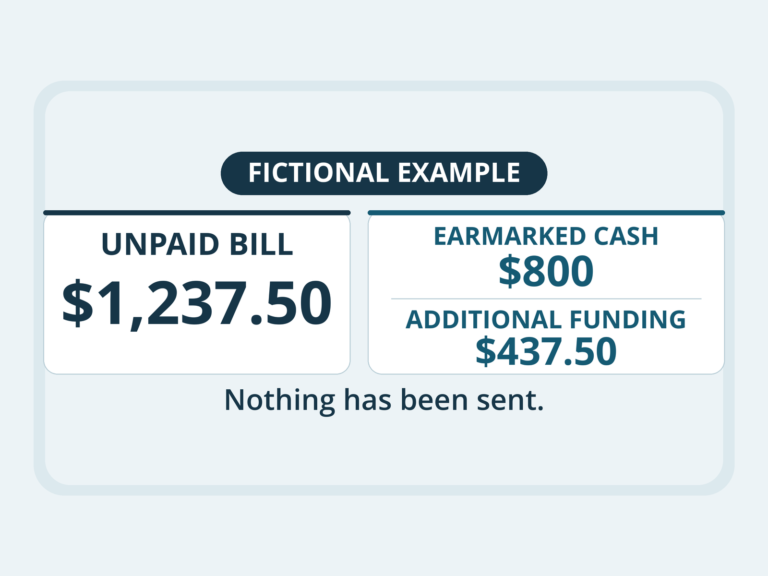
Organize one California supplemental property tax bill, its payment evidence and the cash earmarked for it. A fictional example shows why a funding gap…
Title Insurance Quotes: Compare Policies, Services and Payers
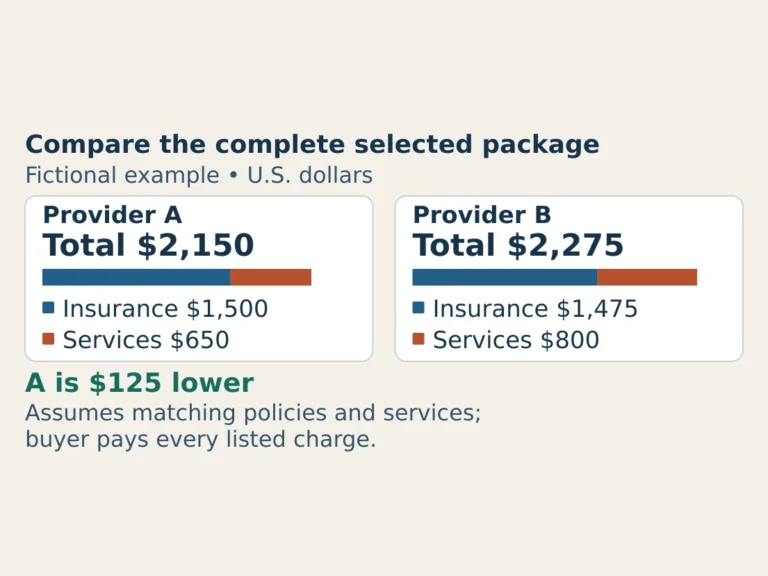
Compare fictional $2,150 and $2,275 title packages using matched coverage, complete service charges and a separate payer worksheet.

Flood Insurance Quote: Test Two Deductibles Against Your Cash Reserve
Test fictional flood quotes against a $6,000 reserve: $180 in annual savings comes with $3,000 more building deductible exposure.