COVID EIDL Payment Assistance: What Borrowers Should Check
Review the cash-flow trade-off, unresolved SBA application-route and loan-status guidance, and questions to confirm for an existing COVID EIDL loan.
COVID EIDL payment assistance may give an existing borrower breathing room, but the useful question is what happens to the business’s cash flow during the reduced-payment period and afterward. This guide explains the trade-off and questions to confirm with SBA; it is not a new-loan application or an eligibility decision.
Research checked: October 19, 2026. This is a source-review date, not a policy effective date.
Two unresolved points to check first
Application route: SBA’s COVID EIDL guidance says eligible loans can apply through the SBA Loan Portal, while retaining email instructions for loans originally above $200,000 at COVIDEIDLServicing@sba.gov. These simultaneous instructions leave the route unclear; this guide cannot establish which applies to your account.
Loan status: SBA separately says “Loan must be less than 90 days past due at the time of the request” and “Loan must be in current status”. Both conditions remain listed. Being fewer than 90 days late alone does not establish eligibility.
Confirm your account’s current instructions with SBA before transmitting documents or changing scheduled payments. Borrower-specific portal enrollment screens were not verified for this guide.
What the published assistance describes
According to the SBA guidance, eligible existing borrowers pay half their installment for six months, available once per five years. The business must operate; the borrower and every owner must be outside active bankruptcy; difficulties must be temporary. Existing enrollment continues through its term, then full installments resume. Interest accrues, and SBA warns of a larger maturity balloon.
An $800 installment: cash retained now
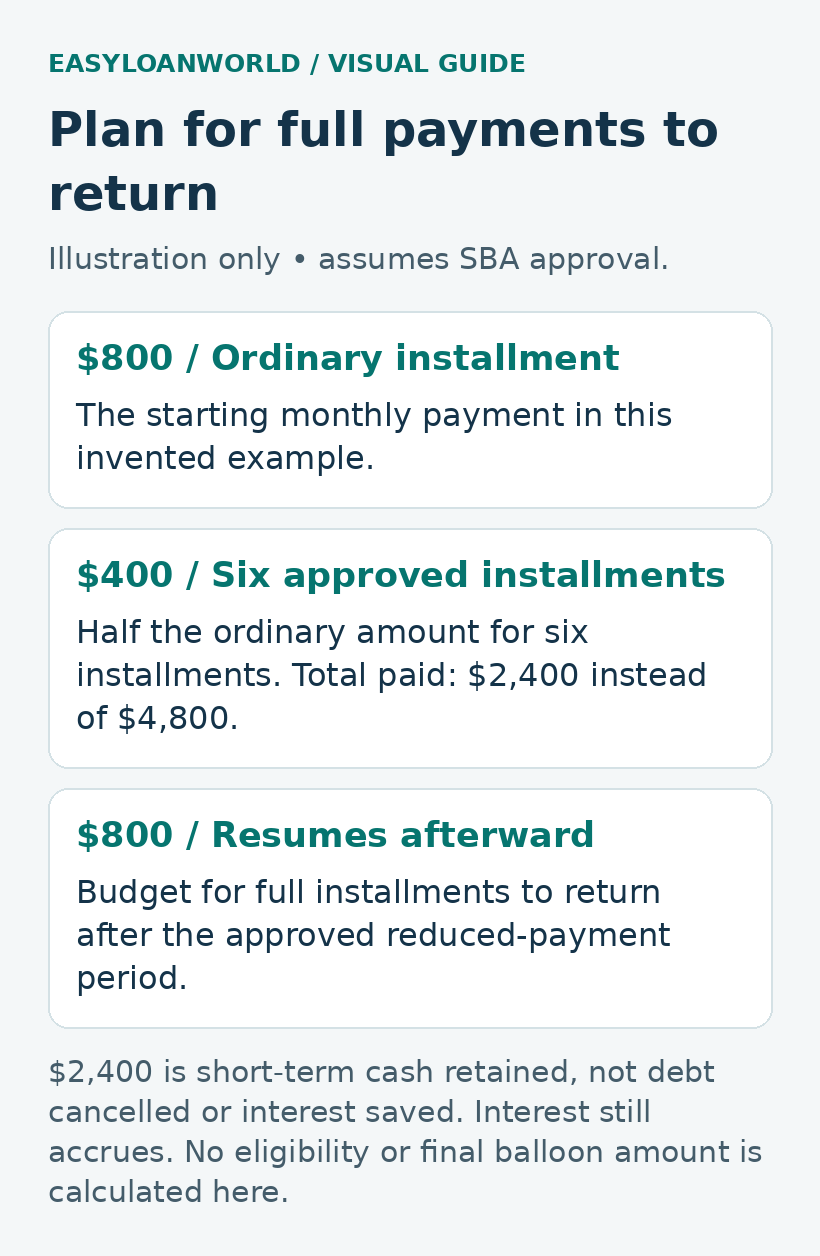
Here is an original illustration, not a real borrower’s schedule. Assume SBA approves six installments at half an ordinary $800 installment:
- Ordinary six-month cash outflow: $800 × 6 = $4,800.
- Illustrative approved installment: $800 × 50% = $400.
- Reduced-payment cash outflow: $400 × 6 = $2,400.
- Cash retained during those six months: $4,800 − $2,400 = $2,400.
- Budget for the illustrative $800 installment to return afterward.
The $2,400 measures short-term cash retained. It does not calculate interest savings, debt cancellation, or the increase in the final balloon payment. A maturity calculation needs the actual balance, interest terms, accrued interest, payment allocation, remaining schedule, and approved servicing terms. The monthly installment alone cannot supply that answer.
Build a budget for the return to full payments
Use the illustration to test a plan rather than treating the reduced amount as permanent spending room. For each affected month, write down:
- Expected customer receipts and when they should arrive.
- Essential operating costs and their due dates.
- The installment confirmed for that month.
- Cash left after those outflows, including any reserve you intend to keep.
Then repeat the worksheet for the first month after the reduced-payment period. In the example, the installment increases by $400 compared with the temporary amount. Identify what change in receipts, expenses, or reserves would cover that difference. If your plan only works while payments stay reduced, that is an important issue to discuss before relying on the arrangement.
Questions to get answered for your account
Keep these questions beside your budget and record SBA’s response, the date, and any written confirmation:
- How do both listed loan-status conditions apply to my account?
- Which application route and supporting documents apply to my loan?
- What installment amount and exact first and last due dates would be approved?
- What payment resumes afterward, and on which date?
- How should existing automatic payments be handled?
- What projected maturity obligation would result, and what assumptions does that projection use?
- How does any previous assistance affect the once-per-five-years condition?
Questions about a proposed schedule are different from confirmation that it has been approved. Keep the approved terms with your loan records so your budget follows the actual arrangement.
This is general education. Obtain account-specific servicing guidance from SBA and appropriate professional advice for distressed-business decisions.
Featured photo: Photo by Jonathan Cooper on Pexels. Used under the Pexels license. Illustrative stock photograph of a workshop; not a business identified as an EIDL borrower or assistance recipient. Photo by Jonathan Cooper on Pexels.

SBA Building Purchase: Measure Occupied Space Before Counting Tenant Rent
Build a classified area worksheet before relying on tenant rent. See how an omitted 500 square feet changes a fictional building’s operating-use calculation.

SBA 7(a) Prepayment: Check the Ledger Before Paying Extra
Use a fictional SBA 7(a) payment worksheet to separate assumptions, principal reduction and cash needed before requesting a written lender calculation.