Mortgage Discount Points: Calculate Break-Even Before Paying Upfront
Calculate a mortgage points break-even estimate, distinguish points from origination fees, and compare costs over the time you expect to keep the loan.

Mortgage discount points exchange money paid upfront for a lower interest rate. To estimate a simple payment break-even, divide the additional upfront cost by the monthly principal-and-interest reduction. Then check the loan balances and other costs at the date you might repay the mortgage: payment break-even alone does not identify the least expensive loan.
This U.S. guide uses invented numbers for education, not a current rate quote or individualized financial or tax advice. Sources checked October 19, 2026.
Start with comparable written quotes
Request a zero-point offer and a paid-point alternative using the same loan amount, term, loan type, quote date and rate-lock assumptions. Compare other lender fees and credits too. Zero points does not mean zero closing costs, or necessarily the cheapest offer across lenders. The CFPB explains the points-and-credits tradeoff.
Give each quote a label, such as A and B, and retain its date and assumptions. If one lender updates a price while another quote expires, request refreshed comparisons. Otherwise, a calculation that looks precise may be comparing offers that were never available together.
Points and origination fees do different jobs
One point costs 1% of the loan amount. It does not reduce the interest rate by one percentage point, and there is no universal conversion from points to rate reduction. Discount points appear in Section A on page 2 of the Loan Estimate and Closing Disclosure. Ask what rate change the quoted charge actually buys.
An origination fee pays the lender for making the mortgage. A percentage-based fee is not automatically a discount point. Put ordinary lender charges in a separate worksheet row rather than assuming they purchase a lower rate.
Calculate the simple cash-flow crossover
The CFPB’s discount-points research describes dividing points cost by monthly payment savings as an approximate break-even calculation. The length of time you keep the mortgage matters. The calculation below is an original illustration, not the report’s market data.
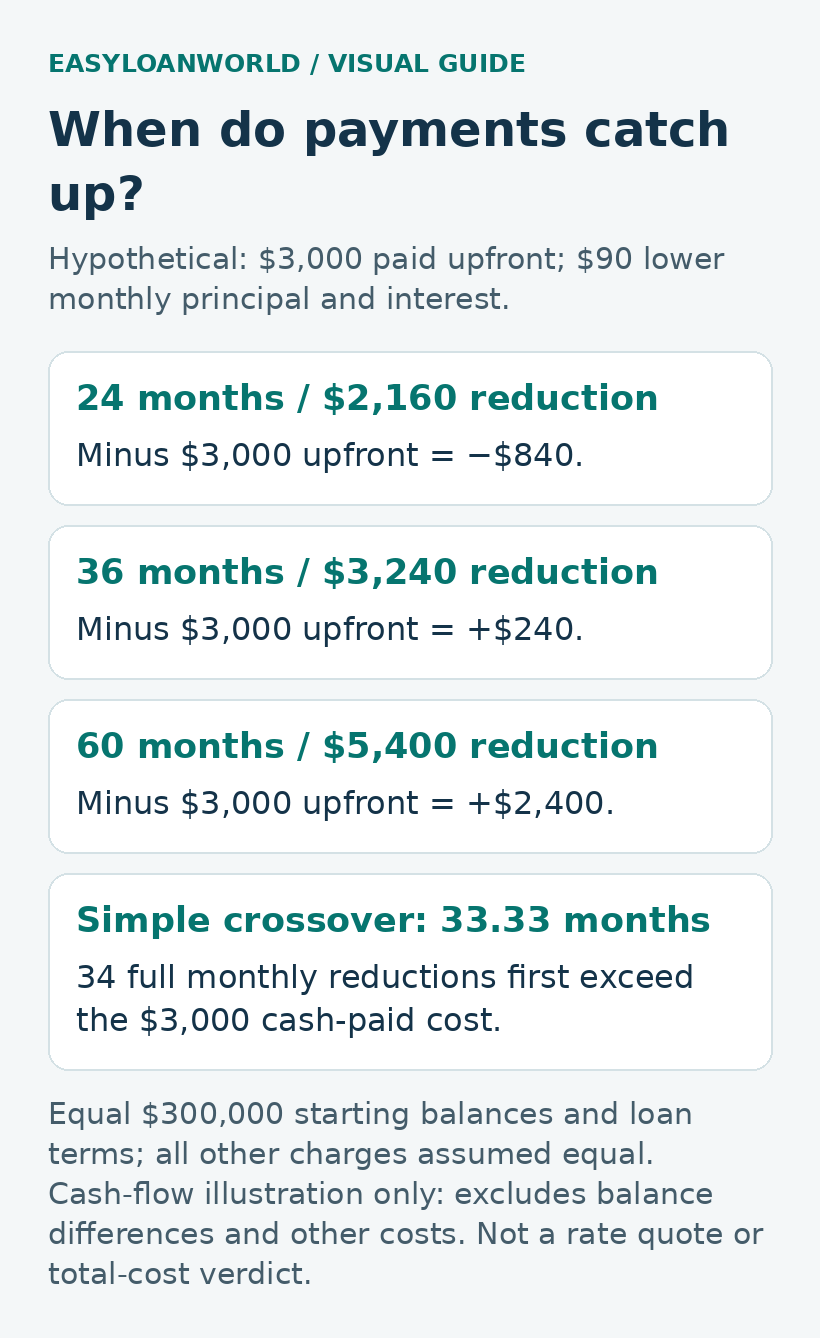
Suppose both offers start with a $300,000 balance and the same loan term. A has no discount points. B charges one point, or $3,000, paid from cash. B’s quoted monthly principal-and-interest payment is $90 lower. Assume all other charges are equal; no interest rates are assumed in this example.
$3,000 ÷ $90 = 33.33 months. With monthly installments, 34 full payment reductions first exceed the upfront $3,000. After 33 reductions, the total is only $2,970; after 34 it is $3,060.
| Loan kept for | Cumulative installment reduction | Reduction minus $3,000 upfront |
|---|---|---|
| 24 months | $2,160 | −$840 |
| 36 months | $3,240 | +$240 |
| 60 months | $5,400 | +$2,400 |
These are net cash-flow differences before other costs and loan-balance differences, not guaranteed savings or economic profit. At 36 months, the $240 margin is narrow. A fee omitted from the comparison could reverse the result.
For a separate sensitivity test, suppose B also has a $450 fee that A does not. The incremental upfront cost becomes $3,450. Dividing by $90 gives 38.33 months, requiring 39 full monthly reductions. This change is not included in the table.
Test three possible payoff dates
Choose an early, likely and later date for keeping this particular loan. The 24-, 36- and 60-month checkpoints above are starting points, not recommended timelines. Replace them with dates that fit your circumstances.
A homeowner might plan to stay in the property for ten years but consider refinancing sooner. That makes the current loan’s holding period shorter than the home’s holding period. Do not build the decision on a promised refinance: future rates, eligibility and availability are uncertain.
Write one sentence explaining each date. For example: “At 24 months, I may move for work”; “36 months is my planning case”; “60 months assumes no move or refinance.” This makes the uncertainty visible instead of hiding it inside one optimistic number.
Why payment break-even is not total borrowing cost
A mortgage installment includes principal repayment as well as interest. Calling every dollar of installments a financing cost would count repaid borrowing as though it were a fee. Different rates also change how quickly principal is repaid, so the alternatives can leave different balances at the same payoff date.
For equal starting loan balances, a useful undiscounted comparison is:
Upfront financing costs + principal-and-interest installments through the chosen date + remaining principal repaid at that date − original principal.
Use costs net of applicable lender credits, counted once. Add any differing mortgage insurance and applicable payoff charges separately. Do not then add interest again: the expression already leaves interest and upfront financing costs after principal is reconciled. Request amortization schedules to check each remaining balance and total interest.
This is a borrowing-cost comparison, not a complete household wealth model. Opportunity cost and tax effects require explicit, defensible assumptions. Keep them separate from the basic arithmetic; do not presume points produce a particular tax benefit.
If points are financed, the starting balances change. The cash-paid example cannot be reused unchanged, and financed costs have not disappeared. Ask for a consistent full comparison of cash flows and payoff balances, especially for irregular payments or changing rates.
A fill-in quote worksheet
Make two copies of this checklist, one for each offer. Mark missing fields “request from lender” rather than entering zero.
- Lender and quote date/time: ___; rate-lock expiration and assumptions: ___.
- Starting balance: ___; term: ___; fixed or adjustable structure: ___; interest rate: ___.
- Points percentage: ___; points dollars: ___; other lender fees: ___; credits: ___.
- Upfront cash attributable to financing costs: ___; monthly principal and interest: ___; differing mortgage insurance: ___.
- At each chosen payoff date: installments paid ___; total interest ___; remaining principal ___; applicable exit charges ___.
- Expected loan-holding period: ___; cash remaining after closing: ___.
Ask four questions before deciding: Which fees reduce the rate? What else changes between these offers? What are the financing costs and payoff balances at my three dates? How much accessible cash will remain?
A favorable calculation does not replace a cash-reserve decision. Record the money needed for near-term repairs and ordinary disruptions before committing additional cash to points. For individualized help, HUD’s housing-counseling network offers independent guidance; ask the agency about services and fees.
Common questions
Does one point always buy the same rate reduction?
No. Use the reduction in the actual written offer, not a rule of thumb.
Can points make sense if I may refinance?
Possibly, but compare costs through that earlier payoff date and test what happens if refinancing is unavailable.
Is an origination fee the same as points?
No. Check the fee’s purpose rather than relying on its percentage or label.
What if the payment reduction is zero?
A positive extra upfront cost has no finite positive break-even under this payment-reduction shortcut.
Featured photo: Photo by RDNE Stock project on Pexels. Used under the Pexels license. Illustrative stock photograph; the calculator display is not a mortgage quote, property price or part of the worked example. Photo by RDNE Stock project on Pexels.
Mortgage Charge Questions: Choose the Record That Answers Them
Match a questionable mortgage charge to account detail, service records or adjustments with a worked property-inspection example and a two-part index.

Partial Mortgage Payment: Track Money Held in Suspense
Follow a fictional $1,100 and $700 mortgage payment trail, compare dated records, and build a precise question about an unexplained entry.

Minnesota Contract for Deed: Check the Seller, Title and Balloon
Before signing a Minnesota contract for deed, organize seller, disclosure and title evidence, then test a fictional balloon-payment ledger.