Escrow Shortage: Read the Two Parts of a Mortgage Payment Increase
Separate higher tax and insurance deposits from escrow shortage repayment, read your annual analysis, and check a mortgage payment increase step by step.
An escrow-related mortgage payment increase can have two parts: more money for future tax and insurance bills, and a separate installment to resolve an escrow shortage. Paying off the shortage does not reverse higher ongoing bills. To understand your notice, separate these amounts before deciding what to question or how to budget.
This U.S. educational guide concerns an ordinary current mortgage with an escrow account. It is not individualized financial or legal advice and does not cover bankruptcy, foreclosure or loss-mitigation procedures. Sources checked October 19, 2026.
Find the component that changed
Place your old payment statement, new statement and escrow analysis together. Compare principal and interest, recurring escrow, shortage collection, mortgage insurance and other charges. The CFPB’s payment-change guide explains that taxes and insurance can change the total payment even when the mortgage rate is fixed. An adjustable-rate reset, expiring temporary buydown or mortgage-insurance change may be a separate cause.
Do not start by subtracting only the two totals. That shows the size of the problem, but not which number needs an explanation. Circle each changed line and note the new payment’s effective date.
Shortage, deficiency and cushion are different
Under Regulation X’s escrow rules, a shortage is the gap between the current balance and the analysis’s target balance. A deficiency is a negative escrow balance. A cushion is a reserve, generally limited to one-sixth of estimated annual escrow disbursements; applicable law or loan documents can require less. It is not a separate tax or interest charge.
Consequently, “shortage” does not automatically mean the account went negative, the servicer made an error or you missed mortgage payments. Ask for the calculation rather than trying to reconstruct it from the word on the notice.
A $200 increase with two separate causes
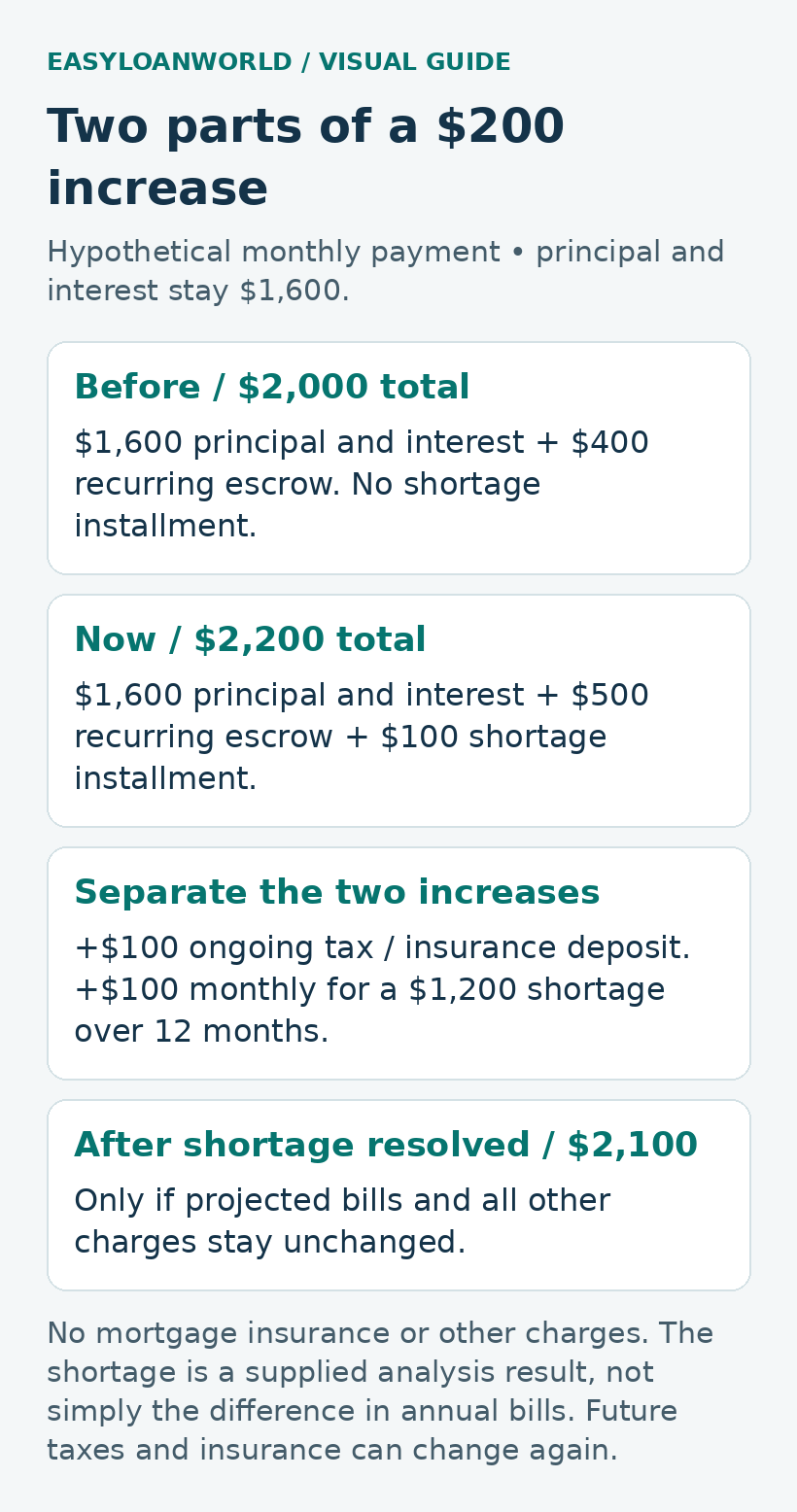
Consider this invented example. Principal and interest remain $1,600 monthly. There is no mortgage insurance, no other charge and no old shortage installment. All figures are hypothetical.
- Old annual bills: $3,600 property taxes + $1,200 homeowners insurance = $4,800.
- Old recurring escrow: $4,800 ÷ 12 = $400 monthly.
- Old total payment: $1,600 + $400 = $2,000.
The new projection lists $4,200 in taxes and $1,800 in insurance, totaling $6,000 annually. That makes ongoing escrow $500 monthly. Separately, the completed analysis identifies a $1,200 shortage, collected over 12 months at $100 per month.
Fictional monthly payment bridge; no mortgage insurance or other charges
- Principal and interest: old $1,600; new $1,600; change $0.
- Recurring escrow: old $400; new $500; change +$100.
- Shortage installment: old $0; new $100; change +$100.
- Total: old $2,000; new $2,200; change +$200.
The $1,200 shortage is a supplied result from this hypothetical analysis. It was not calculated simply by subtracting the old annual bills from the new ones. Those figures happen to match here; real shortage calculations also depend on account balances, bill timing and the applicable reserve.
If the shortage is fully resolved and projected annual bills and all other charges stay unchanged, this example’s payment becomes $2,100, not $2,000. That is a conditional illustration, not a promise about your next analysis.
Read the analysis in a useful order
The annual statement combines past account activity and future projections. Use this reading order, based on the federal escrow-analysis framework:
- Identify the accounting period and the history of deposits and actual disbursements.
- Find the ending balance, then the projected bill amounts and payment dates.
- Locate the lowest projected balance and cushion used.
- Find the shortage or deficiency, collection period, new monthly amount and effective date.
Draw a line between historical entries and estimates. A projected insurance premium is not evidence that the insurer has already received that amount. Ask for the month-by-month running balance if the summary does not explain how the target was reached.
Do not label every shortage dollar “last year’s unpaid taxes.” A timing mismatch or permitted reserve can contribute. Conversely, an annual total that looks reasonable does not prove that every disbursement date or account entry is correct.
Check the underlying bills against the ledger
Match each major item to a document. For property taxes, check the property identity, taxing authority, billed amount and installment dates. For insurance, check the property, policy period and renewal premium. Then compare those details with the servicer’s recorded disbursements.
Use a small reconciliation note for each mismatch: “Analysis shows ___; bill shows ___; dated ___; clarification requested ___.” This gives the next person a specific question to answer.
Ask the tax authority or insurer about its underlying bill. Ask the servicer about money collected, paid or projected in escrow. These are related questions for different organizations; the servicer does not set an insurer’s premium or a property’s tax assessment.
What shortage collection options apply?
The CFPB’s mortgage-servicing FAQs distinguish two shortage sizes:
- Below one month’s escrow payment: the servicer may leave the shortage outstanding, require repayment within 30 days, or collect equal monthly installments over at least 12 months.
- At least one month’s escrow payment: the listed choices are leaving it outstanding or collecting equal monthly installments over at least 12 months.
For the larger shortage, a servicer may accept a voluntary, unsolicited lump sum, but cannot require it or list that option in the annual escrow statement. A separate communication may explain a genuinely voluntary payment. These rules do not guarantee a borrower-selected 24- or 36-month plan.
Deficiencies have different repayment rules. If your balance is negative or your loan is delinquent, request the applicable treatment instead of assuming this shortage summary answers your situation.
Before sending a voluntary payment, ask how to designate it and request written confirmation of its application, the revised payment and the effective date. Do not lower the scheduled payment yourself while awaiting confirmation.
Fill in your own payment bridge
For each line, record the new amount minus the old amount. Preserve negative numbers when a component falls.
- Principal and interest: old ___; new ___; difference ___.
- Recurring escrow: old ___; new ___; difference ___.
- Shortage installment: old ___; new ___; difference ___.
- Mortgage insurance and other charges: old ___; new ___; difference ___.
- Total monthly change: ___; new payment effective date: ___.
- Planned shortage completion date: ___; estimates awaiting updated bills: ___.
Add the component differences and compare the result with the change in the statement total. Subtract an old shortage installment that is ending; otherwise you may overstate the increase. Keep a separate budget note for the ongoing payment and the temporary catch-up amount.
Gather old and new analyses, statements, tax bills, insurance renewal declarations, disbursement records, direct-payment receipts, refunds and a dated communication log. Keep account numbers private. Ask: Which bill or date changed? Which balances produce the shortage? How much is ongoing? Will updated documentation trigger a review?
If the amount is wrong or unaffordable
Contact the servicer promptly with the specific discrepancy. If needed, send a written error notice or information request to its designated address, which may differ from the payment address. Identify the account and the exact issue, retain copies and continue scheduled payments during the dispute. The CFPB provides dispute guidance and sample letters.
If you cannot afford the new amount, ask the servicer about assistance before a missed payment. HUD-participating counseling agencies offer individualized housing guidance; check available services and fees.
Quick answers
Can a fixed-rate payment increase?
Yes. A fixed interest rate does not freeze taxes or insurance collected through escrow.
Will a lump sum restore my old payment?
Not necessarily. Higher ongoing bills remain, and the servicer must confirm any revised amount.
Is a shortage a negative balance?
Not necessarily. Check whether the analysis identifies a shortage, a deficiency or both.
Featured photo: Photo by Kindel Media on Pexels. Used under the Pexels license. Illustrative stock photograph; not a property identified as having an escrow shortage. Photo by Kindel Media on Pexels.
Mortgage Charge Questions: Choose the Record That Answers Them
Match a questionable mortgage charge to account detail, service records or adjustments with a worked property-inspection example and a two-part index.

Partial Mortgage Payment: Track Money Held in Suspense
Follow a fictional $1,100 and $700 mortgage payment trail, compare dated records, and build a precise question about an unexplained entry.

Minnesota Contract for Deed: Check the Seller, Title and Balloon
Before signing a Minnesota contract for deed, organize seller, disclosure and title evidence, then test a fictional balloon-payment ledger.