Mortgage Rate Locks: Check the Deadline, Extension Cost and Float-Down Terms
Understand mortgage rate-lock deadlines, compare extension costs, and use a checklist to ask about float-down terms before closing.

A mortgage rate lock generally preserves the offered interest rate until closing within an agreed period, provided relevant application details stay unchanged. The CFPB explains these conditions.
Before choosing a lock, get three things in writing: its exact expiration, the conditions attached to the quoted pricing, and what happens if closing runs late. Put those answers beside your unfinished closing tasks. A plausible schedule and an affordable backup plan are more useful here than an interest-rate prediction.
This U.S. guide is educational, not individualized financial or legal advice. All example prices are hypothetical. Sources checked October 19, 2026.
Read the confirmation alongside the Loan Estimate
The lock field at the top of your Loan Estimate’s first page shows whether the rate is locked and for how long. The form does not provide the cost of extending the lock or comparing different lock periods. Application changes, including the loan amount, down payment, credit, verified income or appraisal, can affect pricing. See the CFPB’s rate-lock guidance.
Keep the written lock confirmation with the matching estimate. Highlight the rate, points, lender credits and any separate lock charge, then ask the lender to resolve discrepancies. Separate the lock’s pre-closing duration from the loan’s fixed- or adjustable-rate terms after closing.
For planning, keep tracking underwriting after locking; a lock does not establish that underwriting is complete. Ask who will confirm each remaining condition is cleared.
For a broader offer comparison, use our guide to comparing Loan Estimates line by line. Keep this lock review focused on the deadline and the pricing attached to it.
Build the schedule from unfinished work
Ask the lender what event must occur before expiration: signing, closing, funding or another specifically defined milestone. Record the answer exactly. Then work backward from that event with the people responsible for it.
For each unfinished item, write down an owner, a promised completion date and the next check-in. An appraisal review, title issue, insurance document or income question might belong on your list; use the conditions actually identified for your transaction.
For example, “appraisal pending” leaves too much unresolved. “Loan officer will confirm review status on Tuesday” gives you a concrete follow-up. If nobody can give a credible completion date, mark that uncertainty rather than quietly assuming the task will finish on time.
Do not prescribe the same buffer for every purchase. Ask the lender whether your remaining tasks fit the proposed window, and record its explanation. Revisit the schedule when a dependency changes.
Compare a longer lock with a conditional extension
Use actual written alternatives. A statement such as “extensions are available” leaves the cost, deadline and approval conditions unanswered. Ask for those details before treating an extension as your backup plan.
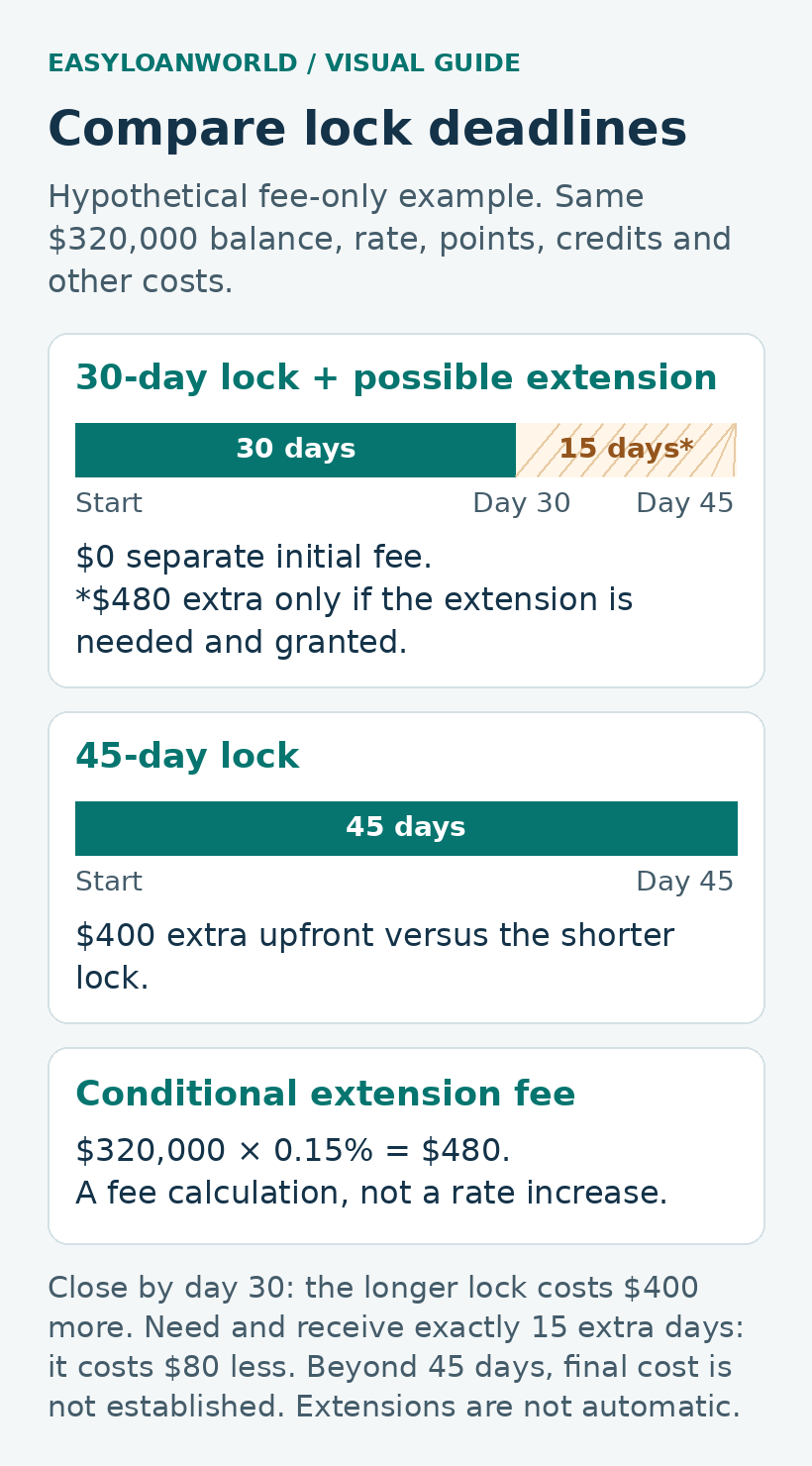
Here is a hypothetical fee-only comparison. Both offers use the same $320,000 loan balance, interest rate, points, credits and all other costs. Both otherwise meet the borrower’s needs:
- 30-day lock: no separate initial lock fee.
- 45-day lock: $400 more upfront than the 30-day option.
- Possible extension of the shorter lock: 15 additional days for 0.15% of the loan balance, subject to the hypothetical agreement’s availability and approval conditions.
$320,000 × 0.0015 = $480. The 0.15% is a one-time fee calculation in this example, not a 0.15-percentage-point increase in the mortgage interest rate.
- Close within 30 days: the longer lock costs $400 more.
- Need exactly the quoted 15-day extension, and receive approval: the shorter-lock path costs $480; the longer-lock path costs $400. The longer lock costs $80 less.
- Need more than 45 days: these assumptions do not establish either path’s final cost.
This calculation compares two specified fees. If rates, points, credits or extension conditions differ, include those differences before deciding. Replace the invented prices with a current written quote; policies and pricing can change. Do not assign an invented probability to a closing delay to manufacture an expected saving.
Ask what a float-down would actually change
Some lenders offer a float-down feature that can reduce a locked rate. It may have a minimum rate-drop trigger, a limited exercise window, use limits and a fee or pricing adjustment. Availability and savings are uncertain. Chase’s float-down explainer describes these possible restrictions.
Ask the lender to show the complete before-and-after offer if you qualify. Record what cash you would pay, whether any fee is refundable, what changes to points or credits apply, and whether you must request the adjustment. Save the response with the lock confirmation. A lower headline rate alone is insufficient for comparing the two offers.
Act before the deadline if closing slips
A delayed closing may require a paid extension even when lender processing caused the delay, according to the CFPB’s loan-offer guide. Ask for the lender’s written policy.
As soon as a delay becomes credible, contact the lender before expiration. Request the revised completion date, available alternatives, exact charges and the deadline for choosing. Keep the answer in writing. If you request an extension, obtain confirmation of approval and the new expiration; sending a request alone should not be your evidence of coverage.
If the locked rate or points change, request a specific explanation. Significant application changes can justify repricing. Compare the explanation with your application and written terms. If the issue remains unresolved after contacting the lender, consider a CFPB complaint. The CFPB explains how to question changed rates or fees.
Your rate-lock control sheet
Copy this checklist into your closing notes. Enter “awaiting written answer” for missing information.
- Offer: lender/contact ___; quote date/time ___; loan program, balance and term ___.
- Pricing: rate ___; points ___; lender credits ___; separate lock charge ___.
- Confirmation: received ___; exact expiration date, time and time zone ___; required completion milestone ___.
- Schedule: planned closing ___; interval before the contractual deadline ___.
- Each unfinished condition: item ___; responsible person ___; due date ___; last confirmation ___.
- Longer-lock alternative: additional cost ___; other pricing differences ___.
- Extension: offered duration ___; fee basis and amount ___; request deadline ___; approval conditions ___; who pays under each delay scenario ___.
- Float-down: available ___; fee/refund terms ___; trigger ___; eligible window ___; uses allowed ___; request procedure ___.
- Next action: contact date ___; question to resolve ___; written response saved ___.
This organizational aid cannot cover every closing dependency or override your agreement. Share sensitive documents only through a verified lender contact or secure channel.
Common questions
Does receiving a Loan Estimate mean my rate is locked?
Check its lock field and your written confirmation. Receiving the form alone is insufficient.
Will my locked rate fall automatically?
Follow your agreement’s downward-adjustment terms, including any request requirement; do not assume an automatic reset.
Who pays if the lender delays closing?
Ask for its written extension policy and the charge proposed for your circumstances.
Can I change lenders?
Switching restarts processing and can endanger the closing timetable. Previously paid application or appraisal fees may be nonrefundable. Include these tradeoffs when considering another offer, as the CFPB advises.
Featured photo: Photo by freestocks on Unsplash. Used under the Unsplash license. Illustrative stock photograph of a desk clock; the displayed time is not a mortgage rate-lock deadline. Photo by freestocks on Unsplash.
Mortgage Charge Questions: Choose the Record That Answers Them
Match a questionable mortgage charge to account detail, service records or adjustments with a worked property-inspection example and a two-part index.

Partial Mortgage Payment: Track Money Held in Suspense
Follow a fictional $1,100 and $700 mortgage payment trail, compare dated records, and build a precise question about an unexplained entry.

Minnesota Contract for Deed: Check the Seller, Title and Balloon
Before signing a Minnesota contract for deed, organize seller, disclosure and title evidence, then test a fictional balloon-payment ledger.