Home Equity Loan vs. HELOC: Match Borrowing to the Spending Plan
Compare a home equity loan with a HELOC using a staged-expense worksheet, payment questions, fees and the risk of borrowing against your home.

A home equity loan and a home equity line of credit can fund the same project while delivering cash differently. Start with when the bills are due, then compare the obligations each written offer creates.
A home equity loan provides a lump sum and can have a fixed or adjustable rate. A HELOC allows repeated borrowing from available credit under its terms and usually has an adjustable rate. If you have a first mortgage, these obligations are additional to it.
Your home is at stake. A home equity loan uses it as collateral; failure to repay can lead to foreclosure. You can also lose your home if you cannot repay a HELOC. Compare the consequences alongside the convenience of receiving money.
Build the spending schedule first
List the project’s required payments before requesting an amount. For each one, record the amount, due date, supporting quote or contract, and whether the figure is confirmed. Keep optional additions separate from work you have already committed to purchase.
A single total hides useful questions. Is the next payment due before materials arrive? Does an estimate include the whole job? Could you postpone the last stage without leaving essential work unfinished? Resolve these with the relevant supplier; a financing comparison cannot repair an unclear project contract.
Label any extra amount as a proposed contingency, with a reason. Do not quietly increase the project because a larger credit amount may be available. The borrowing request should follow the plan you can justify.
Trace the cash through three milestones
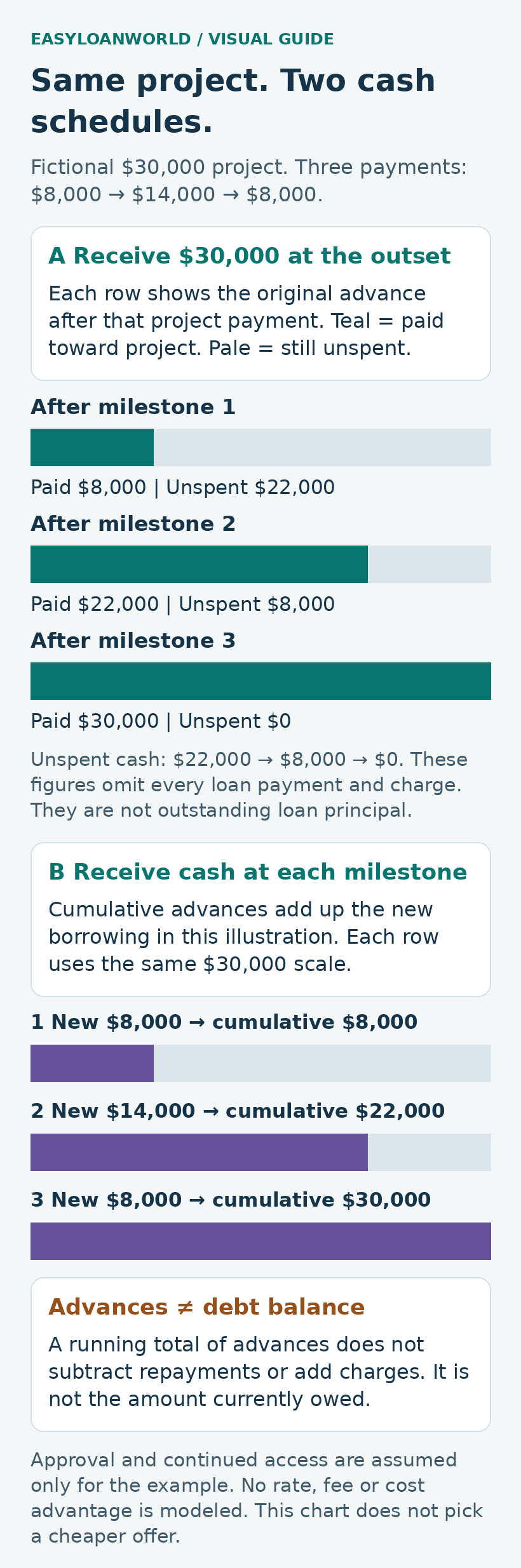
Consider a fictional repair project with three separately confirmed payments: $8,000, then $14,000, then $8,000. Total project spending is $30,000.
For illustration only, assume a borrower can choose between a $30,000 lump-sum loan and a $30,000 line that permits these three draws when needed. Approval and continued access are assumed solely to show timing. No interest rate, fee or cost advantage is assumed.
If all $30,000 arrives at the outset
- First milestone: Pay $8,000. Of the initial advance, $22,000 has not yet been spent on the project.
- Second milestone: Pay another $14,000. The initially advanced money still unspent on the project is $8,000.
- Third milestone: Pay another $8,000. All $30,000 has now been spent on the project.
Those unspent-cash figures exclude every loan payment and charge. They are not the outstanding loan principal. The money waiting for a later bill is borrowed cash, so do not count it again as a new household reserve.
If money is advanced at each milestone
- First milestone: New advance $8,000; cumulative advances $8,000.
- Second milestone: New advance $14,000; cumulative advances $22,000.
- Third milestone: New advance $8,000; cumulative advances $30,000.
Cumulative advances measure how much has been borrowed over time. They do not show the balance owed after repayments and applicable charges. Obtain that balance from the account records rather than relabeling this project’s spending totals as debt.
The example shows different cash-delivery schedules. It does not establish which offer is cheaper or affordable. A cost comparison needs actual rates, charges, draw dates and repayment schedules. Delaying a draw does not, by itself, prove that one complete offer costs less.
If the final $8,000 stage becomes optional, revise the project and ask what each contract permits. Do not assume that reaching a $30,000 plan means you must ultimately spend $30,000.
Check whether later money will actually be available
A HELOC’s future borrowing can be restricted: the CFPB explains that a significant property-value decline or certain changes in financial circumstances can lead a lender to freeze or reduce access.
Write down what would happen if funding for the next stage were unavailable. Identify which commitments would remain, which work could stop safely, and whether you have another realistic way to pay. An unused limit should not be entered as cash already on hand.
Ask the lender to identify the provisions governing later advances. Record the answer beside each proposed draw, including any unresolved conditions. Do not let a contractor’s payment deadline become your deadline for discovering a funding restriction.
Compare the promises you would have to keep
For each offer, obtain written answers to these questions:
- What must I pay first? Record the required amount, first due date and where the calculation appears.
- What can change later? Ask for the rate provisions, payment rules and dates relevant to your agreement.
- What remains at the end? Identify the final payoff requirement and any amount not covered by the regular payments.
- What if the project changes? Ask about unused funds, additional borrowing and early repayment under that specific offer.
Put these obligations into the household plan alongside existing housing costs and other commitments. A low first payment is insufficient evidence for a decision covering many years. Choose a comparison horizon that fits your intended project and borrowing period, then request information for that same horizon from each lender.
If an answer depends on an assumption, label it. “Payment shown using an unchanged rate” tells you something different from “payment fixed by the agreement.” Neither a salesperson’s illustration nor this article replaces the signed terms.
Record each fee’s trigger, not just its headline amount
Home equity loans can have upfront costs.
For HELOCs, the CFPB lists possible charges for applying or opening the account, annual membership, inactivity, early cancellation and converting a balance to a fixed rate. Each plan differs; leaving a line unused does not necessarily make it free.
Give every applicable charge its own short record:
- Name and triggering event.
- Dollar amount or calculation, and date due.
- Whether paid separately or added to what you owe.
- Any stated condition requiring repayment of a previously covered cost.
- Page or written clarification supporting the entry.
Use “not yet confirmed” rather than zero when a detail is absent. Keep one-time and recurring amounts distinct before totaling them over your chosen horizon. Compare the same set of costs for both offers.
Finish with a decision and a missing-information list
Complete three sentences privately:
- “The timing fits because the project’s confirmed payments are…”
- “The plan would stop working if…”
- “Before committing, I still need written clarification about…”
Assign each unresolved question to someone who can answer it, with a date before you need to commit. “Do not proceed yet” is a useful result. Depending on what is feasible, revisiting the scope, postponing optional work or using available cash may change the financing need. None of those options should be assumed affordable without checking your circumstances.
Common questions
Is a line limit the amount I owe?
No. In the fictional example, a $30,000 limit permits assumed advances totaling $8,000 after stage one. Actual debt depends on account activity. Keep the credit limit, cumulative borrowing and current balance in separate fields.
Is a home equity loan always fixed-rate?
No. It can be fixed or adjustable. Check the particular offer rather than relying on its product name.
Does repaying principal guarantee I can borrow it again?
Repayment can replenish available HELOC credit, but another draw still depends on the line’s terms and availability. Confirm those conditions before committing to a later bill.
U.S. educational information, checked October 19, 2026. Examples are fictional and are not offers or personalized borrowing advice.
Featured photo: Photo by Karl Solano on Unsplash. Used under the Unsplash license. Illustrative renovation photograph. It does not depict the fictional project or its cost. Photo by Karl Solano on Unsplash.

Limited 203(k) and HomeStyle: Three Renovation Projects
Compare three fictional renovation projects, then change one logistical detail and prepare a private project brief.
Mortgage Charge Questions: Choose the Record That Answers Them
Match a questionable mortgage charge to account detail, service records or adjustments with a worked property-inspection example and a two-part index.

Partial Mortgage Payment: Track Money Held in Suspense
Follow a fictional $1,100 and $700 mortgage payment trail, compare dated records, and build a precise question about an unexplained entry.