HELOC Draw and Repayment Periods: Prepare for the Payment Change
Find your HELOC's end-of-draw terms, compare a hypothetical payment change and build a transition checklist before the next repayment stage begins.

Before your HELOC reaches the end of its draw period, find the date new borrowing ends and the amount your agreement requires next. The change deserves a fresh cash plan even if the interest rate stays the same.
The CFPB explains that additional borrowing ends after the draw period. Repayment may involve larger installments or an immediate whole-balance obligation, depending on the agreement. If you cannot repay your HELOC, you could lose your home.
This guide helps you assemble a transition record. Its example is fictional; your contract, account information and servicer’s explanation determine which calculation applies to you.
Find the terms before estimating the payment
Gather the agreement, later amendments, a recent statement and any transition notice. Make a short list of three dates: the last permitted draw, the first changed-payment due date, and any balloon or maturity date. Attach the supporting document and page to each entry.
Ask your servicer to explain conflicting figures or unclear labels. Do not choose the smallest payment because it is easier to budget. A statement showing today’s amount may not answer what will be due after the transition.
Use a verified contact method from your account or statement. Keep the response date, representative’s name and written follow-up reference with the record. You do not need to put account numbers into a separate planning worksheet.
Identify which repayment arrangement you have
Bank of America’s servicing explanation distinguishes a balloon arrangement, requiring a lump-sum balance payment, from a standard arrangement with monthly principal-and-interest payments. This illustrates why the account’s particular terms matter; it does not identify the arrangement on your account.
A balloon is a separate branch of the plan. Do not substitute an installment estimate for a lump sum actually required by your agreement. If your documents describe another structure or separate repayment segments, request an explanation covering the whole account.
Draw-period payments also differ. The CFPB’s HELOC booklet describes plans whose payments include principal and plans allowing interest-only payments. Do not assume your current payment is interest-only.
For a concrete counterexample, Bank of America’s page says its described new refinanced HELOC requires principal and interest in both phases. That statement concerns that refinance product, not every existing HELOC.
Separate a repayment change from a rate change
Interagency guidance issued in July 2014 identified principal amortization and interest-rate resets as distinct sources of higher payments. This is historical supervisory guidance, not a new borrower entitlement to an extension or modification.
The distinction helps you ask a precise question: how much of the projected change comes from repaying principal, and how much comes from the rate used? Calculate them separately before combining them.
Example: a $60,000 balance entering installment repayment
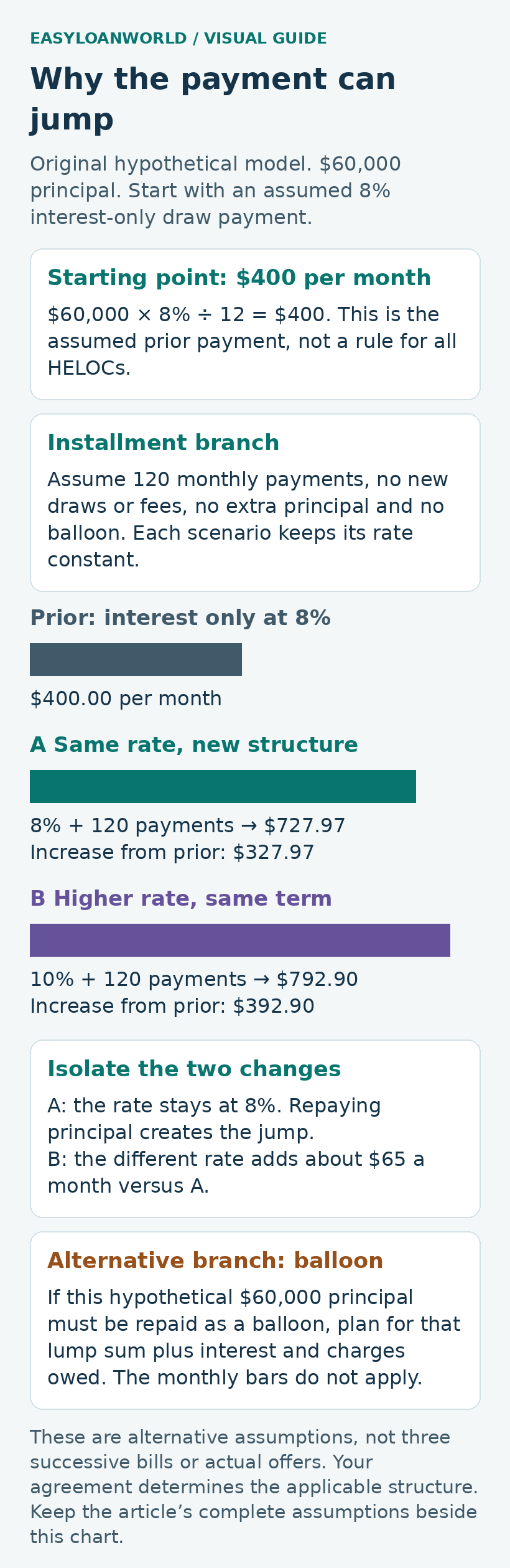
Assume this fictional account has $60,000 of outstanding principal at the transition. Its prior draw payment covers interest only at an illustrative nominal annual rate of 8%. Dividing the annual rate by 12 gives a simplified monthly interest payment of $400.
For this example only, assume the agreement then requires full repayment through 120 monthly installments, with the first one a month later. There are no further draws, fees, overdue amounts, financed charges, payment holidays, extra principal payments or balloon. Each scenario holds its stated rate constant solely to illustrate the arithmetic.
For a fully amortizing installment, the formula is: payment = P × r ÷ [1 − (1 + r)−n], where P is principal, r is the monthly rate and n is the number of payments. Here, P is $60,000, r is the annual rate divided by 12, and n is 120.
Scenario A: same 8% rate, different repayment structure
The modeled principal-and-interest installment is about $727.97 a month. Compared with the assumed $400 draw payment, that is an increase of $327.97, or approximately 81.99%.
No rate increase causes this example’s jump. The new schedule must repay principal as well as interest over the assumed ten years. The percentage describes this constructed account, not a typical HELOC increase.
Scenario B: the same schedule at a hypothetical 10%
Keep the starting balance and 120-payment term unchanged, but use 10% throughout this alternative. The modeled installment becomes about $792.90. That is $392.90 above the assumed draw payment, an increase of approximately 98.23%.
It is also about $65 more per month than Scenario A. That additional change comes from the separate rate assumption. Neither 8% nor 10% is a current offer or a forecast. A real variable-rate payment can change again under the actual agreement.
If the actual contract requires a balloon instead: neither $727.97 nor $792.90 is the contractual amount due. In an otherwise comparable example, the $60,000 principal would need to be paid under that balloon provision, plus interest and charges actually owed. Permission to spread it across 120 payments cannot be assumed.
Translate the change into monthly room
Suppose this fictional household has $850 each month available for the HELOC after its first mortgage, other housing costs, essentials, other required debts, planned savings and provisions for irregular expenses.
- With the assumed $400 draw payment: $450 remains.
- With Scenario A’s modeled $727.97: about $122.03 remains.
- With Scenario B’s modeled $792.90: about $57.10 remains.
Those amounts are arithmetic headroom. A positive result does not certify that the household can absorb repairs, delayed income or another rate change. The $850 is an invented budget input, not a lender qualification rule or recommended reserve.
Do not deduct the first mortgage twice if it is already included in the expenses used to reach $850. Conversely, a separate HELOC statement does not remove the first mortgage from the plan. A balloon requires a separate lump-sum funding calculation; this monthly comparison cannot test it.
Complete a private transition record
- Dates and evidence: Last permitted draw, first changed bill and maturity or balloon date, with document references and questions still unanswered.
- Calculation inputs: Current principal, planned additional use, prior required payment, repayment term and rate assumptions behind the new estimate. Ask what changes if the rate moves before the effective date.
- Cash plan: Monthly amount available after other obligations, projected payment, remaining room and any unresolved gap. Identify only changes you can actually make.
- Confirmation: Servicer’s instructions, any automated-payment adjustment needed, effective date and first statement to check.
If the balance estimate includes a future draw, label it as planned rather than already owed. Ask the servicer to address any fixed-rate segment or separately scheduled amount actually on your account instead of assuming a single calculation covers everything.
Address a gap before the changed bill arrives
The historical guidance emphasizes early communication and reviewing contract provisions; renewal or refinancing can depend on the borrower’s circumstances and lender evaluation. Treat a proposed new loan as unconfirmed funding.
If you expect difficulty, contact the servicer early to discuss your situation and ask what options it can consider. Record any information requested and the next response date. Do not assume a pending request changes the payment already required.
After the first changed statement arrives, compare its amount and dates with the written explanation. Ask promptly about discrepancies and retain the response. Continue meeting existing obligations while a request is pending unless an approved arrangement changes them. The useful outcome is a verified payment plan, with any remaining gap visible before it becomes a missed obligation.
U.S. educational information, checked October 19, 2026. Fictional calculations are not lender quotes or personalized financial advice.
Featured photo: Photo by Towfiqu barbhuiya on Unsplash. Used under the Unsplash license. Illustrative photograph of an hourglass. No actual loan deadline is depicted. Photo by Towfiqu barbhuiya on Unsplash.

Limited 203(k) and HomeStyle: Three Renovation Projects
Compare three fictional renovation projects, then change one logistical detail and prepare a private project brief.
Mortgage Charge Questions: Choose the Record That Answers Them
Match a questionable mortgage charge to account detail, service records or adjustments with a worked property-inspection example and a two-part index.

Partial Mortgage Payment: Track Money Held in Suspense
Follow a fictional $1,100 and $700 mortgage payment trail, compare dated records, and build a precise question about an unexplained entry.