HELOC Variable Rates: Stress-Test a Renovation Budget
Test a hypothetical HELOC budget against higher rates and a larger project balance, then compare payment headroom with your own contract terms.

A renovation budget can face two financing changes at once: a higher interest rate and a larger amount borrowed. Test both before committing to optional work, keeping the payment required by your contract separate from any extra principal you choose to pay.
A HELOC puts your home at risk: the CFPB warns that failure to repay can mean losing your home.
The exercise below is a sensitivity test, not a borrowing recommendation or approval standard. It shows which assumptions make a fictional monthly cash plan stop working.
Start with the rate and payment instructions
The CFPB’s HELOC booklet describes a common variable-rate structure: an index, reflecting market rates, plus a lender’s margin. An introductory rate may apply temporarily. Draw-period payments can include principal or, under some plans, interest alone. Your agreement determines the applicable method.
Find the current statement and agreement before choosing test numbers. Record the date of the rate information and the document explaining the required payment. Keep the outstanding balance separate from credit you have not used.
Under Regulation Z’s home-equity-plan disclosures, the HELOC APR does not include costs other than interest. Record fees separately rather than treating the APR as an all-in cost measure.
Write down the next proposed project expense, whether its price is confirmed, and the borrowing it would add. A higher estimate for optional finishes should appear as a new decision, not disappear inside the original financing total.
Define a deliberately simplified test
Use these fictional inputs:
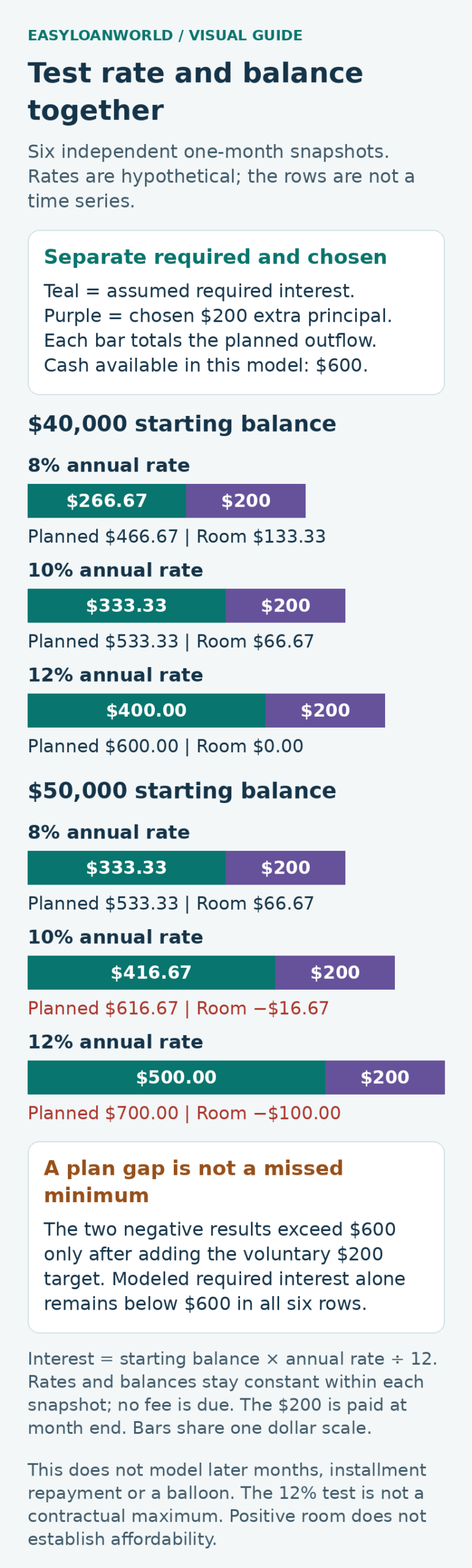
- Two outstanding balances: $40,000 and $50,000. The extra $10,000 is assumed already borrowed at the start of the larger-balance snapshot; the example does not promise approval or continued access.
- Three annual nominal rates: 8%, 10% and 12%. These are chosen test inputs, not current offers, forecasts or the contract’s minimum and maximum.
- Assumed required payment: Interest only during the draw period, solely for this example. No fee is due in the modeled month.
- Cash available: $600 after other housing payments, essentials, other required debts, planned savings and irregular costs.
- Optional principal target: $200 paid at month end. This is the fictional household’s choice, not a lender minimum or a recommendation.
Each row is an independent one-month snapshot. The rate and balance stay constant during that month. The six rows are alternatives, not consecutive months.
Calculate monthly interest as balance × annual rate ÷ 12. Add the chosen $200 principal payment to find planned cash outflow. Subtract that outflow from $600 to find remaining room, or headroom.
The month-end principal payment does not reduce the opening balance used for this simplified month’s interest. It would affect a later month’s calculation, which is outside this snapshot.
First, keep borrowing fixed and change the rate
For a $40,000 outstanding balance, the results are:
- At 8%: Interest $266.67; planned outflow including $200 principal $466.67; headroom $133.33.
- At 10%: Interest $333.33; planned outflow $533.33; headroom $66.67.
- At 12%: Interest $400.00; planned outflow $600.00; headroom $0.00.
Moving from 8% to 12% adds about $133.33 of monthly interest in this model without changing the amount owed. At 12%, the entire selected $600 allocation goes toward interest and the chosen principal target.
Then repeat the test with more already borrowed
For a $50,000 outstanding balance, keeping every other assumption unchanged:
- At 8%: Interest $333.33; planned outflow $533.33; headroom $66.67.
- At 10%: Interest $416.67; planned outflow $616.67; headroom −$16.67.
- At 12%: Interest $500.00; planned outflow $700.00; headroom −$100.00.
At the unchanged 8% rate, borrowing the additional $10,000 adds about $66.67 of monthly interest. Changing both inputs, from $40,000 at 8% to $50,000 at 12%, adds about $233.33. A rate-only test would miss the extra pressure from the larger balance.
For a smaller sensitivity step, one percentage point adds about $33.33 monthly interest on $40,000, or $41.67 on $50,000, using this formula. A percentage point means, for example, moving from 8% to 9%; it does not mean increasing 8% by 1% of itself.
Interpret a planning gap correctly
The negative $16.67 and $100 results mean the household cannot maintain both its $200 extra-principal target and its selected $600 cash allocation in those scenarios.
They do not automatically mean the required interest-only payment is unaffordable. Modeled interest is $416.67 and $500.00, respectively. The voluntary plan has a shortfall; the calculation has not established delinquency or default.
Separate those questions in your own worksheet. Record the actual required payment first, then any additional principal goal. If the minimum already includes principal, replace the example’s interest-only method and avoid counting that required principal twice.
Zero headroom leaves no additional cushion within the chosen allocation. Positive headroom is not proof of overall affordability, either. Recheck the household expenses used to arrive at the available amount before treating any remainder as spendable.
Test the actual maximum, not just this article’s 12%
Variable-rate disclosures address adjustment frequency, applicable periodic limits, the maximum APR and a maximum-rate payment example. An annual increase limit may not exist. A lifetime maximum alone does not promise small changes between adjustments.
As one named illustration, U.S. Bank’s HELOC disclosures specify both a minimum and maximum rate. Use the bounds in your own agreement.
Record any introductory-rate end date, index-and-margin method, adjustment timing, floor, periodic limit and maximum. A floor is a lower bound; a cap is an upper bound of the kind specified. Mark unclear entries as questions.
The 12% scenario is not the contractual worst-case test. Request the lender’s applicable maximum-rate example and an explanation using your balance and payment arrangement. A disclosure illustration with a different balance should not be copied directly into your cash plan.
Handle different payment arrangements separately
U.S. Bank’s FAQ illustrates selectable draw-payment arrangements, with interest-only availability conditional. It also explains that an unconverted variable balance retains its own payment alongside a fixed-rate portion. Those are product-specific features, not universal promises.
If your account has separate portions, calculate their applicable obligations before adding them together. If a conversion is offered, request its written payment, term, fees and effect on the remaining balance. A new label alone is insufficient evidence that the whole budget becomes predictable.
Also run a separate end-of-draw check under your actual terms. This interest-only snapshot does not model amortizing repayment or a balloon. A manageable month today cannot establish that the later obligation is manageable.
Choose a response before the next optional commitment
Make one short record for the proposed expense:
- Decision: Amount, purpose, deadline and whether postponing or reducing it is feasible.
- Evidence: Confirmed price, current balance and dated contract terms supporting the calculation.
- Stress result: Required payment, separate extra-principal target, actual fees due, cash available and gap.
- Next step: Change you can make, question the servicer must answer, and when to revisit the decision.
Put one-time or annual charges on the dates they are due. A monthly provision you save toward them is different from a monthly lender charge. Actual statements may also differ because of day counts, balance methods, rate changes or new draws.
Replace the example’s assumptions with the lender’s calculation before committing. If the plan only works when rates fall or another loan becomes available, make that dependency visible. Do not treat hoped-for financing as money already secured, or skip required payments to preserve an optional project addition.
U.S. educational information, checked October 19, 2026. All rates and calculations in the example are hypothetical.
Featured photo: Photo by Behnam Norouzi on Unsplash. Used under the Unsplash license. Illustrative calculator photograph. The display contains no loan quote or personal calculation. Photo by Behnam Norouzi on Unsplash.

Limited 203(k) and HomeStyle: Three Renovation Projects
Compare three fictional renovation projects, then change one logistical detail and prepare a private project brief.
Mortgage Charge Questions: Choose the Record That Answers Them
Match a questionable mortgage charge to account detail, service records or adjustments with a worked property-inspection example and a two-part index.

Partial Mortgage Payment: Track Money Held in Suspense
Follow a fictional $1,100 and $700 mortgage payment trail, compare dated records, and build a precise question about an unexplained entry.