ARM Rate Caps: Build a Reset-by-Reset Payment Stress Test
Read an ARM's initial, later and lifetime rate limits, then follow a hypothetical reset-by-reset calculation using the remaining balance and loan term.

An adjustable-rate mortgage’s caps are inputs to a payment calculation. Work through the first reset and the route to the contractual ceiling before deciding whether the resulting obligation fits your household.
Payments you cannot afford can lead to foreclosure. Use the ARM handbook, your program disclosure and Loan Estimate together. The interest-rate ceiling, maximum principal-and-interest payment and total housing bill are different figures; taxes and insurance can change separately.
Identify the three rate limits
The CFPB distinguishes three kinds of ARM caps:
- Initial adjustment: Limits the first change from the starting rate.
- Subsequent adjustment: Limits later changes from the preceding rate.
- Lifetime adjustment: Limits the total change over the loan’s life, measured against the starting rate.
These describe rate changes in percentage points, not a percentage limit on payment growth. Read the increase and decrease rules separately: they need not match. A cap shorthand leaves other terms unresolved.
Find the inputs the shorthand leaves out
An ARM’s index reflects market conditions; its margin is set in the agreement. Their sum is the fully indexed rate, subject to applicable caps and other terms. The initial rate can differ from that sum. Check any carryover provisions rather than assuming unused increases are automatically banked.
Operational details are contract-specific. For example, Chase’s October 2025 disclosure, appendix A1–A2, uses an index observation available 45 days before the change date and rounds index plus margin to the nearest one-eighth percentage point. It bases the new payment on the balance and remaining term. Those are that disclosure’s terms, not universal ARM rules.
The CFPB’s fine-print checklist warns that adjustment schedules vary, rate and payment recalculations may occur at different times, and some loans have minimum rates or upward-only provisions. If a payment fails to cover interest, the balance can increase. A standard amortization calculation does not describe every ARM.
Before using a calculator, resolve the rate-effective date and the first payment due at the new amount. Record the index’s exact name, observation date, margin, rounding rule, floor, upward and downward limits, and any replacement-index wording. Ask for clarification wherever the sequence is unclear.
Define a fictional contract before calculating
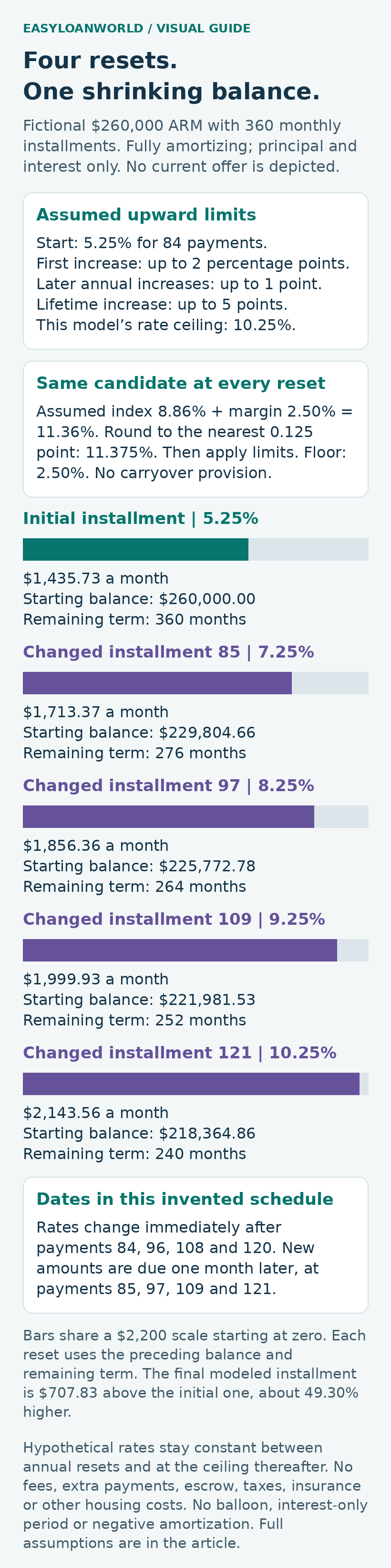
The following stress test is invented, not a current offer or forecast. It is not the Chase product mentioned above. Assume:
- Original principal of $260,000, repaid through 360 monthly installments.
- An initial annual rate of 5.25% for the first 84 payments, with full amortization throughout.
- New rates take effect immediately after payments 84, 96, 108 and 120. The new installment is due one month later, at payments 85, 97, 109 and 121.
- A first upward adjustment limit of 2 percentage points, later annual upward limits of 1 percentage point, and a lifetime upward limit of 5 percentage points. The lifetime ceiling is therefore 10.25%.
- A 2.50% floor and rounding to the nearest 0.125 percentage point before applying limits. No special carryover provision or other rate rule is assumed.
- At every reset, a hypothetical selected index observation of 8.86%, plus a 2.50-percentage-point margin. The raw sum is 11.36%; the rounded candidate is 11.375%.
Rate and payment are recalculated together here, with the rate held constant between resets. After reaching the ceiling, this upward-path illustration holds the rate there. Downward paths are outside the example; their limits would need separate testing.
The model uses monthly payments, the annual nominal rate divided by 12 and no intermediate rounding. It excludes fees, late or extra payments, irregular periods, balloons, interest-only periods and negative amortization. Escrow, taxes, insurance, assessments, HOA charges and maintenance are also excluded. Displayed amounts are approximate.
Apply the rate rules in order
At the first adjustment, compare three figures: the 11.375% rounded candidate, the initial 5.25% plus the permitted 2-point increase, and the 10.25% lifetime ceiling. The lowest is 7.25%. It also exceeds the 2.50% floor, so the floor does not change the result.
At the next annual reset, the previous rate is 7.25%. Adding the allowed 1 point gives 8.25%, still below both the candidate and lifetime ceiling. Repeating the same rule produces 9.25%, then 10.25%.
The candidate index-plus-margin figure stayed unchanged throughout. The modeled rate still climbed because successive permitted steps approached that high candidate. No separate carryover mechanism is assumed. This sequence follows only the fictional terms above.
Recalculate the balance and remaining months each time
The initial principal-and-interest payment is approximately $1,435.73. After 84 scheduled payments, approximately $229,804.66 remains. The first reset therefore starts with that balance and 276 payments left.
For a standard fully amortizing segment, calculate the payment using remaining principal multiplied by the monthly rate, divided by 1 minus the quantity “1 plus monthly rate” raised to the negative number of remaining payments. An amortization calculator can perform that exponent; the important inputs are the current balance, applicable rate and remaining term.
First changed installment: payment 85
Starting balance: $229,804.66. Remaining term: 276 months. Rate: 7.25%. Monthly principal and interest: about $1,713.37.
Second changed installment: payment 97
After another 12 payments, starting balance: $225,772.78. Remaining term: 264 months. Rate: 8.25%. Monthly principal and interest: about $1,856.36.
Third changed installment: payment 109
Starting balance: $221,981.53. Remaining term: 252 months. Rate: 9.25%. Monthly principal and interest: about $1,999.93.
Fourth changed installment: payment 121
Starting balance: $218,364.86. Remaining term: 240 months. Rate: 10.25%. Monthly principal and interest: about $2,143.56.
Every balance reflects the preceding payments at that segment’s rate. Reusing $260,000 would ignore repaid principal; restarting a 360-month term would extend the schedule. Multiplying rate by original principal and dividing by 12 would estimate interest only, not this amortizing installment.
Label each balance “after payment” with its payment number. For example, the balance after payment 96 is the starting balance for the payment-97 calculation. This avoids silently counting one installment twice.
Translate the ceiling into cash required
The fourth adjustment reaches this example’s ceiling. Principal and interest are then about $707.83 a month higher than initially, an increase of approximately 49.30%. The five-percentage-point lifetime rate limit plainly did not limit payment growth to 5%.
Suppose a fictional household has $2,400 available specifically for principal and interest after allowing for other housing costs, essentials, required debts and planned savings. Subtracting the modeled ceiling payment leaves approximately $256.44. That is arithmetic headroom, not a certification that the loan is manageable.
Reconcile your result before relying on it
Ask the lender for its highest-payment calculation and compare cap terms across offers. Two loans with identical starting rates can expose you to different later increases.
Keep a short evidence record with your calculated amount, the lender or servicer’s amount, and the difference. Investigate mismatches in this order:
- Was the same index observation and margin used?
- Were rounding, floors and the correct first or later limits applied?
- Do the balance date and remaining payment count match?
- Are both calculations describing the same installment due date?
Attach the relevant document page and written explanation to your private record; omit account numbers from anything public. Continue required contractual payments while resolving a discrepancy. A worksheet does not change the amount due. Before committing, resolve unexplained terms and any payment conflict in the household plan.
U.S. consumer education. Hypothetical standard-amortization example only. Research checked October 19, 2026.
Featured photo: Photo by Mark Owen Wilkinson Hughes on Unsplash. Used under the Unsplash license. Illustrative measuring tool; its markings do not represent mortgage rates. Photo by Mark Owen Wilkinson Hughes on Unsplash.

Limited 203(k) and HomeStyle: Three Renovation Projects
Compare three fictional renovation projects, then change one logistical detail and prepare a private project brief.
Mortgage Charge Questions: Choose the Record That Answers Them
Match a questionable mortgage charge to account detail, service records or adjustments with a worked property-inspection example and a two-part index.

Partial Mortgage Payment: Track Money Held in Suspense
Follow a fictional $1,100 and $700 mortgage payment trail, compare dated records, and build a precise question about an unexplained entry.