15-Year vs. 30-Year Mortgages: Compare Cost and Flexibility
Compare 15-year and 30-year fixed mortgages with the same balance and rate, then test actual quotes, a five-year horizon and the cash left each month.

Compare a 15-year and a 30-year mortgage in three passes: isolate the term mathematically, replace the assumptions with actual offers, and test how much cash the required payment leaves. A lifetime interest total cannot answer all three questions.
The CFPB explains that shorter terms generally bring higher monthly payments and lower interest costs. Offered rates can also differ. A 15-year rate is not guaranteed to be lower by any particular amount; compare written Loan Estimates.
This guide compares standard, fully amortizing fixed-rate mortgages. The 15- or 30-year label describes the repayment length; the fixed rate is an explicit assumption in this comparison.
First, hold the rate and borrowing amount constant
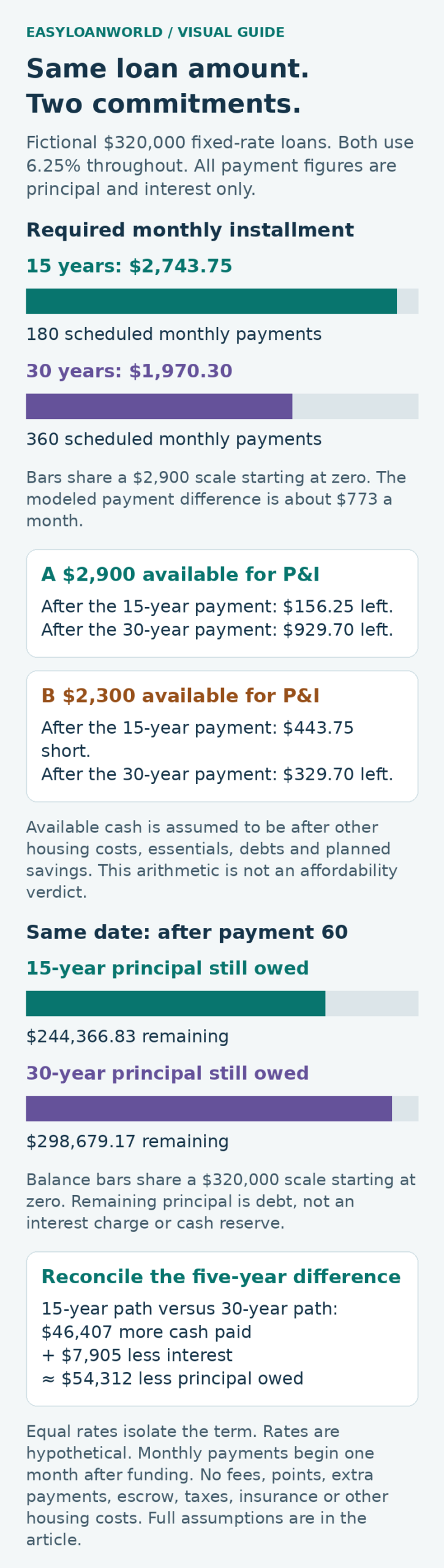
Suppose two fictional loans each start at $320,000 with a constant 6.25% annual rate. One has 180 monthly payments, the other 360. Using the same rate makes the effect of the repayment term visible. These are educational inputs, not current quotes.
The first payment is one month after funding. Calculations use the annual nominal rate divided by 12 and unrounded payments internally. Amounts below are approximate. There are no extra or missed payments, fees, points, financed closing costs or irregular first periods. Mortgage insurance, escrow, taxes, homeowners insurance, HOA charges and maintenance are excluded.
Neither fictional loan has an interest-only period, balloon, adjustable rate, buydown or negative amortization. Every installment shown is principal and interest only.
15-year schedule at the fictional 6.25% rate
- Required monthly principal and interest: about $2,743.75.
- Interest across all 180 scheduled payments: about $173,875.57.
- Total principal and interest paid: about $493,875.57.
30-year schedule at the same fictional rate
- Required monthly principal and interest: about $1,970.30.
- Interest across all 360 scheduled payments: about $389,306.21.
- Total principal and interest paid: about $709,306.21.
The shorter schedule requires approximately $773 more per month. Its full-term interest is approximately $215,430.64 lower if both loans follow their entire stated schedules.
That difference is conditional future interest, not cash available today or an all-in ownership saving. The calculation assumes neither rising income nor property appreciation. Even after this modeled mortgage is paid off, the excluded property expenses remain outside the calculation, as would any separate debt secured on the home.
Then compare the same date, not just the two endpoints
If your planning horizon is five years, inspect both loans immediately after payment 60. Comparing one loan’s 15-year total with the other’s five-year cost would answer a different question.
15-year loan after 60 payments
- Principal and interest paid: about $164,625.19.
- Interest included in those payments: about $88,992.02.
- Principal repaid: about $75,633.17.
- Principal still owed: about $244,366.83.
30-year loan after 60 payments
- Principal and interest paid: about $118,217.70.
- Interest included in those payments: about $96,896.88.
- Principal repaid: about $21,320.83.
- Principal still owed: about $298,679.17.
By this common date, the 15-year borrower has committed about $46,407 more cash and owes about $54,312 less principal. Approximately $7,905 of that balance advantage comes from lower modeled interest.
These figures should reconcile, not be added as three benefits: extra cash paid plus interest avoided equals the balance difference under these assumptions. More principal repayment also means more money has left the household’s available cash.
The remaining principal is still debt, not a borrowing fee. It also is not a dated payoff quote. This example does not calculate sale proceeds, property value, transaction charges or the amount needed to complete an actual payoff. If you later sell, refinance or prepay, evaluate the actual obligations and costs at that date.
Replace the control with your written offers
Keep the equal-rate example as an explanation, then start a new comparison using the amount actually financed, fixed rate, term and required payment from each offer. Record upfront costs separately from financed costs. If borrowing amounts differ, explain why and recalculate rather than attributing the entire payment gap to the term.
Label the comparison date and retain the supporting offer. Ask for the projected principal, interest and balance at the same horizon for each alternative. You can then see how much of a difference comes from the repayment period, the rate or additional borrowing.
Do not carry the example’s $773 monthly gap into an actual application. It belongs only to the stated equal-balance, equal-rate model.
Test the cash left in a difficult month
Chase’s term comparison highlights the pressure of a higher required payment and the flexibility of a lower one. Whether that flexibility helps depends on what the household actually does with the available cash.
For illustration, suppose $2,900 a month is available specifically for mortgage principal and interest after other housing costs, essentials, required debts, planned savings and irregular-expense provisions:
- After the 15-year installment, about $156.25 remains.
- After the 30-year installment, about $929.70 remains.
Now reduce that available amount by a fictional $600, to $2,300. The 15-year allocation is approximately $443.75 short; the 30-year allocation leaves approximately $329.70. This is one stress input, not a prediction of default or a verdict that either loan is affordable.
Record what expense or cash resource would absorb that change. Count escrowed expenses once. Keep liquid money separate from principal already repaid: a lower mortgage balance is not a cash account you can simply withdraw from. Do not assume access to new borrowing to repair the gap.
Keep optional extra principal separate from the minimum
Check the contract before planning early repayment. The CFPB explains that a prepayment penalty can apply to an early payoff or some large principal payments. Small extra-principal payments usually do not trigger it, but confirm the applicable terms.
In this same-rate, same-balance, no-fee model, paying the 30-year loan a total equal to the 15-year installment on each of the same 180 dates produces the same mathematical balance path, provided the excess is applied to principal. That means roughly $773 extra each month in this illustration.
Different rates, delayed or skipped extras, charges or different payment application break that exact equivalence. Ask how to designate extra principal and verify its treatment on the statement. The voluntary target remains separate from the contractual minimum; reducing extras changes the payoff result, and an extra payment does not authorize skipping a later required installment.
Write down the commitment you can sustain
Complete a private decision record with four entries:
- Offer: Amount, fixed rate, term, required payment, charges and supporting document date.
- Horizon: Cash paid, interest incurred and remaining debt at one common comparison date.
- Capacity: Liquid cash after closing, the difficult-month result and any optional principal target.
- Decision: The required commitment you can sustain, outstanding questions and written answers.
“Neither payment works yet” is a useful conclusion. Keep that separate from choosing how aggressively to repay a loan whose required payment already fits.
U.S. consumer education. Fictional fixed-rate examples; all figures are principal-and-interest only unless otherwise stated. Research checked October 19, 2026.
Featured photo: Photo by Maddi Bazzocco on Unsplash. Used under the Unsplash license. Illustrative calendar still life; no actual loan schedule is shown. Photo by Maddi Bazzocco on Unsplash.

Limited 203(k) and HomeStyle: Three Renovation Projects
Compare three fictional renovation projects, then change one logistical detail and prepare a private project brief.
Mortgage Charge Questions: Choose the Record That Answers Them
Match a questionable mortgage charge to account detail, service records or adjustments with a worked property-inspection example and a two-part index.

Partial Mortgage Payment: Track Money Held in Suspense
Follow a fictional $1,100 and $700 mortgage payment trail, compare dated records, and build a precise question about an unexplained entry.