Cash-Out Refinance: Calculate Your Net Proceeds
Follow a fictional $320,000 mortgage through a five-step allocation, identify a funding gap and check the change in home equity.

A proposed $320,000 cash-out mortgage does not put $320,000 in your bank account. The useful question is how much remains after every required payment, and whether that remainder covers the job you need it to do.
A cash-out refinance replaces an existing mortgage with a larger one. The Consumer Financial Protection Bureau explains that closing costs can apply. Your repayment obligation is the full replacement mortgage, even when the cash you receive is much smaller.
Keep the collateral risk in view: the CFPB warns that using mortgage debt to repay non-mortgage debt can increase foreclosure risk. Missed mortgage payments can put your home at risk.
Start with the payoff and a complete allocation
Use a payoff quote for the intended payoff date, rather than copying principal from a monthly statement. The CFPB’s payoff explanation notes that interest through that date, unpaid charges and a possible prepayment penalty can affect the amount needed to settle the mortgage.
Then identify where the proceeds go. Bank of America’s explanation describes mortgage payoffs, closing costs and prepaid items being covered before the remaining money reaches the borrower. Ask your closing professional to identify each use on your transaction’s paperwork.
Keep financing charges, prepaid expenses, escrow funding and other debt payments separate. They can all reduce immediate cash, but they serve different purposes. If another lien or required creditor payment exists, document how it will be handled. An absent figure is unconfirmed, not zero.
Worked example: trace $320,000 to $48,000
These fictional amounts demonstrate allocation only. They are not a loan quote or an eligibility standard. Assume one existing mortgage, no second lien, no borrower cash contribution, no credits, no holdback and no costs paid separately beforehand. All listed uses come from the approved new loan in this example.
The old statement shows $250,000 of principal. The dated payoff is $251,200, including an assumed $1,200 of accrued interest and other payoff amounts. That $1,200 is an input, not a calculated rate or an assumed penalty.
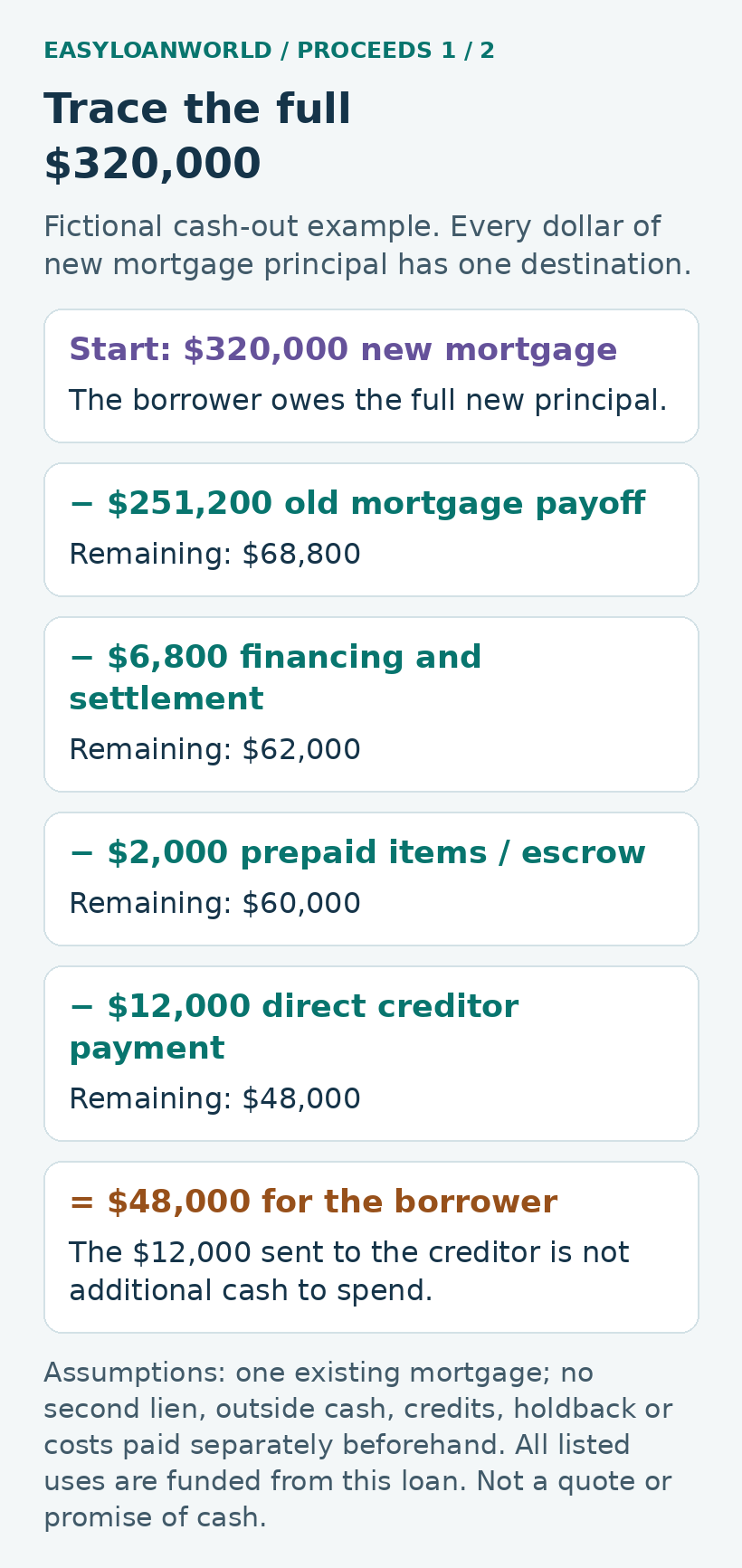
- Start with new mortgage principal: $320,000.
- Pay off the old mortgage: $251,200. The remaining proceeds are $68,800.
- Pay financing and settlement charges: $6,800. The remaining proceeds are $62,000.
- Fund prepaid items and initial escrow: $2,000. The remaining proceeds are $60,000.
- Make a separately authorized direct creditor payment: $12,000. The cash left for the borrower is $48,000.
The allocation balances: $251,200 + $6,800 + $2,000 + $12,000 + $48,000 = $320,000. Every dollar has one destination.
The $12,000 creditor payment retires debt under the example’s assumptions. It is not another $12,000 available to spend alongside the $48,000 deposit. The example does not calculate that creditor account’s interest or assume the account closes automatically.
Find the $22,000 difference
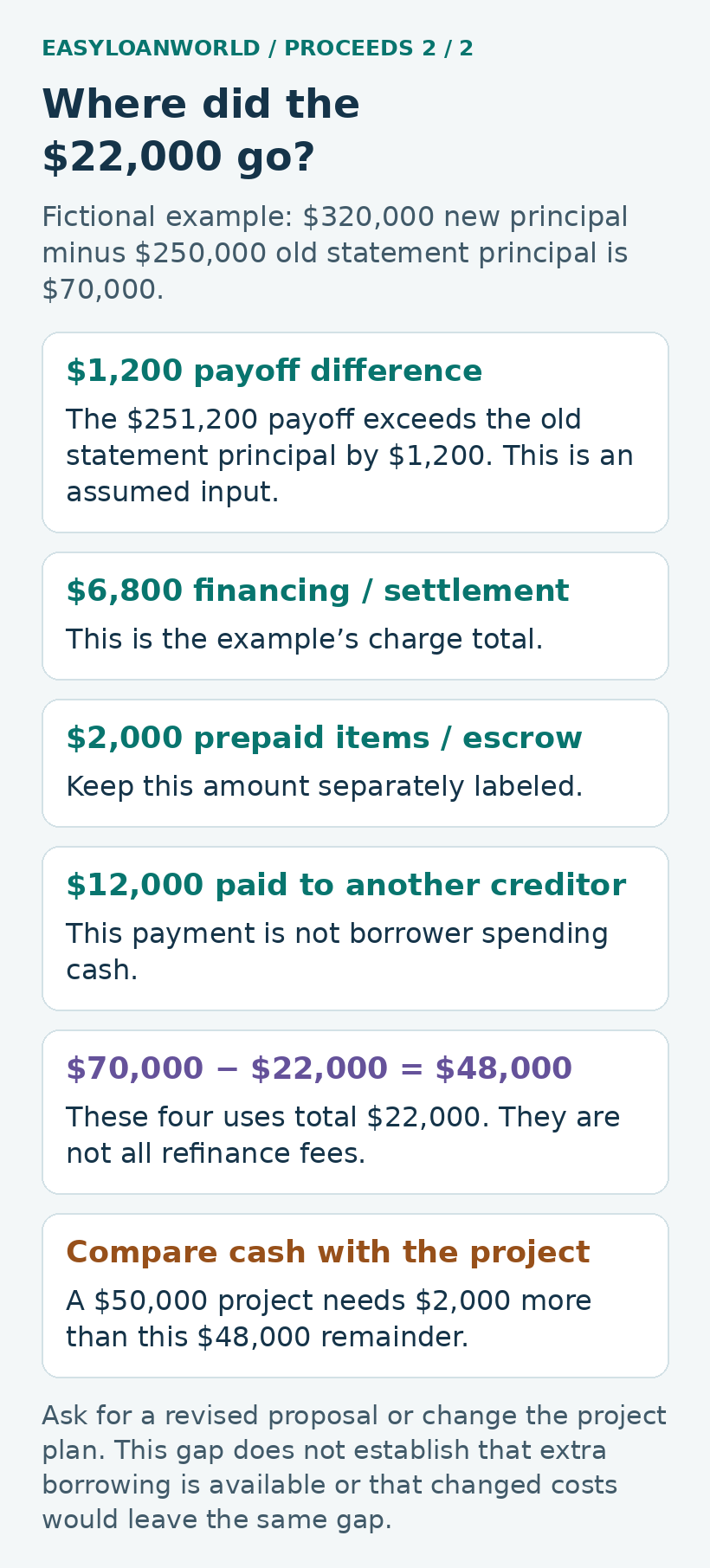
Subtracting the old statement principal from the new mortgage gives $320,000 − $250,000 = $70,000. Treating that as available cash overstates this example’s proceeds by $22,000:
- $1,200: difference between statement principal and the quoted payoff
- $6,800: financing and settlement charges
- $2,000: prepaid items and escrow funding
- $12,000: direct payment to the other creditor
These entries total $22,000, but calling all of them “refinance fees” would obscure what happened. The financing and settlement charge total in this example is $6,800; the other amounts need their own labels.
If the borrower needs $50,000 for a project after that debt payment, the $48,000 remainder leaves a $2,000 gap. Request a revised written proposal or change the project plan. This does not establish that another $2,000 of borrowing is available, or that changed loan costs would leave the same gap.
Cross-check the change in home equity
Assume the property value stays at a fictional $420,000 and there are no other liens. A simple value-minus-mortgage-principal calculation gives:
- Before: $420,000 − $250,000 = $170,000 of home equity
- After: $420,000 − $320,000 = $100,000 of home equity
- Change: principal debt rises by $70,000 and this home-equity measure falls by $70,000
The $48,000 cash receipt is smaller than that $70,000 change because $22,000 went to the listed uses. This is not a household net-worth calculation. It leaves out the separately retired debt, escrow assets, cash retained and other assets, liabilities and taxes. It also does not establish how much a lender will allow you to borrow.
Build a private proceeds record
Keep the record with your own documents. You do not need to send account statements to EasyLoanWorld. Give each amount a document reference and a status so an estimate cannot silently become a confirmed figure.
1. Identify the proposal
Record the lender, version date, new principal, proposed payoff and funding dates, rate type, term, payment and unresolved conditions. Keep superseded versions separate.
2. Record existing borrowing
Pair the statement principal and date with the payoff amount and good-through date. Ask which pending payments or unclear charges the quote assumes.
3. List every source and use once
For each amount, record its label, payee, payer, timing and document location. Note whether it comes out of proceeds or is paid separately. Record credits and outside cash only when included in the current proposal; check whether a credit is already netted against a cost.
4. Reconcile the remainder
Subtract all documented uses from all documented sources. Compare the result with the amount needed. Mark missing amounts unconfirmed and ask the closing professional to explain any mismatch.
Confirm what arrives and when
Ask for the final amount, expected disbursement and availability dates, and remaining conditions before committing the proceeds. Keep an anticipated old escrow refund separate until its amount, timing and treatment are confirmed; do not count the same money twice.
A date change can affect the reconciliation. If the example’s final payoff rises by an assumed $450 while every other entry and the approved new principal stay fixed, available cash falls to $47,550. This is a simple sensitivity check, not a daily-interest estimate or a promise that a delay has no other consequences.
After funding, compare the receipt and creditor-payment confirmations with the final allocation. Separately review the new rate, term, payment and total cost before choosing the loan. A proposal can deliver enough cash while still being unsuitable for your budget or plans.
U.S. educational information. Examples are fictional; individual loan terms and transaction details require verification.
Featured photo: Photo by Steven Ungermann on Unsplash. Used under the Unsplash license. Illustrative residential setting. Photo by Steven Ungermann on Unsplash.

Limited 203(k) and HomeStyle: Three Renovation Projects
Compare three fictional renovation projects, then change one logistical detail and prepare a private project brief.
Mortgage Charge Questions: Choose the Record That Answers Them
Match a questionable mortgage charge to account detail, service records or adjustments with a worked property-inspection example and a two-part index.

Partial Mortgage Payment: Track Money Held in Suspense
Follow a fictional $1,100 and $700 mortgage payment trail, compare dated records, and build a precise question about an unexplained entry.