Private Student Loan Co-Signer Release Checklist
Check your private student loan's release policy, qualifying payment record and required evidence, then verify the written decision for each loan.

A private student loan co-signer release file should distinguish three stages: evidence that a requirement may be met, a complete request under review, and a written release with an effective date. Reaching a payment milestone does not establish all three.
The CFPB explains that release is available for some private loans, subject to the lender’s or servicer’s specific criteria. Start with the terms for your actual loan; there is no single payment-count rule to apply across providers.
The practical goal is a traceable request and a decision whose scope you can verify. Do not substitute a family understanding, changed account access or a removed payment instruction for lender confirmation.
Why the exact product and policy matter
These selected examples were checked October 19, 2026. They illustrate differences, not a ranking or complete eligibility test. Follow each provider’s full current instructions for the loan involved.
Sallie Mae’s release policy includes graduation or certificate completion, income and credit review, and twelve qualifying on-time principal-and-interest payments or qualifying prepayment. In-school, separation and grace-period interest-only or fixed payments do not count. Account-standing and recent-hardship restrictions also apply. Parent Loans originated after May 2026 are excluded. Meeting a payment condition alone is insufficient; requirements may change.
College Ave’s detailed release page requires half the original repayment term to have elapsed, alongside income, residency and credit criteria. Its example is five years of principal-and-interest payments for a ten-year term. Only the primary borrower may submit its request; a request submitted by the co-signer is declined.
Do not use either example to decide that another loan qualifies. If payments are becoming unaffordable, ask about available assistance and its consequences. Do not skip needed help or make an unsustainable payment to pursue a possible later release.
Build six small records
Keep sensitive documents privately and use the lender-approved secure channel for submissions. Do not upload personal records to EasyLoanWorld. In a shared planning sheet, use private file references rather than full account identifiers.
1. Loan map
Give each loan a separate card with its lender or servicer, product, origination date, borrower and co-signer roles, repayment stage, and agreement reference. If you have several yearly loans, avoid collapsing them into one unlabeled account total. Ask which loans a combined request would cover.
2. Policy copy
Save the contractual release provision and current policy or application, including the date checked. Ask about any apparent inconsistency.
Keep the original version alongside a replacement. Otherwise, a later review can leave you unsure which wording you relied on. A website summary is a starting reference, not a personalized decision.
3. Payment reconciliation
Separate interest-only, fixed and principal-and-interest periods. Record each scheduled amount, due date, credited date, returned-payment status and confirmed qualifying classification.
Keep a statement or transaction reference for each entry. Mark disputed classifications unresolved instead of counting them optimistically. An amount leaving a bank account and a payment being credited correctly are different facts to verify.
4. Requirement evidence
List the current form’s requested completion and income evidence, required recency, items supplied and remaining questions.
This is not a universal document list. Use a simple evidence status such as located, submitted or acknowledged. A document in your folder has not necessarily reached the reviewer.
5. Submission trail
Verify who must request release, required signatures and the accepted submission method before sending anything.
Save the receipt, reference number, acknowledged missing items and any follow-up date supplied by the lender. Do not call the file complete solely because an upload finished; look for the lender’s confirmation of what remains needed.
6. Decision record
Identify the loans covered, the stated outcome, reasons or missing evidence, and any next steps. If approved, retain the written release’s effective terms and date for both borrower and co-signer. Keep “received a response” separate from “verified an effective release.”
Worked example: sixteen months do not mean sixteen qualifying payments
Consider an invented policy requiring twelve qualifying on-time principal-and-interest payments, plus separate credit and other requirements. This is not a Sallie Mae or College Ave eligibility calculation.
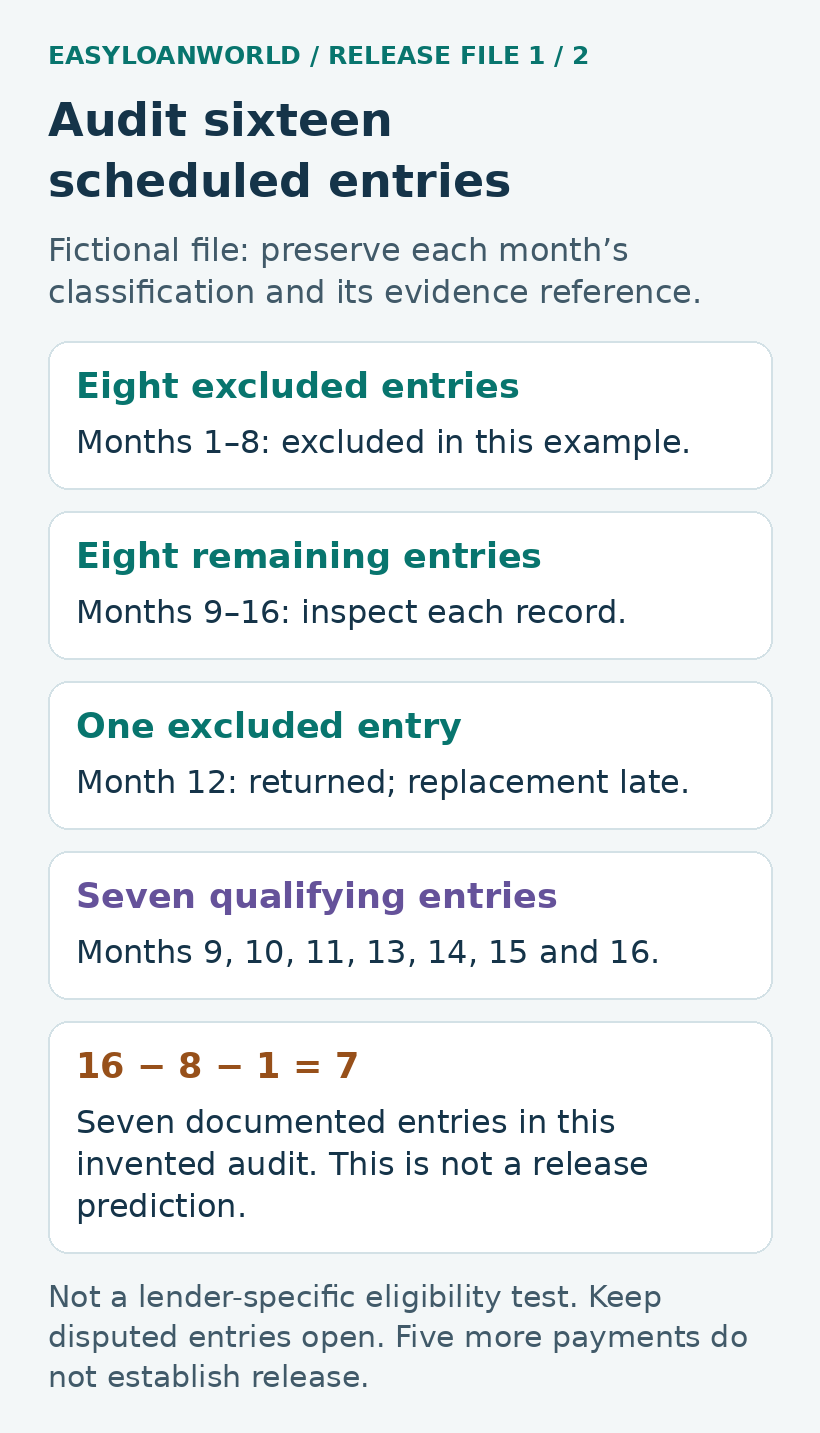
The borrower’s file contains sixteen scheduled payment months:
- The first eight were in-school interest-only months, excluded by this fictional policy.
- The next eight required principal-and-interest payments.
- One of those payments was returned; its replacement arrived after the due date and does not qualify under the invented rule.
- Seven entries are documented as qualifying: 16 − 8 − 1 = 7.
The file therefore supports seven qualifying entries, not sixteen. That does not mean five more payments will secure release. The actual policy may treat sequence, account standing and other conditions differently; the lender still must review the request.
If the returned payment’s classification is disputed, retain its original and replacement references and ask for an account-level explanation. Do not overwrite the history with a single check mark.
Follow the decision through to the named loans
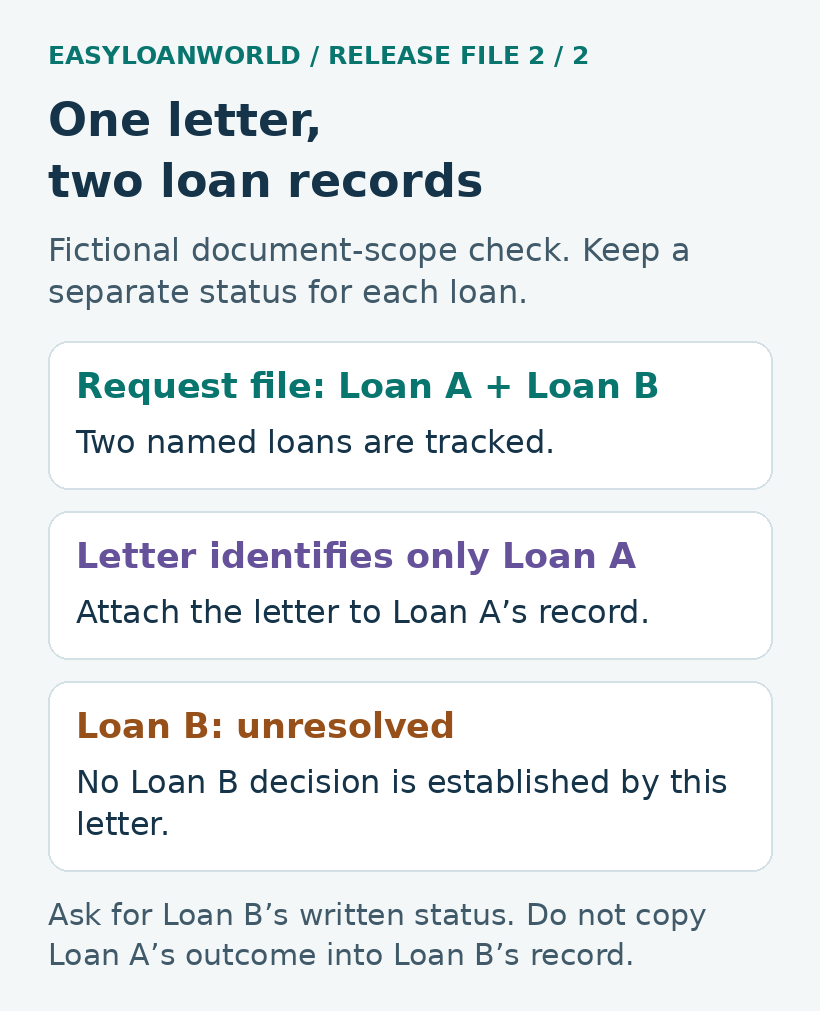
Suppose an approval letter explicitly identifies Loan A, but Loan B is absent. Save A’s letter and ask for B’s written status. Do not mark both loans released because they appear in the same account.
The CFPB’s 2014 sample requests offer an older, useful approach to unclear outcomes: ask which policy was applied, the reason for the result and what evidence or next step is needed. They are not current lender application instructions.
Do not assume a particular reconsideration right or response deadline. If the record or contract interpretation remains disputed, seek qualified advice rather than treating this worksheet as a legal demand.
Sallie Mae’s application also confirms that releasing a co-signer does not remove the borrower’s repayment obligation.
Check your own written terms. This record does not forecast a new interest rate, credit-score change or removal of accurate past reporting. Its endpoint is narrower: documented status for each requested loan, with unresolved questions still visible.
Featured photo: A quiet library study space. Photo: Austin / Unsplash. Used under the Unsplash license.

Before You Compare 401(k) Access: Three Document Checks
Use three situation-specific cards to organize documents and prepare questions before comparing 401(k) access.
College Withdrawal Bill: Reconcile the School Account
Use three school records and a fictional $1,340 example to trace each adjustment, check a changed balance and organize questions for the right office.

Student Aid Credit Balance: Separate the School Ledger From Spendable Cash
Use two fictional aid snapshots and a private payment record to organize the amounts, permissions and dates behind a college-account credit.