College Withdrawal Bill: Reconcile the School Account
Use three school records and a fictional $1,340 example to trace each adjustment, check a changed balance and organize questions for the right office.

Estimated reading time: 8 minutes
A college withdrawal bill can rise even when the school reduces its charges. In the fictional example below, a $700 charge reduction is outweighed by $1,440 of aid returned by the school. The account moves from $600 to $1,340: $600 − $700 + $1,440. This is a supplied teaching case, not a determination of your bill.
An unexpected college withdrawal bill is easier to investigate when each amount has a document behind it. Gather the school’s charge-adjustment decision, its aid worksheet and a dated, itemized account statement. Your goal is one checked account snapshot, plus a short list of unresolved entries.
| Record | What it explains in this example | Question for the school |
|---|---|---|
| Charge-adjustment decision | Why charges were reduced by $700. | Which policy decision and charge items does the adjustment cover? |
| Aid-return worksheet | Why the school’s calculated aid return is $1,440. | Which worksheet version and school-confirmed inputs apply? |
| Dated account statement | Which changes were actually posted and how the balance became $1,340. | Which entries connect the earlier and later balances? |
Don’t start by adding every number shown on the three documents. A worksheet result and the account entry implementing it can describe the same event. First identify which document explains a decision and which shows that the change was posted.
School refunds and aid-return calculations are separate. In this nonexempt example, the charge reduction doesn’t replace the original charge input. Handbook, Volume 5, Chapters 1 and 2, Part 2
Ask whether this worksheet fits your situation
- Has financial aid confirmed that a return calculation is required and that no withdrawal exemption applies?
- Does your actual program, funding mix and disbursement history match the narrow premises above?
- Are you comparing the school’s current worksheet with a dated statement that confirms the modeled adjustments were posted?
If any answer is unknown or differs, use the three-record organizer to ask questions. Don’t substitute your figures into this example as though it determines the school’s required calculation.
College withdrawal bill: match inputs before results
Give each document a version or date reference. The following letters keep unlike amounts separate; use the school’s own labels when making your private copy.
| Reference | Description | Value |
|---|---|---|
| C | Applicable original charges | $3,000 |
| A | Aid already disbursed | $2,400 |
| Q | Additional includible aid | $0 |
| N | School-confirmed completed days | 40 |
| D | School-confirmed denominator days | 100 |
| J | Posted charge reduction | $700 |
For this bounded case, the completion fraction determines earned aid; the school returns the smaller of unearned aid and the charge-based comparison. 34 CFR 668.22(e)–(h)
| Reference | Description | Calculation |
|---|---|---|
| f | Completion fraction | 40 ÷ 100 = 0.40 |
| E | Earned aid | $2,400 × 0.40 = $960 |
| U | Unearned aid | $2,400 − $960 = $1,440 |
| T | Charge-based comparison | $3,000 × 0.60 = $1,800 |
| R | School return | min($1,440, $1,800) = $1,440 |
| S | Initial student share | $1,440 − $1,440 = $0 |
S is zero; that doesn’t make the school-account balance zero. The next step checks the account itself. A worksheet number alone isn’t evidence of posting.
Rebuild the $1,340 account balance
Start with the complete set of signed entries. Positive entries increase the modeled balance; negative entries reduce it:
$3,000 − $2,400 − $700 + $1,440 = $1,340
Or use the matching earlier snapshot, then include only subsequent entries:
The earlier balance is B0 = $3,000 − $2,400 = $600. The closing account balance is B1 = $600 − $700 + $1,440 = $1,340.
A second cross-check groups the remaining amounts: revised charges C1 = $3,000 − $700 = $2,300; aid remaining on the account A1 = $2,400 − $1,440 = $960. Therefore, C1 − A1 = $1,340.
For each adjustment, match its reference to the decision or worksheet and to one statement entry. If your chosen snapshot already includes an entry, don’t add it again. Adding $1,440 to this closing snapshot would produce $2,780, an overcount of $1,440.
The $700 reduces recorded charges. It isn’t money received by the student. B1 describes this fictional account only; it establishes no actual obligation, payment deadline or later award entitlement.
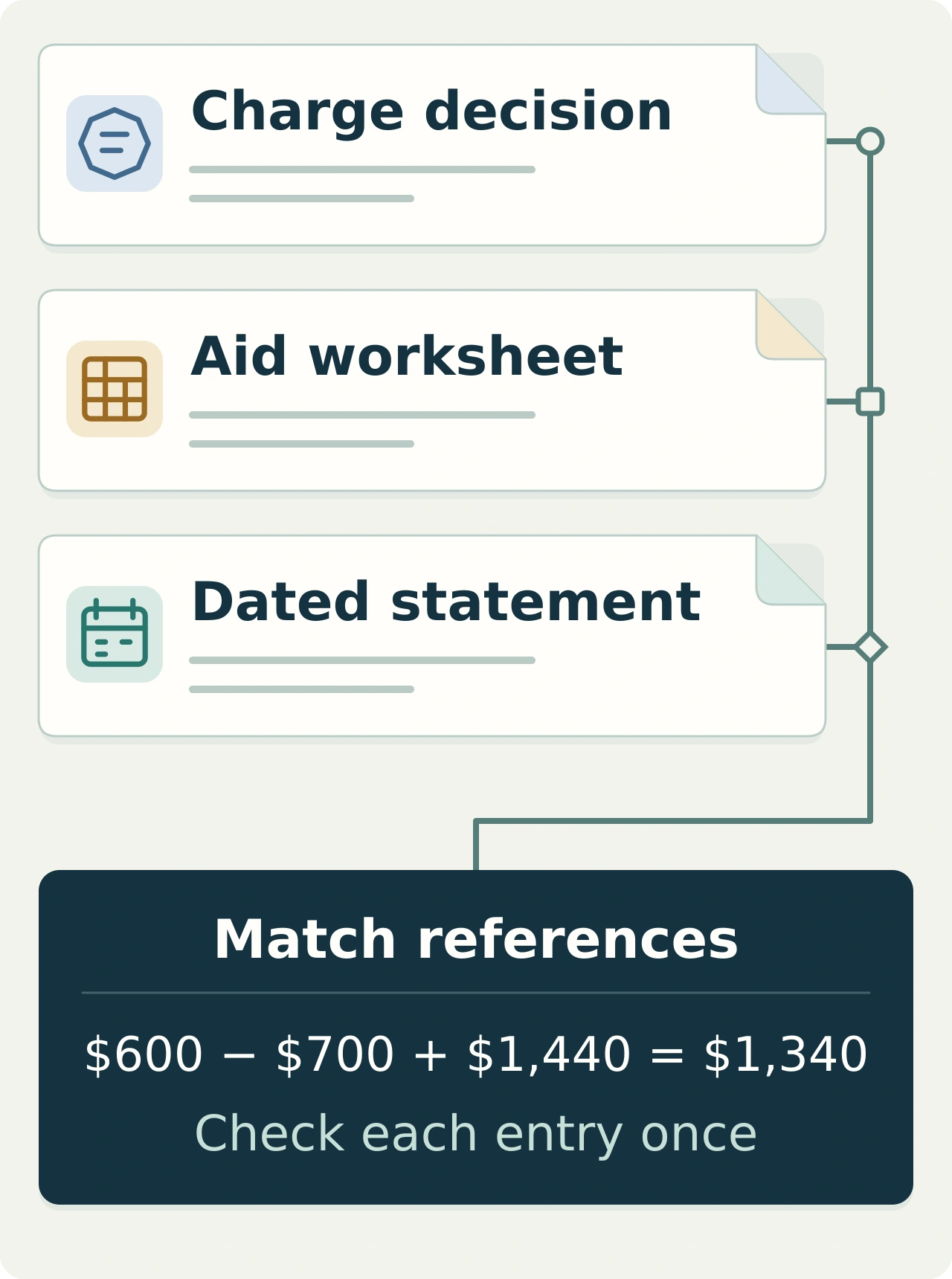
Match the decision and worksheet references to the statement entries. The fictional account bridge is $600 − $700 + $1,440 = $1,340.
What if C1 wrongly replaces C here?
Comparison: $2,300 × 0.60 = $1,380; min($1,440, $1,380) = $1,380. Account: $600 − $700 + $1,380 = $1,280.
That is $60 below the checked example. The difference flags an input to investigate; it doesn’t independently determine who must pay $60. Ask which document and version supplied the disputed figure before assuming a school error.
College withdrawal bill: compare an intermediate posting snapshot
The original example assumes every modeled adjustment is already posted. A separate timing variation can show why an earlier statement differs without changing the worksheet’s confirmed result. Keep the same $600 starting balance, $700 charge reduction and $1,440 school aid return, but examine the account between the two adjustments.
If the $700 reduction posts first and the $1,440 return hasn’t yet posted, that limited intermediate account reads minus $100: $600 minus $700. When the $1,440 entry is subsequently applied, the account becomes $1,340. These are two snapshots of the same sequence, not two balances to add together.
The intermediate negative amount doesn’t establish that $100 was paid to the student, that it’s spendable cash or that a particular refund is legally due. This variation supplies only account entries. Ask the school about the confirmed pending action and the current account status instead of treating a temporary screen balance as a disbursement decision.
Record an as-of date beside each view. Then list which adjustment is already included and which is still unconfirmed at that point. A worksheet showing a calculated return explains an amount; it doesn’t establish that the corresponding statement entry has been posted. Conversely, once the $1,440 is included in a closing snapshot, adding the worksheet result again would duplicate it.
Use a focused question for the student-accounts office: “This dated view includes the $700 reduction. Does it also include the school-confirmed $1,440 return, and which transaction references connect it to the later balance?” Ask financial aid to identify the matching worksheet version if its amount or inputs differ.
Keep the charge-policy decision, aid calculation and posting record in their separate roles. A charge reduction doesn’t substitute for the return calculation, and an apparent posting gap doesn’t independently establish a calculation error. Identify the missing fact before choosing which office needs to answer.
For a real college withdrawal bill, confirm the current amount, due date and payment instructions with the school while resolving the record question. Don’t reuse this intermediate example for a different funding mix, exemption or withdrawal situation. It demonstrates how to reconcile a sequence, not how to determine a student’s actual aid return, eligibility or legal obligation.
Keep one private reconciliation record
Use a shorthand case label and term. For each document, record its date, amount, status, related entry reference and one unresolved question. Keep this on your own device or paper; don’t submit student IDs, account numbers, tax records or credentials to EasyLoanWorld.
- Charge decision: identify the original charge group, the decision, the posted adjustment, the revised group and any unexplained items.
- Aid worksheet: record the version, input references, result and the school’s confirmation of action taken. Match that action to the statement.
- Account statement: record the earlier dated balance, subsequent signed entries, closing dated balance and any unreconciled difference. Mark missing posting evidence “unconfirmed”; don’t invent a date.
Record withdrawal and school determination dates separately. Handbook, Volume 5, Chapter 2, Part 1
Also keep the worksheet date and statement posting dates as distinct fields. Leave an unknown date blank.
Take the remaining questions to the right office
Ask the charge-policy office which items remain and which decision explains them. Ask financial aid which worksheet version matches your statement and which inputs it used. Ask the student-accounts office which entries connect the two dated balances, and what balance, payment instructions and due date the school currently confirms.
Use the answers to finish the record, rather than treating the illustration as advice to withdraw, borrow or delay payment. If your separate question concerns a positive account credit, see the student-aid credit-balance guide. Its scope is different from this withdrawal example.
Official source checks updated October 25, 2026. This educational example doesn’t determine individual eligibility or legal rights.
Related reading
For a related question, read Student Aid Credit Balance: Separate the School Ledger From Spendable Cash and College Aid Offers: A Two-Packet Practice Exercise.

Parent Pays Student Loan Interest: Who Deducts?
Separate payment and obligation.

Returned Loan Debit: Two Fees?
Trace the payment and fees.

Rehabilitation Payment Too High?
Check an alternative request.