Reverse Mortgage Responsibilities: Build a HECM Property-Cost Plan
Organize property bills, payment responsibilities and unanswered questions before evaluating a HECM proposal. Includes a fictional planning example.

This guide concerns Home Equity Conversion Mortgages, or HECMs. Borrowers do not make regular monthly mortgage repayments, but interest and fees add to the loan balance. That repayment structure does not eliminate property expenses. See the CFPB’s HECM overview.
The worksheet below is an original organizing method for a U.S. household. It is not an eligibility assessment, loan recommendation or substitute for individual financial or legal advice.
Match the record to the HECM arrangement
HECM borrowers must pay property charges such as taxes and homeowners insurance on time, maintain the home and use it as their principal residence. Failing these requirements can lead to foreclosure. Payment arrangements can involve direct payment, servicer payment or reserved loan funds; some arrangements provide money for the homeowner to pay. Confirm your specific arrangement with the lender or servicer. The CFPB explains these responsibilities.
For property taxes and homeowners insurance, a fully funded reserve pays bills directly; partial funding sends you money to pay. Check your statement or ask the servicer about set-asides.
A fictional property-cost worksheet
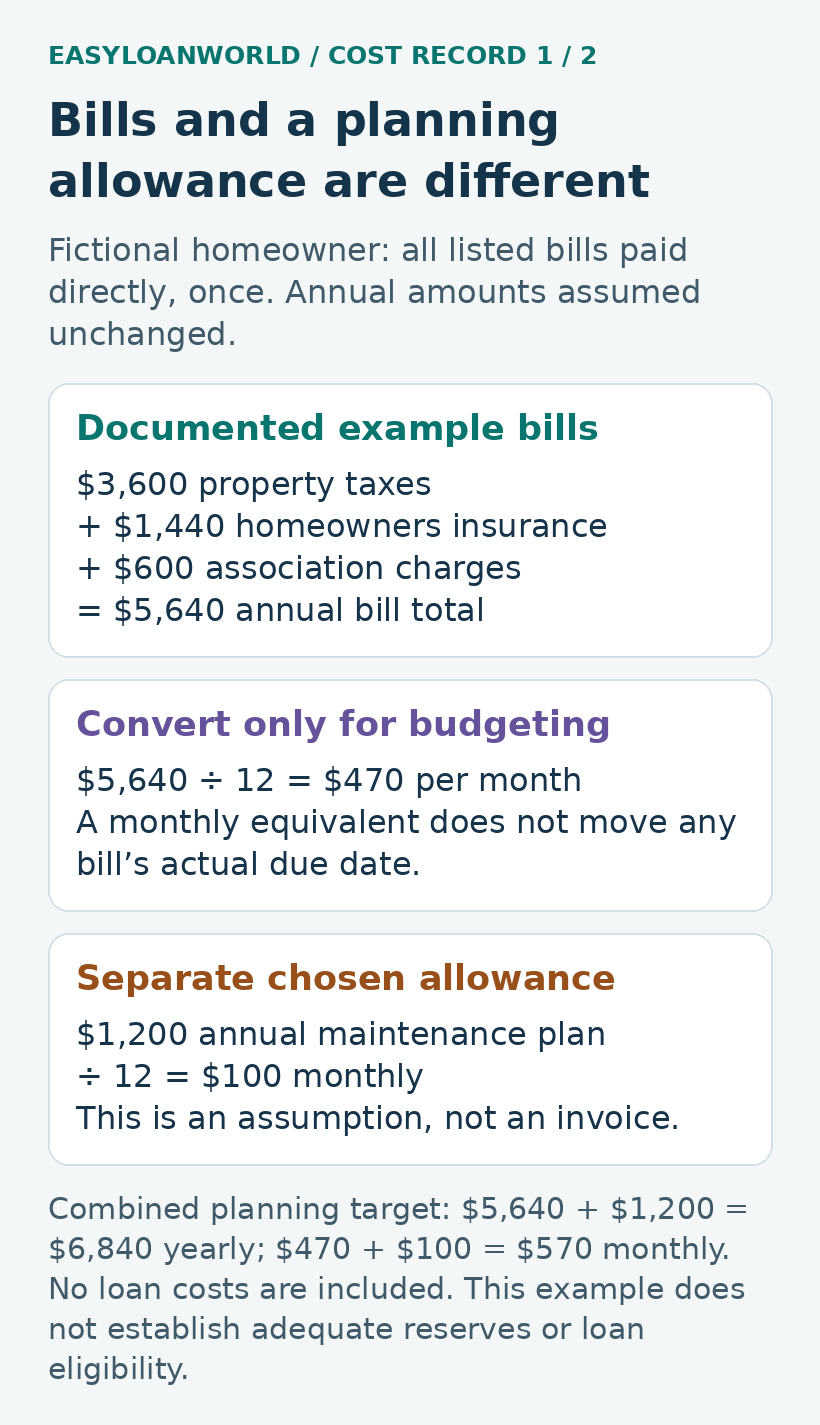
Assume a fictional homeowner pays all these costs directly. None is paid again through a servicer arrangement. Annual property taxes are $3,600, homeowners insurance is $1,440 and association charges are $600. All three amounts are assumed unchanged for this example.
The actual-bill total is $5,640 a year: $3,600 + $1,440 + $600. Dividing by 12 gives a monthly budgeting equivalent of $470. That conversion helps compare annual figures with a monthly household budget; it does not change any bill’s due date.
The homeowner also chooses a $1,200 annual maintenance planning allowance. This is a discretionary assumption, not an actual invoice, required payment or prediction of repair costs. It adds $100 per month to the planning figure, producing a combined target of $6,840 a year, or $570 per month.
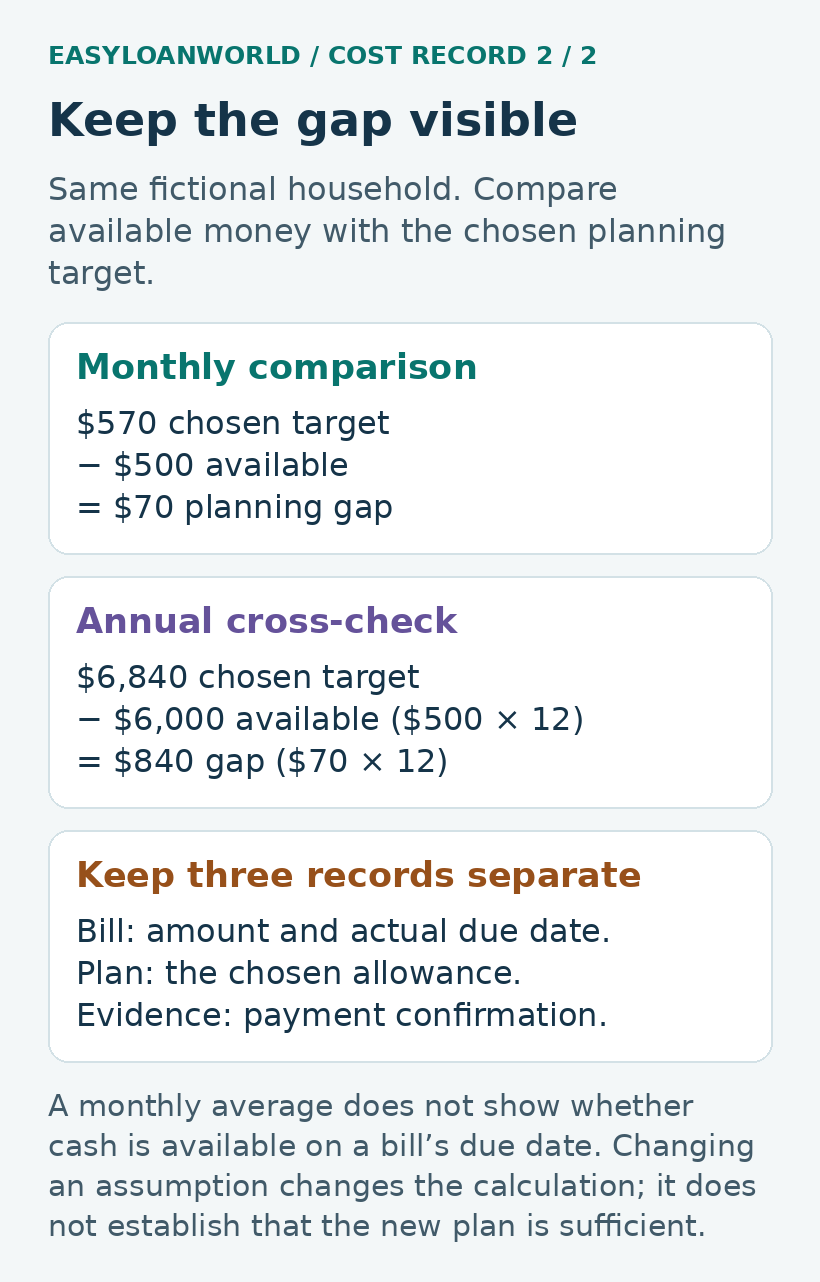
Suppose the household has $500 per month available after its other outgoings. Against the chosen $570 target, the gap is $70 monthly, or $840 annually. Record that gap openly. Calling the allowance “optional” does not establish that a smaller allowance would meet the household’s needs.
This arithmetic establishes neither loan eligibility nor adequate reserves. It omits loan costs and says nothing about what a particular home will need. The homeowner must also check whether money will be available on the actual bill dates. A monthly average alone cannot answer that question.
Turn unknowns into a counseling agenda
HECM borrowers must receive counseling from a HUD-approved reverse-mortgage counseling agency. You can consult a counselor while considering the loan. Discuss household occupants, possible future moves and alternatives, as well as the proposal itself. The CFPB’s counseling preparation page offers a starting point.
Featured photo: A house exterior with a porch and lawn. Photo: Ronnie George / Unsplash. Used under the Unsplash license.

Limited 203(k) and HomeStyle: Three Renovation Projects
Compare three fictional renovation projects, then change one logistical detail and prepare a private project brief.
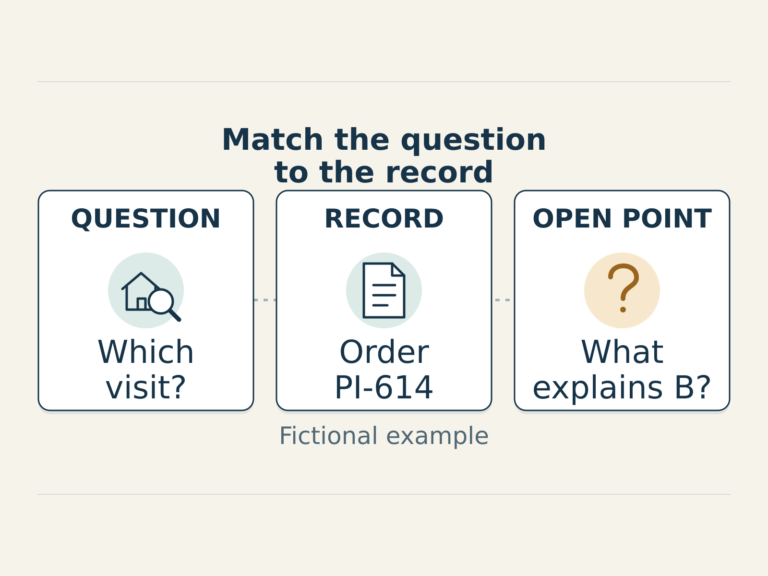
Mortgage Charge Questions: Choose the Record That Answers Them
Match a questionable mortgage charge to account detail, service records or adjustments with a worked property-inspection example and a two-part index.

Partial Mortgage Payment: Track Money Held in Suspense
Follow a fictional $1,100 and $700 mortgage payment trail, compare dated records, and build a precise question about an unexplained entry.