Mortgage Servicer Changed: Check Payment Routing and Records
Build a private transfer file linking payment instructions, receipt evidence and the new mortgage statement, with a fictional reconciliation example.

When your mortgage servicer changes, start a small transfer file before changing payment settings. The most useful pieces are the transfer notice, the prior statement with payment evidence, and the first statement from the new servicer. Together, they let you compare what was supposed to happen with what each account record actually shows.
A bank debit and a mortgage payment credit are different pieces of evidence. One shows money leaving an account; the other shows how the loan record reflects it. Keeping both avoids turning a missing screen entry into an unsupported conclusion.
This U.S. educational checklist focuses on payment routing and record reconciliation. It is not individual financial or legal advice, a refinancing guide or a calculation of what your next payment should be.
Make a transfer card
Transfer notices identify the effective date and when the old servicer stops accepting payments and the new one starts. A servicing transfer does not change loan terms other than those directly related to servicing. See Regulation X’s transfer provisions.
Copy the stated dates into a private record, keeping their labels intact. “Notice printed,” “notice received” and “transfer effective” should remain separate entries. If two notices disagree, preserve both versions and mark the difference for clarification rather than selecting the date you prefer.
- Documents: filenames or paper locations for each notice.
- Dates: effective date and each stated payment-acceptance date.
- Contacts: old and new servicer details, plus how you checked them.
- Account reference: the private reference used to identify the loan.
- Questions: conflicting instructions or missing information.
As a practical precaution, use a known account channel or contact information from established records to check unexpected instructions. An unsolicited payment link is not a substitute for that check. Keep full account numbers and financial documents out of public comments or social-media posts.
Identify who initiates your payment
If your bank or credit union sends mortgage payments through its bill-pay system, update the recipient for the transfer. Review mortgage statements to check accurate crediting. The CFPB’s servicer-change guide explains these checks.
First identify your actual setup. Are you asking a bank to send money, authorizing the servicer to withdraw it, or making individual payments yourself? Record the answer from your settings and recent payment evidence, rather than assuming every recurring payment works the same way.
For servicer-initiated automatic debit, ask whether your authorization will transfer, whether a debit is already pending and what action, if any, you need to take. Save the answer and the confirmation reference. Do not assume automatic migration, and do not cancel an existing arrangement merely because a new portal is available.
Before creating any replacement instruction, compare it with pending activity. A screen that offers “set up autopay” does not establish whether another instruction already exists. If the required payment’s status is uncertain, obtain account-specific instructions promptly instead of deciding from the screen alone to pay twice or skip payment.
Trace one payment from instruction to loan record
Make a separate payment card for the installment crossing the transfer. Use a fresh line for each event so later information does not overwrite earlier evidence:
- Amount and stated due date.
- Payment method and scheduled processing date.
- Actual recipient shown in the payment instruction.
- Bank funds movement, including its date and reference.
- Recipient’s confirmed receipt date, if available.
- Loan credit, forwarding or return evidence.
Use “not yet confirmed” where a record is missing. It is more informative than “lost” or “paid” when neither conclusion is established. If a representative supplies an answer by phone, note the date, reference and exact remaining question. Request the relevant account record when the answer depends on a posting you cannot see.
The protection depends on receipt
During the 60 days beginning on the effective transfer date, a payment received by the old servicer on time, including any applicable contractual grace period, cannot be treated as late. This is not permission to stop paying. The old servicer must promptly forward a misdirected payment or return it with notice of the proper recipient.
That distinction is why the payment card separates a bank’s debit from a recipient’s receipt. Preserve both records when they are available. Do not replace a missing receipt date with the date you clicked “pay.”
A fictional transfer record
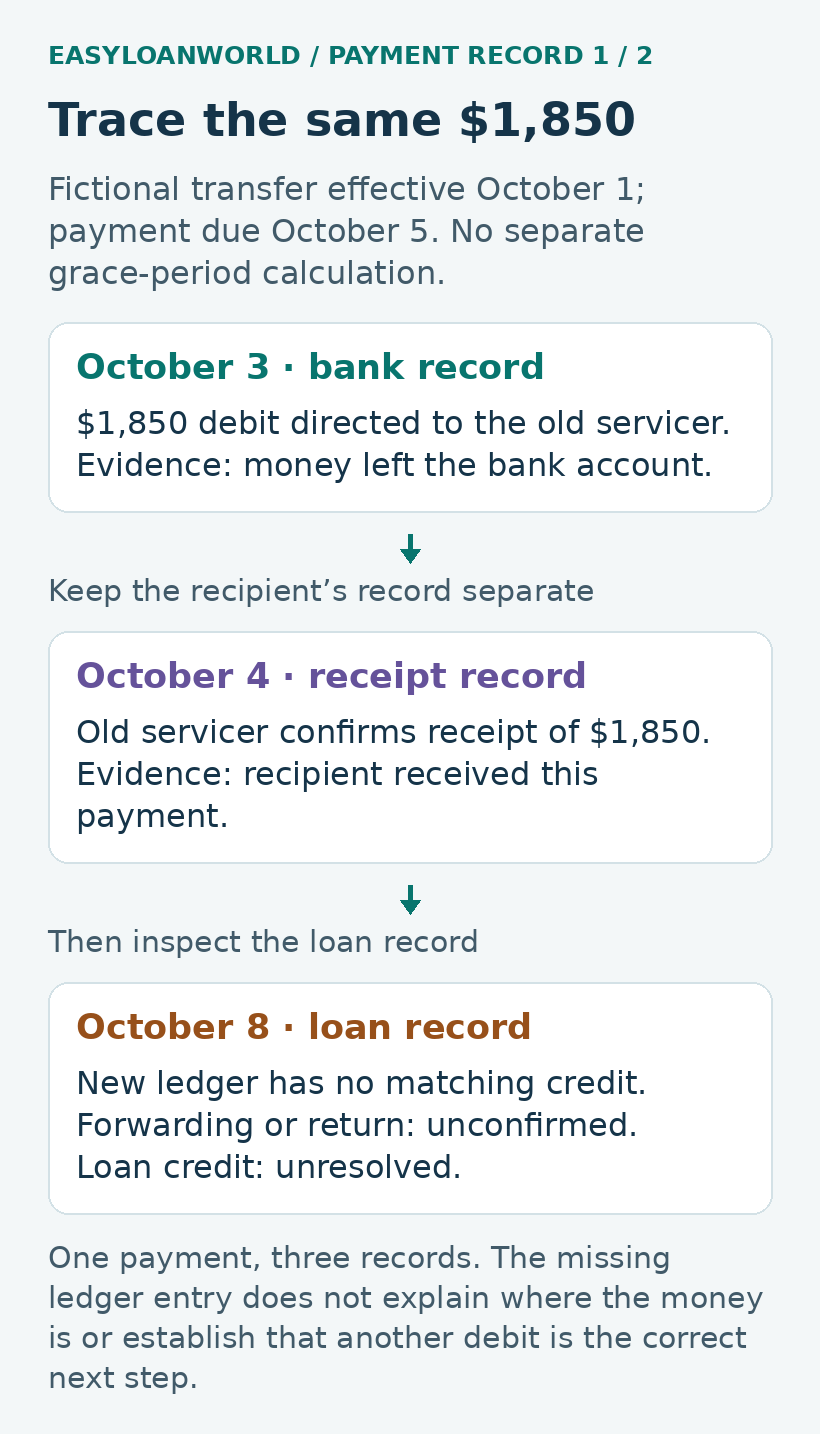
Consider an invented $1,850 monthly payment. The transfer takes effect October 1, and the assumed payment due date is October 5. This example makes no separate grace-period calculation.
- October 3: the bank shows a $1,850 debit directed to the old servicer.
- October 4: the old servicer confirms receiving that payment.
- October 8: the new loan ledger still shows no corresponding credit.
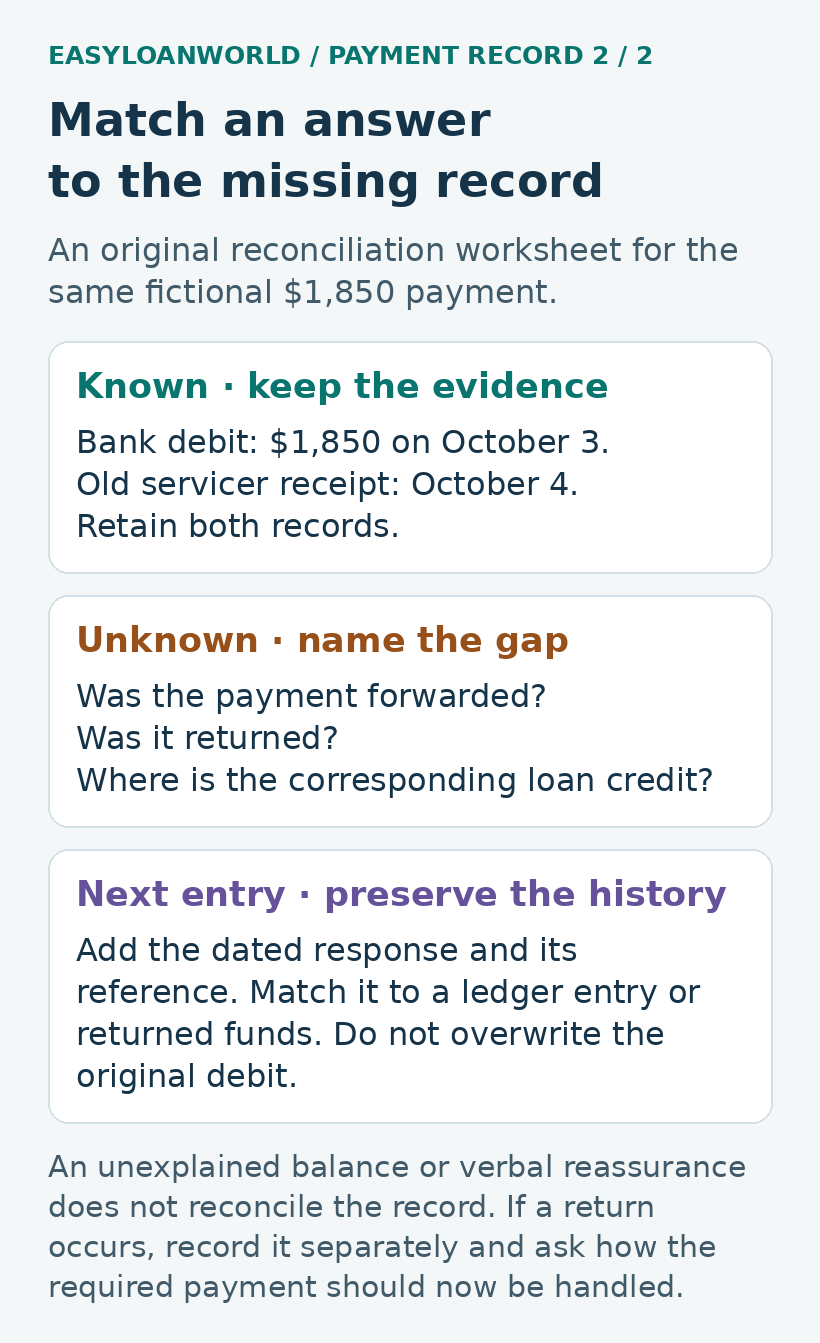
The amount to trace is $1,850. Receipt by the old servicer is confirmed; forwarding or return is not. The new loan credit remains unresolved. Those are the findings the evidence supports. The missing display alone does not explain where the money is or establish that another debit is the correct next step.
If a return later appears, add it as another event with its amount and date. Do not erase the original debit or continue labeling it a completed payment. Ask how the required payment should now be handled; a return does not erase the underlying obligation.
Close the file with records, not reassurance
For persistent transfer problems, the CFPB guide above points to information requests and notices of error that can be sent to both servicers. Use that official route to investigate unresolved records.
Prepare a concise summary identifying the payment, the evidence already available and the exact missing record. Save each servicer’s response separately. A useful request asks where the specific payment went and how it appears on the loan, rather than asking only whether the account “looks fine.”
Finish by matching the response to the statement entry or returned funds. Keep any disagreement open until the records explain it. This checklist does not supply a universal posting deadline: the goal is a documented resolution of your actual payment trail.
Featured photo: A blank notebook illustrates keeping a record of payment details. Photo: Kelly Sikkema / Unsplash. Used under the Unsplash license.

Limited 203(k) and HomeStyle: Three Renovation Projects
Compare three fictional renovation projects, then change one logistical detail and prepare a private project brief.
Mortgage Charge Questions: Choose the Record That Answers Them
Match a questionable mortgage charge to account detail, service records or adjustments with a worked property-inspection example and a two-part index.

Partial Mortgage Payment: Track Money Held in Suspense
Follow a fictional $1,100 and $700 mortgage payment trail, compare dated records, and build a precise question about an unexplained entry.