Mortgage Gift Funds: Reconcile Two Destinations
Work through a fictional split payment and keep confirmed amounts separate from expectations.

This guide uses Fannie Mae’s conventional-loan guidance.
Check the arrangement first
Gifts support primary and second homes, excluding investment properties. Donors include relatives and people with long-standing familial-like or mentorship relationships. Ask about transaction-participant restrictions, including seller-donor cases. Eligibility.
Have your lender apply the contribution table, including exceptions, to your property and loan-to-value ratios.
See letter requirements.
Match the route to its evidence
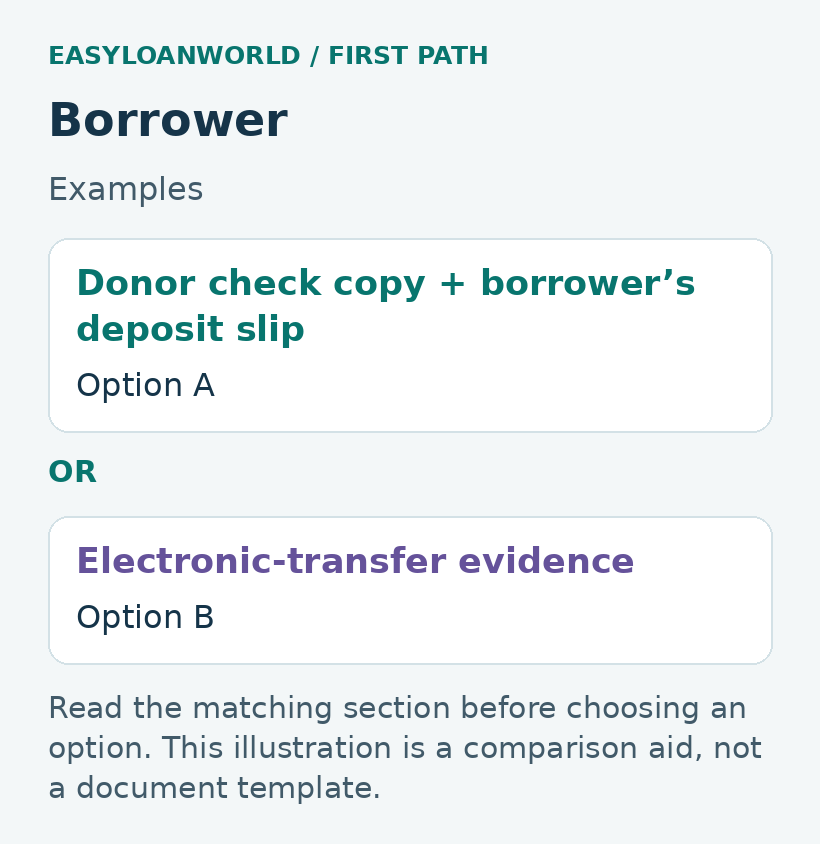
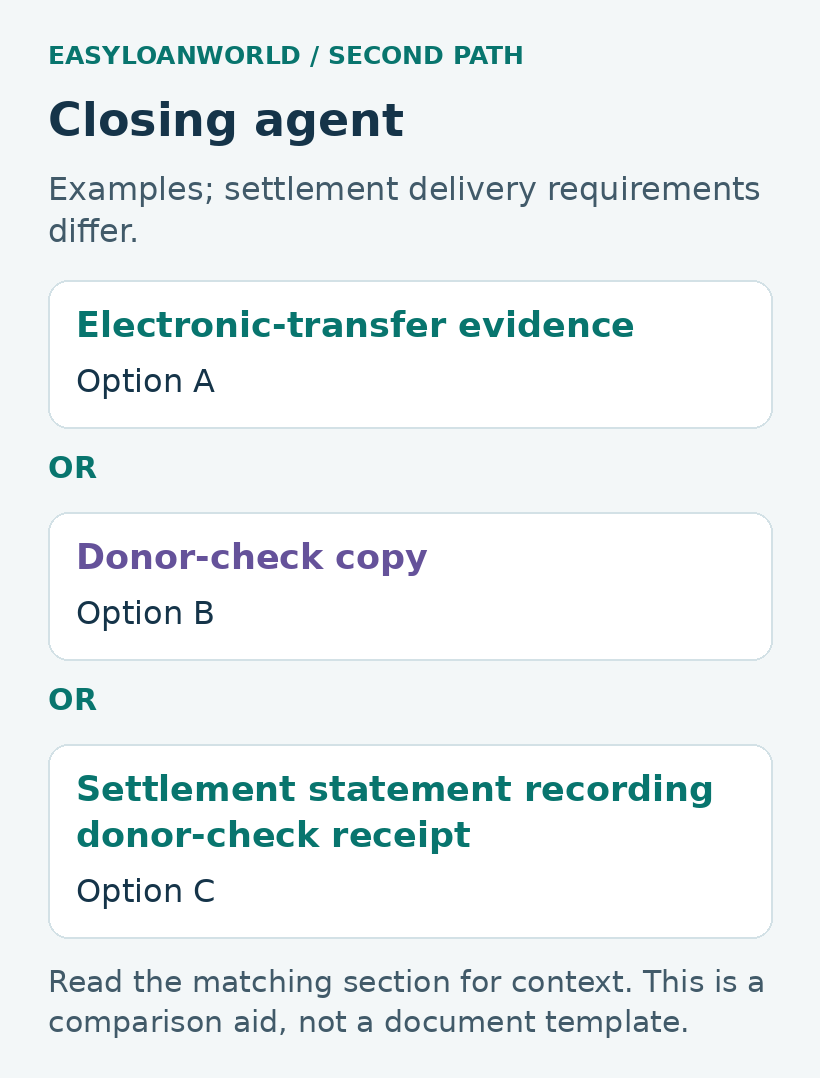
Examples:
- To borrower: donor check plus borrower’s deposit slip, or electronic-transfer evidence.
- To closing agent: electronic-transfer evidence, donor check copy, or settlement statement recording receipt of the donor’s check.
Settlement delivery requirements differ. Evidence requirements.
Ask which route your lender wants to review before choosing how to send the money. A screenshot of an instruction you entered is not the same event as a recipient confirming that the payment arrived. Keep actual personal and banking details out of public comments; use the lender’s verified private channel.
A $24,000 plan with $18,000 received
This fictional example assumes the arrangement is eligible. A buyer needs $36,000 for already-calculated remaining transaction uses, including only amounts still due. The buyer has $12,000 and plans on $24,000 from one donor. See the cash-to-close guide if the funding target itself is unclear.
The letter’s maximum is not another payment.
Suppose there are two electronic-transfer records: one traces $8,000 from donor to borrower; the other traces $10,000 from that donor to the closing agent. Compare their destinations before adding them. These are fictional records.
The received gift is $18,000, so identified funding is $12,000 + $18,000 = $30,000. The unresolved difference is $6,000. Adding the planned $24,000 again would count a promise as another movement of money.
If another $6,000 is only expected, keep it out of the received total. Ask the donor whether more is actually coming, then ask the lender about underwriting updates. The question is how the remaining difference will be resolved, not how to make the original plan appear complete.
U.S. education, checked October 19, 2026; not financial, legal or tax advice. This is not a gift-letter template or approval. Do not conceal repayment.
Featured photo: Illustrative photograph. Jakub Żerdzicki / Unsplash. Used under the Unsplash license.
Mortgage Charge Questions: Choose the Record That Answers Them
Match a questionable mortgage charge to account detail, service records or adjustments with a worked property-inspection example and a two-part index.

Partial Mortgage Payment: Track Money Held in Suspense
Follow a fictional $1,100 and $700 mortgage payment trail, compare dated records, and build a precise question about an unexplained entry.

Minnesota Contract for Deed: Check the Seller, Title and Balloon
Before signing a Minnesota contract for deed, organize seller, disclosure and title evidence, then test a fictional balloon-payment ledger.