Rent or Buy Before a Planned Move? Test the Required Resale Price
Compare invented 24-, 36- and 60-month housing scenarios, separating upfront cash from exit recovery and calculating the resale price needed for buying to match renting.

If you expect to move in three years, compare renting until that date with buying now and selling then. A lower monthly loan payment alone does not answer the question. In the invented example below, buying requires much more cash before the move and only matches renting if the eventual sale price reaches about $317,352.
This is a nominal, undiscounted cash comparison for comparable housing use. It is not a property-price forecast, an affordability assessment or a complete wealth model. Every rate, rent change, expense and sale price is an invented input, not a current quote or a market norm.
Freddie Mac defines home equity as home value minus mortgage debt; renting avoids exposure to falling home values.
Give both choices the same ending
Our renter leaves and our buyer completes a sale after exactly 24, 36 or 60 monthly payments. The renter receives the entire deposit back at that point. Full deposit recovery is a model assumption, not a statement about any lease or legal entitlement. The buyer receives the sale price less the assumed selling costs and remaining loan payoff.
We track two different results: cash paid before that recovery, and net cash cost after recovery. That distinction matters if you can meet the monthly payment but cannot comfortably supply the initial cash. Money recovered at a future sale cannot fund today’s down payment or next month’s expenses.
The invented inputs
| Input | Rent | Buy |
|---|---|---|
| Starting commitment | $1,900 refundable deposit plus $500 nonrefundable start fee | $300,000 purchase price; $60,000 down payment plus $6,000 purchase transaction costs |
| Loan | None | $240,000; 6% fixed annual rate; 360 monthly payments |
| Housing payment | $1,900 monthly in year one; increases 3% after each 12 months | $1,438.92 monthly principal and interest |
| Other monthly spending | $20 renter insurance | $300 property tax, $100 home insurance and $200 maintenance |
| Exit | Full $1,900 deposit return | Selling costs equal to 6% of sale price, followed by loan payoff |
The $200 monthly maintenance amount is actually spent. It is not money retained in a reserve and returned at sale. The buyer’s $600 monthly operating spending is separate from principal and interest; there is no second charge for those same expenses through escrow.
Before the first periodic payment, the model requires $2,400 for renting or $66,000 for buying, a $63,600 difference. First-year monthly spending is $1,920 for renting and $2,038.92 for buying. These timings are chosen for the example; replace them with the actual payment schedule before using the comparison.
Work through a move after 36 months
The rental path
Monthly rent is $1,900 in year one, $1,957 in year two and $2,015.71 in year three. Twelve payments at each amount total $70,472.52. Add $720 of insurance, the $500 start fee and the $1,900 deposit: cash paid is $73,592.52.
Subtract the assumed $1,900 deposit return to get a net rental cost of $71,692.52. Counting the deposit as both a permanent expense and a returned amount would obscure this result.
The purchase path at a $300,000 sale price
Cash paid before sale is the $60,000 down payment, $6,000 purchase costs, $51,801.17 in loan payments and $21,600 in operating spending. Total: $139,401.17. The calculation uses the unrounded loan payment internally, so multiplying its displayed two-decimal amount can differ slightly.
After payment 36, the modeled loan balance is $230,601.77. A $300,000 sale incurs $18,000 of assumed selling costs. The recovery is therefore:
$300,000 sale price − $18,000 selling costs − $230,601.77 payoff = $51,398.23 net sale proceeds.
Subtract those proceeds from the buyer’s prior cash outlay. Using unrounded calculations, the buyer’s net cost is $88,002.93, or $16,310.41 more than renting. Rounded displayed components can differ by a cent.
The $9,398.23 of principal repaid is already reflected in the smaller payoff and therefore in the proceeds. Do not subtract that principal again, or add the down payment as a second recovery. This comparison credits only the actual modeled cash left after the sale costs and debt payoff.
What sale price would make buying match renting?
At 36 months, the buyer needs $67,708.65 back to reduce the $139,401.17 outlay to the renter’s $71,692.52 net cost. With the assumed 6% sale charge, 94% of the sale price is available before paying off the debt.
Required sale price = (buyer cash paid − renter net cost + loan payoff) ÷ 0.94.
Using the unrounded inputs gives $317,351.50, or approximately $317,352. This is the required price under these assumptions, not a prediction that the home will sell for that amount. A higher selling-cost fraction or more ownership spending raises the required price, holding the other inputs fixed. A larger rental cost lowers it.
A useful decision question is: would you still choose to buy if the eventual price fell short of this threshold? Test that before relying on a favorable resale outcome.
Test lower and higher resale prices
| Assumed sale price | Net sale proceeds after costs and payoff | Buyer net cost | Buying compared with renting |
|---|---|---|---|
| $270,000 | $23,198.23 | $116,202.93 | $44,510.41 more |
| $300,000 | $51,398.23 | $88,002.93 | $16,310.41 more |
| $330,000 | $79,598.23 | $59,802.93 | $11,889.59 less |
The result reverses across these deliberately chosen prices. The $330,000 outcome supports buying on this narrow net-cost measure; the other two support renting. None removes the buyer’s larger initial funding requirement. If another tested price produces negative net sale proceeds, this hypothetical arithmetic requires additional cash at settlement rather than providing a recovery.
What if the move happens sooner or later?
| Exit after | Renter net cost | Buyer cash paid before sale recovery | Buyer net cost at $300,000 resale | Required resale price to match renting |
|---|---|---|---|---|
| 24 months | $47,264 | $114,934 | $66,858 | $320,845 |
| 36 months | $71,693 | $139,401 | $88,003 | $317,352 |
| 60 months | $122,748 | $188,335 | $129,666 | $307,359 |
With resale fixed at the original $300,000 price, buying remains more expensive at all three tested dates. Its excess net cost falls from approximately $19,594 at 24 months to $6,917 at 60 months. A longer stay improves the purchase comparison in this specific model, but five years does not automatically make buying cheaper.
If a two-year move is plausible, do not base the decision solely on the five-year row. Use the earlier exit as a separate decision case. Conversely, do not treat a possible longer stay as guaranteed just to make the numbers favor buying.
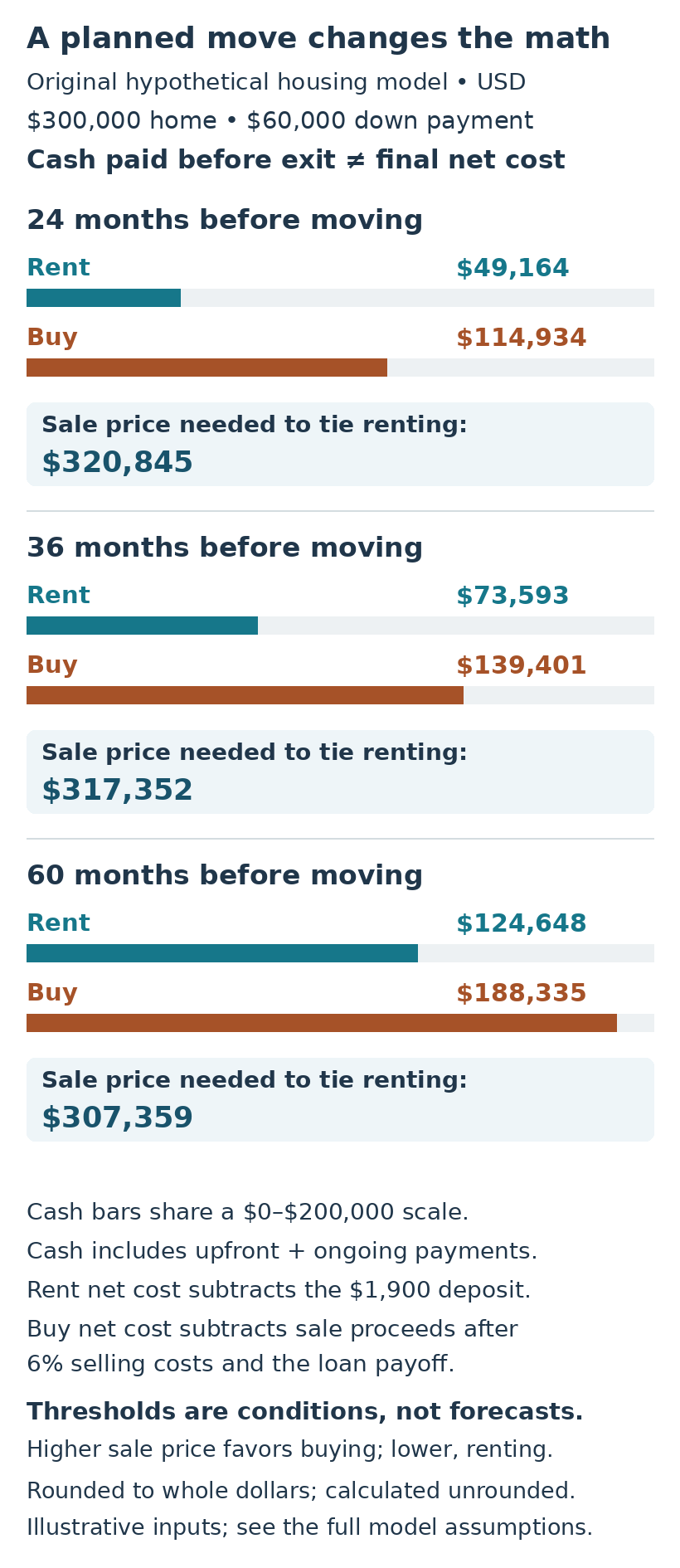
Replace the assumptions that could change your decision
The model assigns zero opportunity return to cash and includes zero tax benefits. It does not estimate investment gains on the renter’s lower initial outlay. Utilities and moving costs are assumed equal and excluded. Housing use is assumed comparable, with no value assigned to differences in space, flexibility or personal preference.
There are no HOA charges, mortgage-insurance charges or escrow balances in these inputs. Selling delays and early lease-termination charges are also excluded. Those omissions do not establish that your actual amounts will be zero. An exit delayed beyond the chosen date would need a revised cash timeline, not just a different sale price.
Before deciding, obtain actual rental terms, deposit deductions and exit charges; a purchase financing estimate; and property-specific ownership and sale-cost estimates. Replace the corresponding inputs rather than adding duplicate expense lines. Then rerun your plausible move dates and resale cases.
Use two tests: can you fund the upfront and ongoing obligations without depending on future recovery, and is the net result acceptable at a resale price you are willing to test? In this example, buying wins only in sufficiently favorable sale scenarios. Renting offers the lower modeled net cost at an unchanged sale price, including the 60-month exit. Your decision should follow your revised inputs and tolerance for an unfavorable exit, rather than an assumed universal break-even year.
Mortgage Charge Questions: Choose the Record That Answers Them
Match a questionable mortgage charge to account detail, service records or adjustments with a worked property-inspection example and a two-part index.

Partial Mortgage Payment: Track Money Held in Suspense
Follow a fictional $1,100 and $700 mortgage payment trail, compare dated records, and build a precise question about an unexplained entry.

Minnesota Contract for Deed: Check the Seller, Title and Balloon
Before signing a Minnesota contract for deed, organize seller, disclosure and title evidence, then test a fictional balloon-payment ledger.