Profitable Business, Falling Cash: Reconcile the Difference
An invented one-month example reconciles net income, customer receipts, supplier payments, equipment, debt and an owner distribution to the closing cash balance.
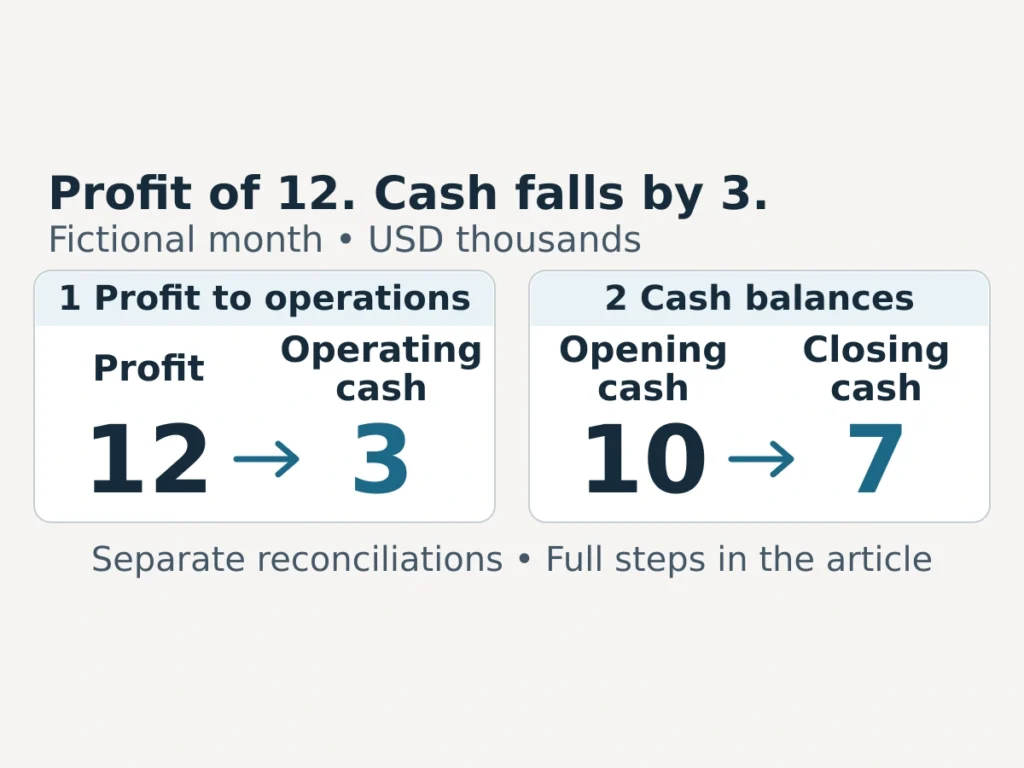
A worked example: $12,000 profit, $3,000 less cash
A fictional business starts a month with $10,000 in cash, reports $12,000 of net income and ends with $7,000 in cash. The statements below explain the entire $3,000 decline. No balancing figure is inserted to make the answer work: cash is calculated from the transactions and checked against the opening and closing accounts.
All amounts are invented. Every table uses USD thousands, so 12 means $12,000. The example covers one completed month and one unrestricted, reconciled business-wide cash total. It is an arithmetic exercise, not a set of actual accounts.
This original, simplified bookkeeping exercise uses an invented company and a complete stipulated set of transactions. The account treatments and cash-flow groupings are stipulated for this exercise. It is not an audit or tax calculation, does not claim compliance with a financial-reporting framework, and provides no tax-method guidance.
The boundaries of this example
The following assumptions are part of the calculation. Changing one can change the reconciliation.
- All 50 of revenue is earned credit sales. Customers pay all 8 of opening receivables and 33 of this month’s sales. There are no returns, discounts, write-offs, allowances, customer deposits, deferred revenue, sales taxes, factoring or currency movements.
- All 27 of inventory purchases are on supplier credit. Trade payables contain only those inventory purchases. There is no shrinkage, write-down, production overhead or depreciation included in inventory cost.
- The 12 of other operating expense is fully paid. It includes any ordinary owner salary once. Prepaid expenses, accrued payroll and other operating accruals do not change.
- Interest expense of 1 and stipulated entity income-tax expense of 2 are both paid in full. Interest and tax payables are zero at both dates; there are no tax receivables, refunds or deferred taxes. The assumed tax amount supplies no tax rate or entity-choice guidance.
- Depreciation of 3 is the only noncash expense. Equipment costing 8 is purchased for cash. There are no disposals, impairments, leases, equipment payables or noncash asset acquisitions.
- The business receives 5 of new loan cash and separately pays 2 of principal. There are no withheld fees or other financing costs. Principal excludes the 1 of interest.
- The owner receives a separate distribution of 1, in addition to any salary already inside operating expense. Contributed capital stays unchanged.
- No other cash flows, omitted transfers, restricted-cash movements or cash-equivalent reclassifications occur.
1. Establish the month’s accrual profit
The income statement records 50 of revenue and 38 of expenses, leaving 12 of net income. Its expense total includes inventory cost recognized as goods are sold and the month’s depreciation. It does not include the equipment purchase, principal repayment or separate owner distribution.
| Item | Amount |
|---|---|
| Revenue from credit sales | 50 |
| Less: cost of goods sold | 20 |
| Gross profit | 30 |
| Less: other operating expense | 12 |
| Less: depreciation | 3 |
| Operating profit | 15 |
| Less: interest expense | 1 |
| Profit before the stipulated entity income tax | 14 |
| Less: stipulated entity income-tax expense | 2 |
| Net income | 12 |
These are accrual figures for the month. To find the cash result, the next steps use the opening and closing balances and the actual modeled receipts and payments.
2. Put both balance sheets beside the income statement
Cash is only one account that changes. Receivables rise by 9, inventory rises by 7, and inventory payables rise by 4. The business also buys equipment, borrows, repays principal and distributes cash to its owner.
| Account | Opening | Closing |
|---|---|---|
| Cash | 10 | 7 |
| Accounts receivable | 8 | 17 |
| Inventory | 10 | 17 |
| Equipment at gross cost | 30 | 38 |
| Less: accumulated depreciation | 10 | 13 |
| Equipment, net | 20 | 25 |
| Total assets, using net equipment once | 48 | 66 |
| Trade accounts payable: inventory only | 6 | 10 |
| Interest payable | 0 | 0 |
| Income tax payable | 0 | 0 |
| Other accrued liabilities | 0 | 0 |
| Debt principal outstanding | 18 | 21 |
| Contributed capital | 15 | 15 |
| Retained earnings | 9 | 20 |
| Total equity | 24 | 35 |
| Total liabilities and equity | 48 | 66 |
The equipment rows show the calculation behind its net balance. Total assets include net equipment of 20 at the start and 25 at the end; they do not add the gross and net figures together. Similarly, total equity is the subtotal of contributed capital and retained earnings, not another amount to add to those components.
3. Reconcile net income to operating cash
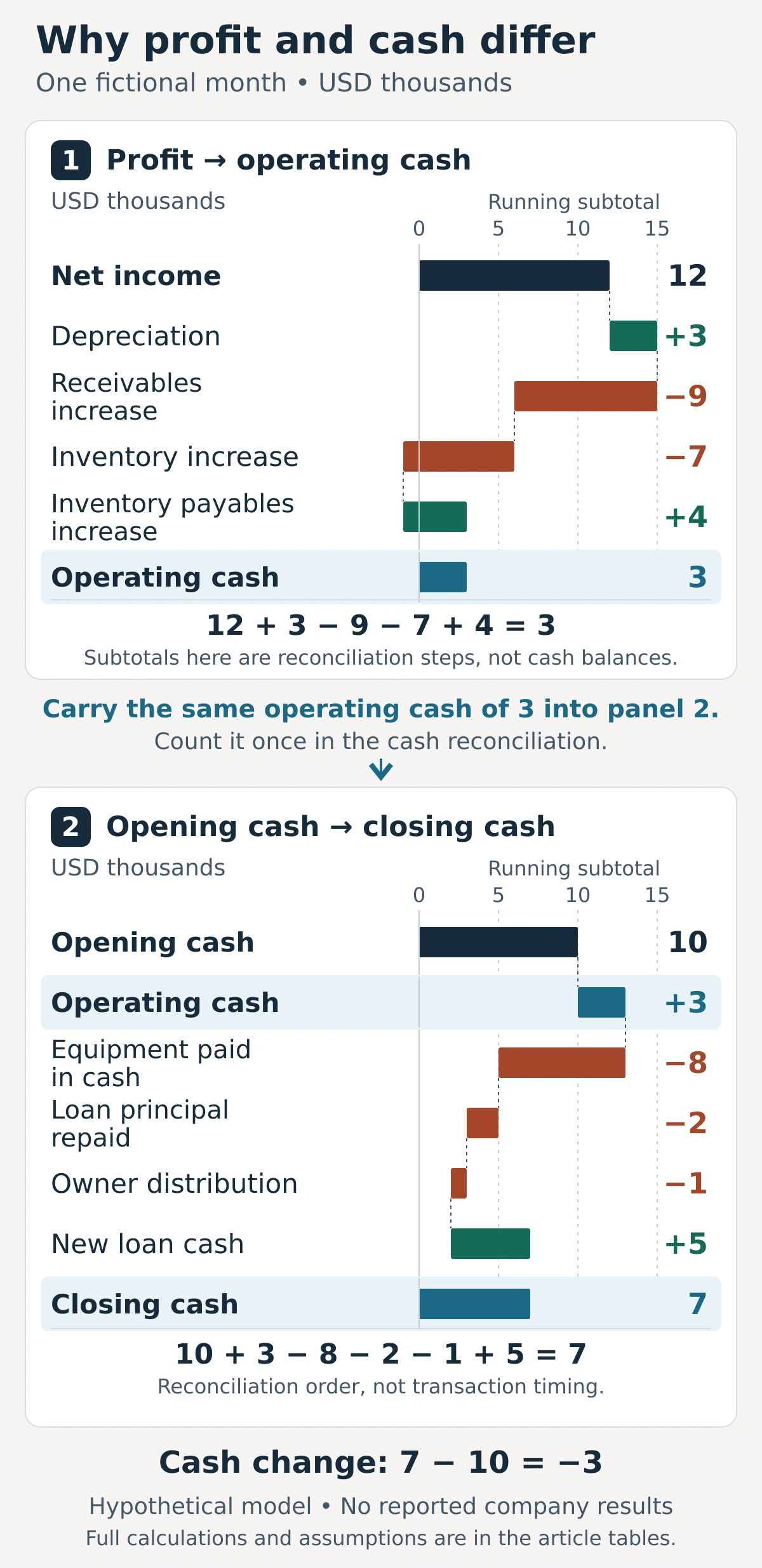
Start with the 12 of net income. Add back the 3 of depreciation because this modeled expense has no cash payment. Then account for the movements in receivables, inventory and inventory payables.
| Step | Effect | Calculation |
|---|---|---|
| Start with net income | 12 | From the income statement |
| Add depreciation | +3 | Expense without a cash payment in this model |
| Subtract the increase in receivables | −9 | 17 closing − 8 opening = 9 |
| Subtract the increase in inventory | −7 | 17 closing − 10 opening = 7 |
| Add the increase in inventory payables | +4 | 10 closing − 6 opening = 4 |
| Operating cash | 3 | 12 + 3 − 9 − 7 + 4 = 3 |
The receivables adjustment is 9, the net increase, rather than the closing balance of 17. The business collects 8 from its opening invoices plus 33 from the month’s 50 of new sales. Total customer cash is therefore 41, which is 9 below the 50 of revenue.
The inventory and payables adjustments work together. Purchases of 27 exceed the 20 of cost of goods sold by 7. Yet supplier cash payments are 23 because payables increase by 4. The combined adjustment is −7 + 4 = −3: supplier payments exceed this month’s cost of goods sold by 3.
At the intermediate step, net income plus depreciation is 15. That is not the finished operating-cash subtotal: the three operating-balance movements reduce it by a net 12, leaving 3.
Interest of 1 and stipulated entity income tax of 2 have already reduced net income and are paid in the same amounts. Their payable balances do not move, so this example needs no adjustment for either item. They are not added back here or deducted a second time later.
4. Prove operating cash again from receipts and payments
The second route does not start with profit. It reconstructs the cash received from customers and the cash paid to suppliers, then deducts the other cash operating payments.
| Amount to derive | Opening and closing balance calculation | Result |
|---|---|---|
| Customer receipts | 8 opening receivables + 50 credit sales − 17 closing receivables | 41 |
| Inventory purchases on credit | 20 cost of goods sold + 17 closing inventory − 10 opening inventory | 27 |
| Supplier payments | 6 opening payables + 27 credit purchases − 10 closing payables | 23 |
The transaction splits provide another check. Customer receipts are 8 from opening receivables and 33 from current sales. Supplier payments are 6 to settle opening payables and 17 against current purchases. The remaining 10 of current purchases stays in closing payables.
| Receipt or payment | Cash effect |
|---|---|
| Customer receipts | +41 |
| Payments to inventory suppliers | −23 |
| Other operating payments | −12 |
| Interest paid | −1 |
| Stipulated entity income tax paid | −2 |
| Operating cash | 3 |
Customer receipts of 41 less cash operating payments of 38 leave 3. This independently matches the indirect reconciliation.
The two totals of 38 have different contents. Income-statement expenses are 20 of cost of goods sold, 12 of other operating expense, 3 of depreciation, 1 of interest and 2 of tax. Cash operating payments are 23 to suppliers, 12 of other operating payments, 1 of interest and 2 of tax. Their equality is a coincidence of these invented numbers.
5. Explain the rest of the cash movement
Operating cash of 3 is only part of this month’s story. The equipment purchase uses 8. New borrowing brings in 5, while principal repayment uses 2 and the separate owner distribution uses 1.
| Cash item | Amount or movement |
|---|---|
| Opening cash | 10 |
| Operating cash generated | +3 |
| Investing: equipment paid in cash | −8 |
| Financing: new debt received in cash | +5 |
| Financing: debt principal repaid | −2 |
| Financing: separate owner distribution | −1 |
| Net cash change | −3 |
| Closing cash: opening cash plus net change | 7 |
The change is 3 − 8 + 5 − 2 − 1 = −3. Adding that change to opening cash gives 10 − 3 = 7. Net investing cash is −8, and net financing cash is +2; the table keeps each underlying payment and receipt visible.
The 5 of borrowing is an actual cash receipt. It is not a plug for an unexplained difference. The 8 equipment payment is shown separately, even though borrowing and the equipment purchase happen in the same month.
The principal repayment of 2 reduces debt and cash without entering this model’s income statement. Interest of 1 is already included in the operating-cash subtotal. The owner distribution of 1 also sits outside net income and reduces equity. It is separate from any salary included once in the 12 of operating expense.
6. Check that debt, equipment and equity also close
A cash answer that ties is more useful when the other modeled accounts tie too. These roll-forwards connect the transactions to the closing balance sheet.
| Account | Roll-forward | Closing amount |
|---|---|---|
| Debt principal | 18 opening + 5 new borrowing − 2 principal repaid | 21 |
| Equipment at gross cost | 30 opening + 8 cash-paid additions | 38 |
| Accumulated depreciation | 10 opening + 3 depreciation | 13 |
| Equipment, net | 20 opening + 8 additions − 3 depreciation | 25 |
| Retained earnings | 9 opening + 12 net income − 1 distribution | 20 |
| Total equity | 24 opening + 12 net income − 1 distribution | 35 |
Finally, closing assets are 7 cash + 17 receivables + 17 inventory + 25 net equipment = 66. Closing liabilities and equity are 10 inventory payables + 21 debt + 35 equity = 66. Opening assets and opening liabilities plus equity both total 48.
The apparent contradiction is now accounted for: the fictional business earns 12, generates 3 from operations and uses a net 6 through equipment and financing flows. Cash falls by 3, while retained earnings rise by 11 after the distribution. Those are different movements, and each has its own reconciliation.
This completed-month example establishes only where its cash went. It does not determine how much the business should borrow, whether the remaining 7 is an adequate reserve, or whether future payments are affordable.
SBA Surety Bonds vs. Working-Capital Loans: Four Contractor Scenarios
Follow Riverton Build through four fictional alternatives at one pre-start review. Identify what remains unresolved and prepare a focused next conversation.
Export Payment Documents: A Two-Packet Review
A worked export-packet review follows an unresolved instruction proposal, an incomplete selected inventory and an unknown carrier arrangement, without inventing the missing evidence.
One Customer Pays Late: Stress-Test Cash and Credit Availability Together
A fictional 13-week test shows how one late customer payment can reduce cash and credit capacity together, leaving a $6,000 gap before added financing…