Export Payment Documents: A Two-Packet Review
A worked export-packet review follows an unresolved instruction proposal, an incomplete selected inventory and an unknown carrier arrangement, without inventing the missing evidence.

A complete-looking folder can still leave the important decision unresolved. In DEMO-DC below, the three selected document IDs are present, but the proposed instruction differs from the agreed option. In DEMO-LC, the selected inventory has a gap. Start by identifying the record supporting the proposed release and the record describing each bank’s role. Keep each unanswered point beside the evidence you actually have.
This guide compares a commercial letter of credit (LC) with a documentary collection through two deliberately incomplete, fictional packets. Every deal reference, bank name, document requirement, period and amount in the exercise is invented. The packets contain document IDs, not complete documents. They are teaching material, not bank forms, executable instructions or findings about a real transaction.
Read the payment mechanism once
Commercial LC issuers undertake payment against complying documents; examination concerns documents, not goods. Advising adds no payment undertaking; confirmation adds another bank’s. Ordinary collection banks neither guarantee payment nor verify document accuracy; separate undertakings need separate review. D/P exchanges documents for payment; D/A for the buyer’s acceptance of a future-payment draft, not cleared money.
Put the two selected packets side by side
For this exercise only, both packets stipulate the same three selected IDs: DOC-INVOICE, DOC-PACKING and DOC-TRANSPORT. Read the inventory against that list. A tick would mean only that an ID appears in the supplied set; it would say nothing about the document’s contents, authenticity or suitability.
Actual export-document requirements vary with destination and shipment type.
Documents in an Export Transaction
| Selected ID | DEMO-DC: supplied set | DEMO-LC: supplied set |
|---|---|---|
| DOC-INVOICE | Present | Present |
| DOC-PACKING | Present | Present |
| DOC-TRANSPORT | Present | Not supplied |
These are selected records, not a complete export checklist. “Not supplied” describes this packet, not every place a record might exist. No document dates, goods descriptions or originals-and-copies requirements have been provided for examination.
DEMO-DC: resolve the conflicting proposal
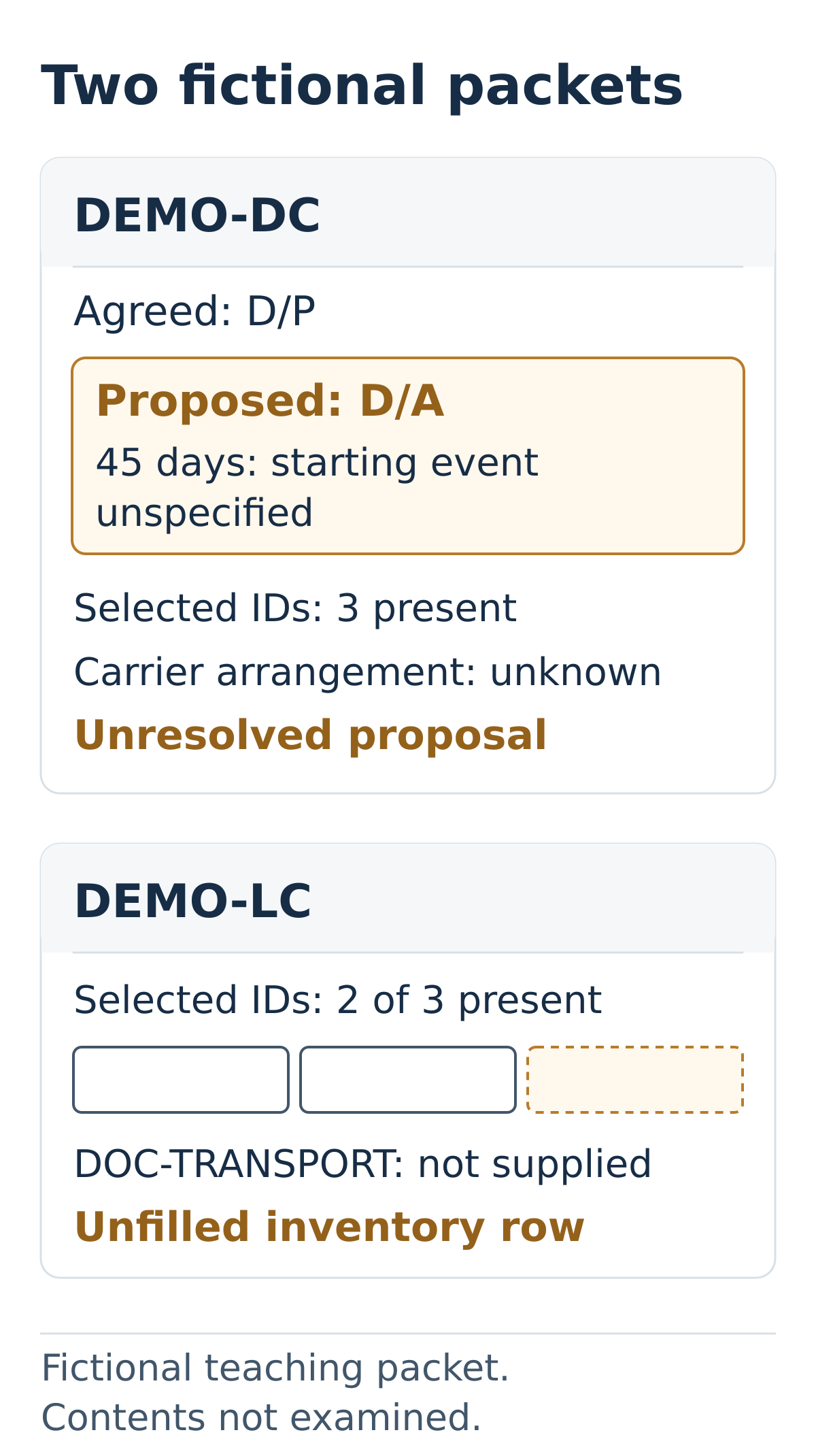
The agreement entry says D/P. The proposed collection instruction says D/A with an invented 45-day period. No starting event is supplied. The packet also supplies no collection-bank names, so those fields remain blank.
The comparison produces two separate findings. First, the agreed and proposed option entries conflict. Keep the proposal marked “proposed”; neither a complete selected inventory nor a draft instruction establishes that the change was accepted. Second, “45 days” has no stated point from which to count. There is no maturity date to calculate from these inputs.
In your review notes, retain the agreement entry and the proposal as separate records. Put the exact difference beside them: “Agreed D/P; proposed D/A; starting event unspecified.” Ask the trade-finance bank which instruction version is being considered and what evidence is needed to resolve the difference. Do not silently edit the agreement to make the two entries match.
The inventory result stays at three selected IDs present. The instruction result stays unresolved. Those findings can coexist. The exercise has not established an agreed revision, an executable instruction or an actual receipt.
DEMO-LC: keep the bank-role and inventory questions separate
Fictional Bank I: issuer. Fictional Bank A: advising only. Confirmation record: not supplied.
That is a finding about the supplied evidence. A record outside the packet could change the review. Record the exact source of any additional information before changing the entry.
The invented LC record stipulates three selected IDs. The supplied set contains DOC-INVOICE and DOC-PACKING, leaving DOC-TRANSPORT unfilled. The useful follow-through is specific: locate the stipulated record or record what the bank says about the gap. Adding another copy of DOC-INVOICE still leaves the same row unfilled. Adding DOC-OTHER does too.
Even if DOC-TRANSPORT later arrives, the first update is only to the inventory. The model has no document contents to examine and reaches no rejection or payment outcome. Do not turn its two-versus-three count into a verdict about the transaction.
The actual LC, amendments and applicable requirements need transaction-specific bank and professional review; this exercise decides neither compliance nor payment entitlement.
Leave the carrier-release question open
Carrier arrangement: unknown.
Document control depends on transport arrangements. Air waybills and straight ocean bills are non-negotiable; order ocean bills can be negotiable. Labels alone establish neither ownership nor delivery control.
Keep the fee subtraction in its place
For a secondary arithmetic check, suppose the same USD 50,000 invoice is fully received under either alternative. Invented all-inclusive charges paid by the exporter are USD 250 for DEMO-DC and USD 700 for DEMO-LC, each deducted once. No other costs are modeled. Net receipts are USD 49,750 and USD 49,300, a USD 450 difference. These are alternative receipts, not two payments to add together. The fee payer and amounts are assumptions, not market practice or quotes. This subtraction measures neither profit nor default probability, prices no risk premium and does not identify a suitable arrangement.
Take these unresolved points to the bank and forwarder
Keep a private review sheet with the packet reference, exact record or version, unresolved point, person answering, supporting record and remaining question. These are editorial organizer fields. Use only the rows relevant to your transaction; they are not a universal checklist or a requirement that another party create documents for you.
- DEMO-DC: How will the agreed D/P entry and proposed D/A entry be reconciled, and which version will record the resolution?
- DEMO-DC: What starting event was intended for the proposed 45-day period? Until it is identified, leave the maturity-date field blank.
- DEMO-LC: Where is DOC-TRANSPORT, and what does the bank need to review the selected packet? Keep its response beside that row.
- What is the actual carrier release arrangement, and what supports that answer?
Keep real customer identities, bank details and trade records private. The useful finish is a versioned answer to the conflict, a traceable answer for the missing row and a supported answer to the carrier question. Until those answers arrive, preserve the specific uncertainties rather than filling them with assumptions.
Profitable Business, Falling Cash: Reconcile the Difference
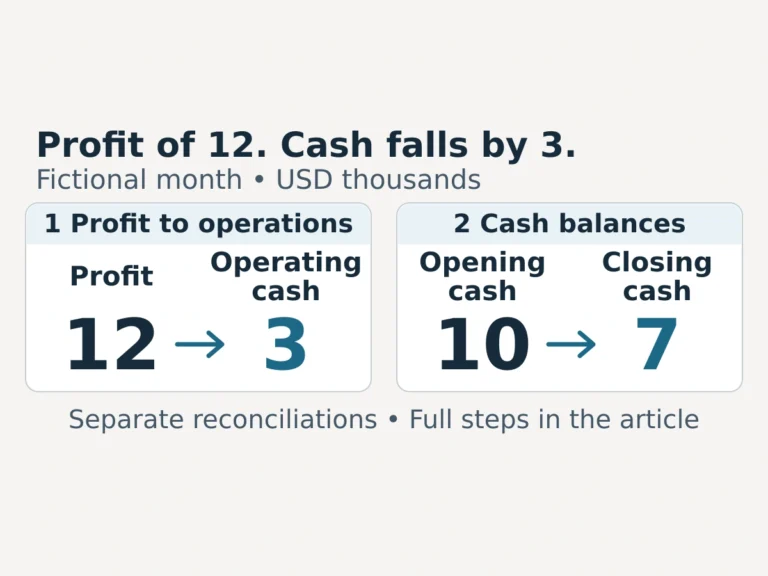
An invented one-month example reconciles net income, customer receipts, supplier payments, equipment, debt and an owner distribution to the closing cash balance.

One Customer Pays Late: Stress-Test Cash and Credit Availability Together
A fictional 13-week test shows how one late customer payment can reduce cash and credit capacity together, leaving a $6,000 gap before added financing…

Seasonal Credit Line: Check Every Day of the Clean-Down
A fictional 30-day clean-down register shows why a zero month-end can mislead. Trace stock collections, retained equipment debt and a late invoice through a…