College Withdrawal Bill: Reconcile the School Account
Use three school records and a fictional $1,340 example to trace each adjustment, check a changed balance and organize questions for the right office.

An unexpected college withdrawal bill is easier to investigate when each amount has a document behind it. Gather the school’s charge-adjustment decision, its aid worksheet and a dated, itemized account statement. Your goal is one checked account snapshot, plus a short list of unresolved entries.
Do not start by adding every number shown on the three documents. A worksheet result and the account entry implementing it can describe the same event. First identify which document explains a decision and which shows that the change was posted.
School refunds and aid-return calculations are separate. In this nonexempt example, the charge reduction does not replace the original charge input. Handbook, Volume 5, Chapters 1 and 2, Part 2
Match the inputs before comparing results
Give each document a version or date reference. The following letters keep unlike amounts separate; use the school’s own labels when making your private copy.
| Reference | Description | Value |
|---|---|---|
| C | Applicable original charges | $3,000 |
| A | Aid already disbursed | $2,400 |
| Q | Additional includible aid | $0 |
| N | School-confirmed completed days | 40 |
| D | School-confirmed denominator days | 100 |
| J | Posted charge reduction | $700 |
For this bounded case, the completion fraction determines earned aid; the school returns the smaller of unearned aid and the charge-based comparison. 34 CFR 668.22(e)–(h)
| Reference | Description | Calculation |
|---|---|---|
| f | Completion fraction | 40 ÷ 100 = 0.40 |
| E | Earned aid | $2,400 × 0.40 = $960 |
| U | Unearned aid | $2,400 − $960 = $1,440 |
| T | Charge-based comparison | $3,000 × 0.60 = $1,800 |
| R | School return | min($1,440, $1,800) = $1,440 |
| S | Initial student share | $1,440 − $1,440 = $0 |
S is zero; that does not make the school-account balance zero. The next step checks the account itself. A worksheet number alone is not evidence of posting.
Rebuild the $1,340 account balance
Start with the complete set of signed entries. Positive entries increase the modeled balance; negative entries reduce it:
$3,000 − $2,400 − $700 + $1,440 = $1,340
Or use the matching earlier snapshot, then include only subsequent entries:
The earlier balance is B0 = $3,000 − $2,400 = $600. The closing account balance is B1 = $600 − $700 + $1,440 = $1,340.
A second cross-check groups the remaining amounts: revised charges C1 = $3,000 − $700 = $2,300; aid remaining on the account A1 = $2,400 − $1,440 = $960. Therefore, C1 − A1 = $1,340.
For each adjustment, match its reference to the decision or worksheet and to one statement entry. If your chosen snapshot already includes an entry, do not add it again. Adding $1,440 to this closing snapshot would produce $2,780, an overcount of $1,440.
The $700 reduces recorded charges. It is not money received by the student. B1 describes this fictional account only; it establishes no actual obligation, payment deadline or later award entitlement.
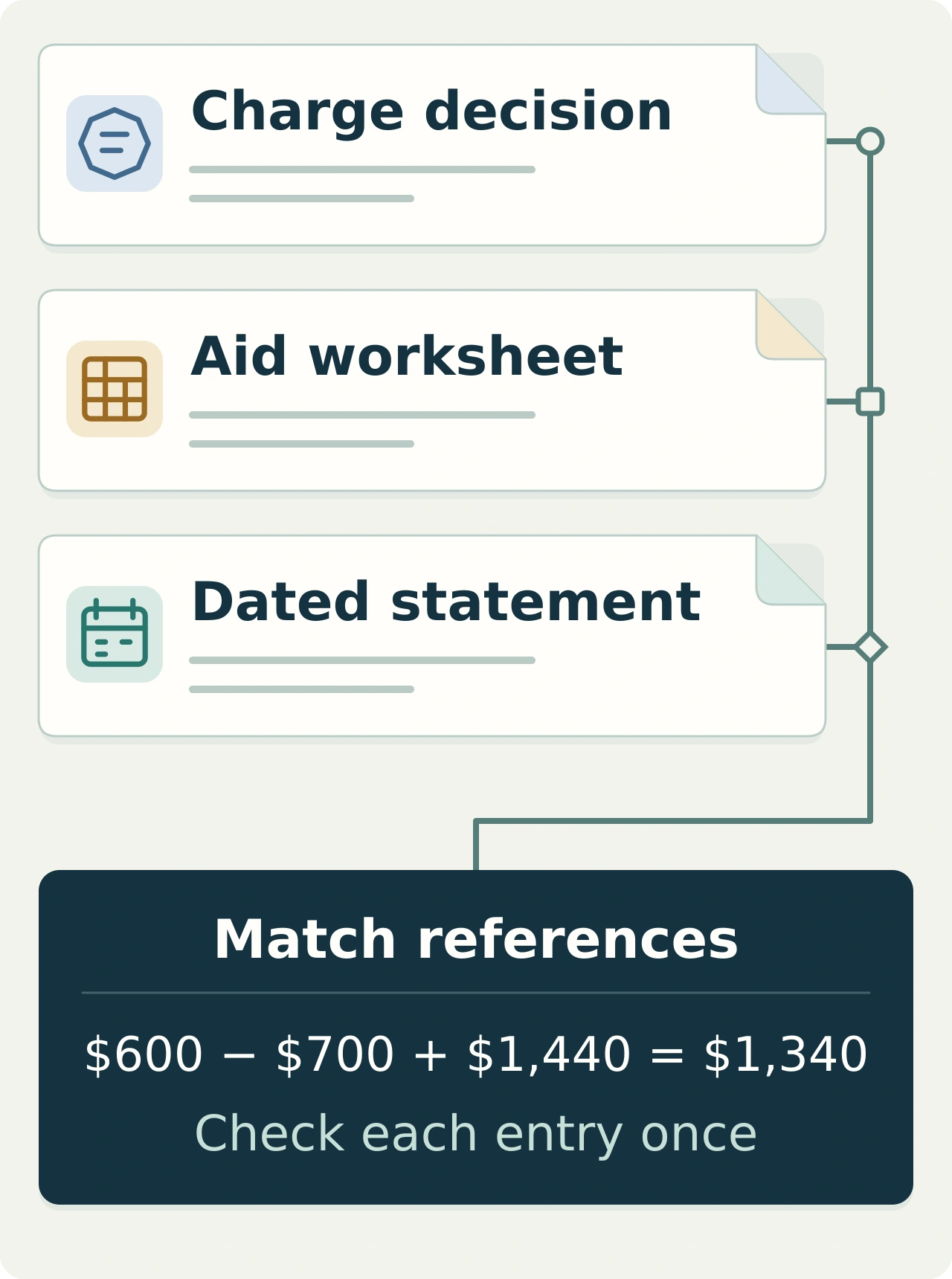
Match the decision and worksheet references to the statement entries. The fictional account bridge is $600 − $700 + $1,440 = $1,340.
What if C1 wrongly replaces C here?
Comparison: $2,300 × 0.60 = $1,380; min($1,440, $1,380) = $1,380. Account: $600 − $700 + $1,380 = $1,280.
That is $60 below the checked example. The difference flags an input to investigate; it does not independently determine who must pay $60. Ask which document and version supplied the disputed figure before assuming a school error.
Keep one private reconciliation record
Use a shorthand case label and term. For each document, record its date, amount, status, related entry reference and one unresolved question. Keep this on your own device or paper; do not submit student IDs, account numbers, tax records or credentials to EasyLoanWorld.
- Charge decision: identify the original charge group, the decision, the posted adjustment, the revised group and any unexplained items.
- Aid worksheet: record the version, input references, result and the school’s confirmation of action taken. Match that action to the statement.
- Account statement: record the earlier dated balance, subsequent signed entries, closing dated balance and any unreconciled difference. Mark missing posting evidence “unconfirmed”; do not invent a date.
Record withdrawal and school determination dates separately. Handbook, Volume 5, Chapter 2, Part 1
Also keep the worksheet date and statement posting dates as distinct fields. Leave an unknown date blank.
Take the remaining questions to the right office
Ask the charge-policy office which items remain and which decision explains them. Ask financial aid which worksheet version matches your statement and which inputs it used. Ask the student-accounts office which entries connect the two dated balances, and what balance, payment instructions and due date the school currently confirms.
Use the answers to finish the record, rather than treating the illustration as advice to withdraw, borrow or delay payment. If your separate question concerns a positive account credit, see the student-aid credit-balance guide. Its scope is different from this withdrawal example.
Official sources checked October 21, 2026. This educational example does not determine individual eligibility or legal rights.

Student Aid Credit Balance: Separate the School Ledger From Spendable Cash
Use two fictional aid snapshots and a private payment record to organize the amounts, permissions and dates behind a college-account credit.

Solar Loan Quotes: Compare the Cash Price Before the Low Rate
Match the installation scope, reconcile a fictional $6,000 financed-price uplift, and test the later payment if a planned savings payment never arrives.

Leaving a Car Lease Early: Compare the Settlement Quote With Keeping It
A fictional ten-month comparison shows how a $100 apparent lease-exit saving becomes a $1,900 premium once replacement transport is included, before other matched costs.