Federal vs Private Student Loans: Which Is Better?
The Difference Starts With Who Provides the Loan
Federal student loans are part of federal student aid programs administered by the U.S. Department of Education. Depending on the loan type and the student’s circumstances, they can include Direct Subsidized Loans, Direct Unsubsidized Loans, and PLUS Loans.
Private student loans are provided by lenders such as banks, credit unions, state-based organizations, or other private financial institutions. The lender sets the loan’s terms, including its interest rate, eligibility requirements, repayment conditions, and policies for dealing with borrowers who experience financial difficulty. That contractual difference matters because a private loan does not automatically carry the same federal protections simply because it is being used to pay for education.
A Quick Comparison
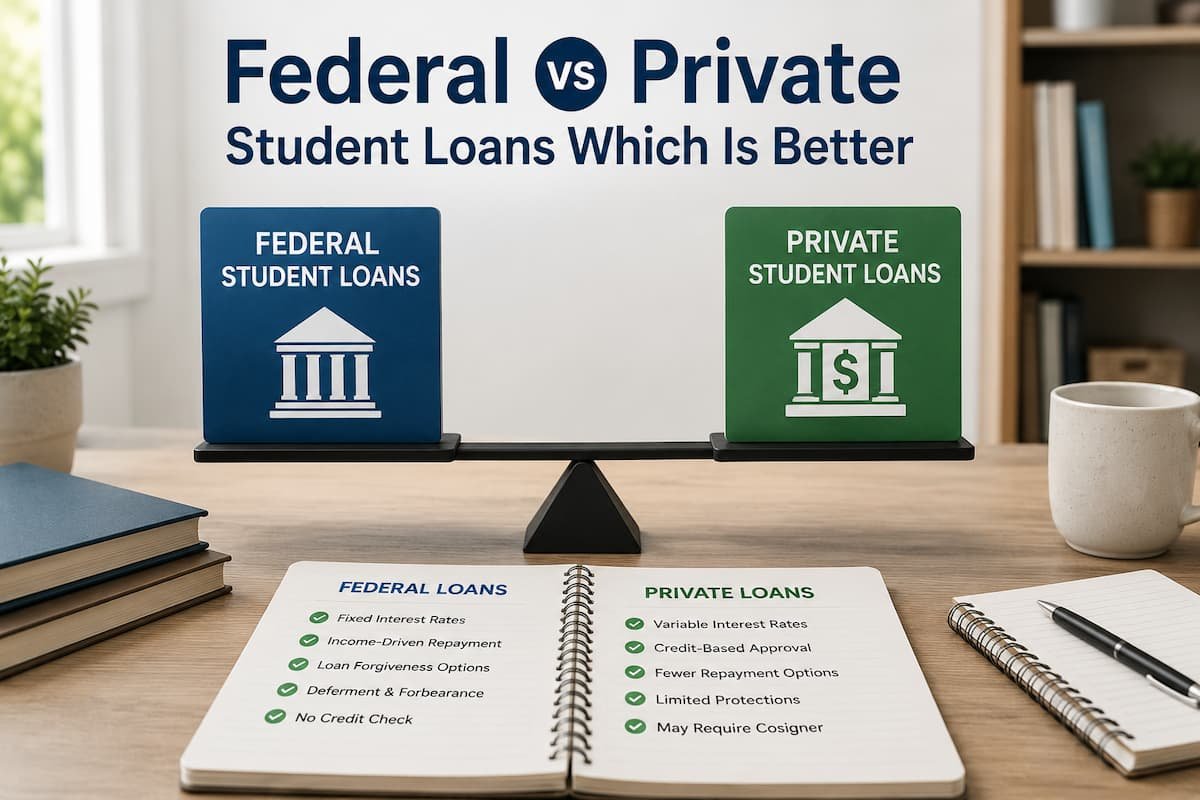
| Factor | Federal Student Loans | Private Student Loans |
|---|---|---|
| Provider | Federal student loan program | Bank, credit union, or other private lender |
| Credit requirements | Most Direct Loans do not require a credit check; PLUS Loans are an exception | Credit history commonly affects eligibility and pricing |
| Co-signer | Generally not required for Direct Loans | Often required, especially for students with limited credit history |
| Interest rate | Federal student loan rates are fixed for the loan | May be fixed or variable depending on the loan |
| Repayment flexibility | Generally offers more federal repayment and hardship options | Options depend on the lender and loan agreement |
| Borrowing limits | Federal program limits apply | Limits are set by the lender and applicable rules |
Why Federal Loans Usually Come First
The strongest reason to look at federal loans first is not simply that their interest rates may be lower. It is the collection of protections surrounding the debt. Federal borrowers may have repayment options and relief mechanisms that are not automatically available with a private loan, which becomes particularly important when someone’s income changes after graduation.
For example, a new graduate might leave school expecting a certain salary and then discover that the job market, starting wage, or personal circumstances are different from what was expected. Federal student loans can provide repayment options that take a borrower’s circumstances into account. Private lenders, by contrast, generally operate according to the individual loan contract, and relief options can be narrower or vary considerably between lenders.
Another difference is access. Most federal Direct Loans do not depend on a student’s credit score in the same way that private loans do, and a co-signer is generally not required for those loans. Private lenders commonly consider credit history and may require a co-signer when a student has little or no established credit. That can make a private loan more difficult to obtain and can also create another person’s financial obligation if the borrower fails to repay.
Where Private Loans Can Make Sense
Calling private student loans “bad” is too simplistic. They can fill a legitimate funding gap when scholarships, grants, savings, payment arrangements, and available federal aid do not cover the remaining education costs.
The important distinction is why the private loan is being considered. If a student has already examined federal options and still has a necessary funding gap, a private loan may be worth comparing. Someone with strong credit may also receive a private offer with an attractive rate, although the advertised rate is not necessarily the rate that borrower will receive. Private lenders use their own underwriting criteria, so the final offer depends on the applicant’s circumstances.
A private loan becomes more difficult to justify when it is being used simply because the application appears easier or because the lender’s advertisement highlights a low starting rate. A low rate means little if the borrower receives a substantially higher rate, has a variable-rate loan, needs an expensive co-signer arrangement, or gives up protections that could become valuable later.
The Rate You See May Not Be the Rate You Get
This is one of the easiest details to overlook when comparing private loans. Lenders may advertise a range of interest rates, but the rate offered to an individual borrower can depend on credit history, income, the presence of a co-signer, and other underwriting factors.
A student should therefore compare the actual loan offer, not the most attractive number appearing in an advertisement. The same principle applies to monthly payments: a lower payment may simply reflect a longer repayment period, which can increase the total amount paid over the life of the loan.
The Risk of Comparing Only Monthly Payments
Suppose two loans produce monthly payments that appear manageable. That does not mean they cost the same.
A longer repayment period can reduce the required monthly payment while keeping the balance outstanding for more years. A variable interest rate can also change the payment or total interest cost later. With student debt, these differences matter because repayment can continue long after the excitement of starting college has disappeared.
A better comparison asks several questions at once:
- What is the actual interest rate offered to you?
- Is the rate fixed or variable?
- What fees are charged?
- When does repayment begin?
- How long is the repayment period?
- What will the total repayment amount be?
- What happens if you temporarily cannot make the scheduled payment?
- Is a co-signer required?
- Can the co-signer eventually be released?
- Are there penalties or restrictions associated with paying the loan early?
- Which borrower protections are available if your circumstances change?
The answers are more useful than a single “lowest rate” number.
A Realistic Way to Decide
Imagine a student has received scholarships and grants but still has a remaining education bill. The first step should not be opening several private-loan applications. The student should determine how much of the gap can reasonably be covered through available federal student loans and whether other funding options can reduce the amount that needs to be borrowed.
If a private loan is still necessary, the next step is to compare actual offers. A student with a strong credit profile and a financially reliable co-signer might receive a competitive private offer. Another student with limited credit history might receive a much higher rate or need a co-signer whose financial position could be affected if payments are missed.
Those two students are looking at the same type of loan but facing very different risks. That is why there is no responsible one-line answer that says private loans are always better or always worse. The structure of the loan and the borrower’s ability to handle it matter.
What Happens If Repayment Becomes Difficult?
This is where the difference between the two loan types becomes particularly important.
Federal loans have established federal repayment and relief programs, although eligibility and available options depend on the specific loan and the borrower’s circumstances. Private student loans do not follow one universal hardship program. A private lender’s willingness to reduce payments, postpone payments, or offer another arrangement depends on the contract and the lender’s policies.
That does not mean a private lender will never help a struggling borrower. Some lenders may offer temporary assistance or other arrangements. The point is that the borrower should read the contract before assuming those options will exist.
This is also why refinancing a federal student loan into a private loan deserves careful consideration. A lower private interest rate can look attractive, but moving federal debt into a private loan can mean losing federal benefits and protections. A lower rate is not automatically a better financial outcome if the borrower gives up protections that could become important later.
A Better Borrowing Order
For many students, the decision becomes simpler when viewed as a sequence rather than a head-to-head competition between two loan types.
Start by reducing the amount you need to borrow. Review grants, scholarships, savings, school payment arrangements, and other available resources before taking on additional debt.
Then examine federal student loan options. Federal Student Aid and your school’s financial aid office can help you understand which federal loans you are eligible to receive and what those loans would mean for your education financing.
Only then investigate private borrowing if a gap remains. If a private loan is necessary, compare multiple actual offers rather than choosing a lender based on advertising alone. The CFPB recommends exploring federal options first and shopping around if private borrowing is still needed.
This approach also helps prevent a common mistake: borrowing more simply because a lender is willing to offer more. The amount you can borrow is not necessarily the amount you should borrow.
When Federal Loans Are Usually the Better Choice
Federal student loans generally deserve priority when:
- You qualify for federal borrowing and still need education financing.
- You do not have a strong credit history.
- You want access to federal repayment options and protections.
- You do not want to involve a co-signer.
- You are uncertain about your future income.
- You want a fixed federal interest rate rather than taking on the possibility of a variable private rate.
- You want to preserve federal benefits that could matter if your financial situation changes.
These factors do not guarantee that a federal loan will be the cheapest option in every individual situation. They show why looking beyond the advertised rate is important.
When Comparing a Private Loan May Be Reasonable
A private loan deserves consideration when federal aid and other reasonable funding sources do not cover the remaining education cost and the borrower has carefully reviewed the private terms.
It may also be worth comparing when a borrower has strong credit and receives a genuinely competitive offer. Even then, the comparison should include the full repayment structure and the protections being given up—not just the initial interest rate.
For graduate or professional students in particular, the CFPB notes that there can be limited situations where a private loan could compare favorably with a federal option, depending on factors such as credit quality, the offered rate, expected employment, and the borrower’s repayment plan. That is an exception to evaluate carefully, not a general reason to prefer private borrowing.
The Bottom Line
For most students who need to borrow, federal student loans are the better starting point. Their combination of access, fixed federal rates, and borrower protections generally makes them more forgiving when life does not go according to plan.
Private student loans have a legitimate place, but they should normally be considered after federal options and other sources of education funding have been examined. If you need one, compare the actual offer—not the headline rate—and pay close attention to repayment rules, variable-rate exposure, fees, co-signer obligations, and what happens if you cannot make payments.
The best student loan is not necessarily the one with the lowest advertised rate. It is the one whose cost, repayment structure, and protections make sense for the amount you actually need to borrow and the uncertainty you can realistically afford to carry.
Frequently Asked Questions
Are federal student loans always cheaper than private student loans?
No. A private lender may offer a borrower a lower interest rate than a particular federal loan. However, interest rate is only one part of the comparison. Federal loans can provide repayment options and protections that may have substantial value if the borrower’s financial circumstances change.
Do private student loans require a co-signer?
Many private student loans require or strongly favor a co-signer when the student has limited credit history. Requirements vary by lender. A co-signer should understand that they can become responsible for the debt if the primary borrower does not repay it.
Can I have both federal and private student loans?
Yes. A student may use federal loans and, if a remaining education-funding gap exists, a private student loan. The important issue is to understand the separate terms, balances, interest rates, and repayment obligations for each loan.
What should I compare before taking a private student loan?
Look beyond the advertised interest rate. Compare the actual rate offered to you, whether it is fixed or variable, fees, repayment start date, repayment period, total expected cost, hardship options, co-signer requirements, and other contractual terms.
Should I use a private student loan before federal student loans?
For most borrowers, federal options should be investigated first. Federal Student Aid and the CFPB both recommend considering federal borrowing before turning to private student loans because federal loans generally provide more borrower protections and repayment flexibility.
Can refinancing a federal student loan into a private loan save money?
It can potentially reduce the interest rate for some borrowers, but it can also mean losing federal student-loan benefits and protections. A lower rate should therefore be weighed against what you would give up by moving the debt into the private system.