Fixed-Rate Mortgage, Adjustable Payment Table: Read Both
Read two different disclosure concepts, then reconcile a fictional payment change and calculator mismatch.
Estimated reading time: 4 minutes
A Loan Estimate can describe a fixed interest rate alongside changing scheduled payments. Read the product description and the payment information together before treating the starting installment as permanent.
AP and AIR answer different questions
The Loan Estimate rules distinguish an Adjustable Payment (AP) table from an Adjustable Interest Rate (AIR) table. AP covers specified payment changes unrelated to a rate adjustment; AIR applies when the interest rate may increase. A fixed-rate interest-only loan can therefore have AP information without AIR information. The rules expressly recognize a product combining an interest-only period with a fixed rate.
In the AP table, check the interest-only period, first changed payment and amount, subsequent changes, and maximum payment. These aren’t interchangeable with an interest-rate ceiling. This guide concerns a mortgage using the Loan Estimate, not a HELOC disclosure.
Build a three-line reading record
The CFPB’s Loan Estimate explainer recommends checking that the form matches the loan discussed with the lender and asking about unexpected differences. Separate the stated loan product from the monthly principal-and-interest amount and the estimated total monthly payment. Taxes, insurance and other included charges can make the total larger; costs outside escrow need their own budget allowance.
For a practical review, use three lines in your notes: “What I expected,” “What the dated document shows,” and “What remains unanswered.” Copy enough surrounding text to preserve the meaning, rather than recording an isolated dollar figure. Keep the page number and document date beside each entry. These notes are your comparison aid, not a replacement agreement.
A fictional offer: follow payment 120 into payment 121
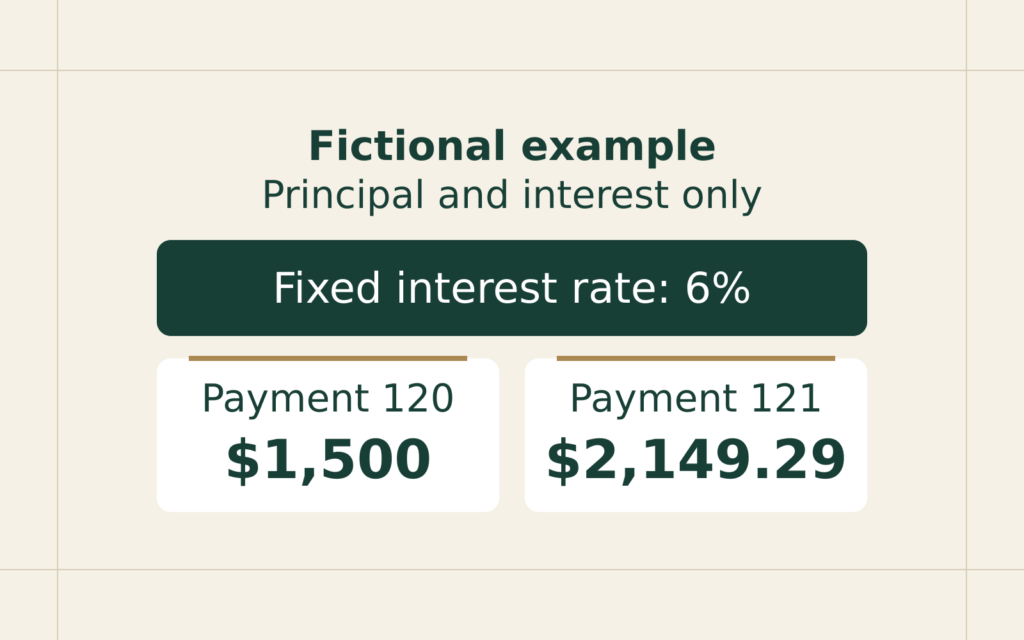
Assume a completely invented $300,000 mortgage with a fixed nominal annual rate of 6%, a 360-month total term, and interest-only payments for the first 120 months. Its contract then requires 240 fully amortizing monthly payments. There’s no balloon. The first payment occurs one month after funding; subsequent periods are equal months. This isn’t a current offer or a prediction of any lender’s terms.
Use 6% divided by 12 as the monthly rate. Exclude fees, extra payments, missed payments, financed charges, irregular periods, taxes, insurance and escrow. Calculations retain full precision; displayed cents are approximate. Under these assumptions, the first 120 payments are $1,500 each. After payment 120, the principal is still $300,000.
The CFPB’s repayment-ability rule commentary illustrates fixed-rate interest-only loans using the term remaining when amortizing payments begin. That regulatory example isn’t a promise that every loan has the repayment structure assumed here.
| Checkpoint | Payment | Principal afterward |
|---|---|---|
| Payment 120 | $1,500.00 | $300,000.00 |
| Payment 121 | $2,149.29 | $299,350.71 |
Payment 121 contains $1,500 of interest and about $649.29 of principal. The rate did not change. The extra cash now begins repaying the balance. For this invented schedule, the document-reading question is specific: does the written explanation connect the last $1,500 installment with the first $2,149.29 installment, rather than treating both as descriptions of the same month?
Don’t restart the calculator at thirty years
At the transition, use $300,000 principal, a monthly rate of 0.005, and 240 remaining payments. The formula is payment = principal × monthly rate ÷ [1 − (1 + monthly rate)−remaining payments]. It produces approximately $2,149.29.
Entering 360 payments instead produces approximately $1,798.65. That result is mathematically valid for a new thirty-year repayment schedule, but it isn’t the stipulated twenty-year remainder. It understates this example’s required installment by about $350.64 a month. Keep both calculator input records so the discrepancy is explainable without guessing that the lender used a different rate.
The original 360-month term isn’t an instruction to start counting again after ten years. Here, 360 minus 120 leaves 240. Nor should you subtract the $180,000 of interest paid during the first phase from principal: those payments did not repay the amount borrowed in this model.
Resolve the mismatch before relying on the lower amount
Imagine your notes expected $1,798.65 indefinitely, while the fictional offer describes $2,149.29 after payment 120. Ask not simply “Why did the payment rise?” Ask which remaining term supports the later figure and request the actual first changed-payment due date. Attach the input comparison, not just a screenshot of the lower result.
The CFPB’s interest-only explanation cautions against counting on a sale or refinance when payments rise. Depending on the loan, the end of the period can involve a lump-sum payoff or higher installments; refinancing isn’t assured. If the actual documents require a balloon, this example’s monthly calculation doesn’t replace it.
Finish with the lender’s written explanation and an updated record of the amount and date you’ll use for planning. An unresolved difference should remain visible, not disappear because one calculator result fits the budget. For an existing credit line rather than this mortgage disclosure, use the separate HELOC end-of-draw guide.
U.S. consumer education, checked October 29, 2026. Fictional arithmetic isn’t personalized advice or a lender quote.

One Mortgage Form, Two Borrowers
Match each person’s share.