Business B Notice: Another W-9 May Not Be Enough
Identify the notice stage and required evidence before treating a name-and-number mismatch as resolved.
Estimated reading time: 5 minutes
A business receiving a “B Notice” from a customer or payment company should first identify the account and the mismatch being reported. The notice concerns taxpayer-identification information used for payment reporting. Ask which reported entry needs attention before assuming the payer’s message identifies who made an error in reporting.
Separate the payer’s IRS notice from your notice
The IRS sends CP2100 or CP2100A notices to payers when reported payee information is missing or doesn’t match its records. For incorrect name/TIN combinations, the payer compares the listing with its own records. If the information agrees, the payer sends the appropriate B Notice to the payee.
If the payer’s records and the IRS list differ, the explanation may instead be a recent update, a filing error or an IRS processing error. Ask which account and reported combination are involved; a mismatch isn’t, by itself, proof that your business intentionally supplied false information. IRS CP2100 guidance.
First and second notices require different evidence
IRS Publication 1281 distinguishes the first B Notice, which requests a certified Form W-9 or acceptable substitute, from the second-notice process. For an EIN account, the second process requires IRS validation through Letter 147C; another W-9 isn’t the required validation.
“Second” isn’t simply the second envelope you opened. The rules track notifications for the account within three calendar years and include exceptions for notices received in the same calendar year or relating to the same account’s same reporting year. Ask the payer to explain its classification if unclear.
This guide’s second-notice discussion is limited to EIN accounts. Other identifier types have different validation procedures. Follow the actual notice promptly and obtain qualified tax help with uncertain status or timing. Don’t assume sending a document immediately stops withholding on the next payment. IRS Publication 1281.
A business name isn’t always the tax name
Form W-9’s instructions distinguish the name on line 1 from a different business or disregarded-entity name on line 2. For a sole proprietor or disregarded entity, line 1 generally identifies the owner. The TIN must match the line 1 name; the instructions contain specific rules for entity types and ownership arrangements.
Consequently, a familiar trading name on an invoice doesn’t settle which name and number belong on a tax certification. Review the actual entity classification with a qualified adviser if needed, rather than copying an invoice header into every field.
The form is provided to the requester, not sent to the IRS as a routine W-9 submission. Its certifications matter. This article doesn’t select your classification, exemption code or identifier, and doesn’t instruct you to sign a blank form. Current Form W-9 and instructions.
Withholding changes cash received, not the final tax calculation
The IRS states that backup withholding applies at 24% when required. Its B program concerns identification problems; the separate C program concerns certain interest-and-dividend reporting or certification problems. This article doesn’t determine whether a particular payment is subject to withholding.
For a fictional payment, assume the entire $5,000 is subject to 24% backup withholding and there are no other deductions. Withholding is $1,200, leaving $3,800 in cash. The $1,200 isn’t a processing fee or an additional invoice discount.
For cash planning, the fictional deposit supplies $3,800, not $5,000. A possible later tax credit isn’t another $1,200 available to pay a supplier on that deposit date.
The IRS explains that backup withholding shown on Form 1099 or W-2G is reported as federal income tax withholding on the return for the year the income was received. That doesn’t establish the final tax due or guarantee a $1,200 refund. Keep the withholding record separate from the cash deposit when discussing reporting with your tax preparer. IRS backup withholding overview.
Make the inquiry specific and keep it private
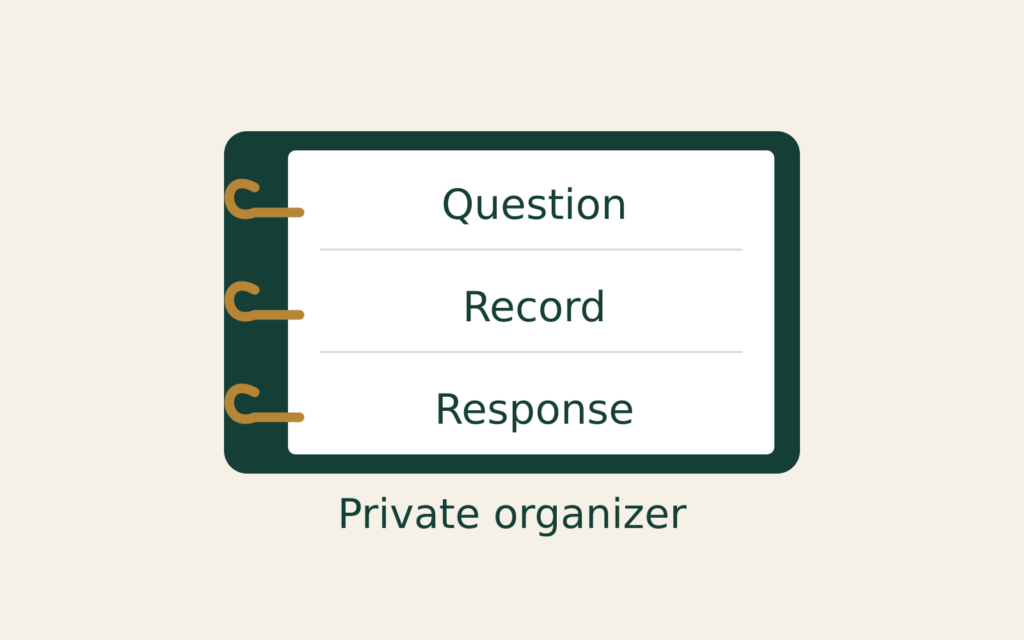
A short document index can prevent two customer accounts from being mixed together. Use internal labels rather than full tax identifiers in working notes that don’t need them. The table is an organizer, not a tax form or a complete compliance checklist.
| Record | What to retain |
|---|---|
| Original document | Date, sender and private account label |
| Question | Exact unclear entry and relevant page |
| Response | Who answered, when and what remains unresolved |
For example, “Customer A, account X, name entry unclear” and “Customer A, account Y, document requested” should remain separate entries until their relationship is confirmed. The same customer name doesn’t prove that every record concerns one account.
Use a previously verified contact route to clarify an unexpected request before sharing sensitive documents. Don’t post EINs, Social Security numbers, completed certifications or IRS letters in public comments. Keep a genuine submission acknowledgment with the exact document supplied; a draft saved on your computer isn’t evidence that the recipient received it.


