Business Failure Measures
A business-risk headline is useful only after its population, event and observation period are identified. These examples measure different things.

Estimated reading time: 5 minutes
A business-risk headline is useful only after its population, event and observation period are identified. These examples measure different things.
Follow the original establishment cohort
The Bureau of Labor Statistics’ October 30, 2026 analysis reports that 15.7% of private-sector establishments born in 2000 survived until 2026. That is a long observation of one birth cohort, not the percentage of businesses expected to survive their first year after a loan application today.
BLS describes an establishment as an economic unit, usually at one physical location and predominantly engaged in one activity. A firm can contain several establishments. Its survival data use over-the-year employment changes measured from March of each year.
For a borrowing proposal, label this evidence with its original birth year and endpoint. Calling the figure simply a “success rate” removes the elapsed time and changes the question the statistic actually answers. It does not supply an individual applicant’s repayment probability.
Check the Census event definition
The Census Bureau’s Business Dynamics Statistics FAQ defines firm death as the firm and all its associated establishments ceasing operations. A legal entity disappearing through merger or acquisition is not classified as a firm exit in these data. A disappearance from a business directory therefore cannot automatically be assigned that statistical label.
The FAQ also explains why an establishment entrant can have an age greater than zero: it may have positive March 12 employment, subsequently have zero employment on that date, and later have positive employment again. Entry is not necessarily a newly created operation.
For published entry and exit rates, Census uses longitudinally consistent counts across the two years. Its FAQ warns against simply combining unadjusted annual establishment totals. Use the published definition rather than constructing a denominator from conveniently available totals.
Match the bankruptcy reporting window
The U.S. Courts’ bankruptcy statistics index describes quarterly releases for twelve-month periods ending March 31, June 30, September 30 and December 31. A release appearing quarterly is therefore not automatically a count covering only three months.
The index separately identifies business and nonbusiness filings in the twelve-month F-2 table, fourth-quarter filings in a three-month F-2 table, monthly filings and county-level reports. Those labels matter before comparing two headlines. A total combining business and nonbusiness filings does not become a business-only series because it appears in an article about entrepreneurs.
Record both the table and its period when using this evidence. Adding successive rolling twelve-month releases would count overlapping months repeatedly, rather than produce a clean annual total.
Keep loan dollars separate from business counts
The SBA loan-program performance page, updated September 15, 2025, describes tables with data through June 30, 2025. Its fiscal year runs from October 1 through September 30. The programs include 7(a), 504, disaster lending and other specified SBA programs—not every U.S. business borrowing arrangement.
The page distinguishes loan counts, gross approval amounts, outstanding principal, charge-off amounts and recoveries. Its charge-off rate uses unpaid principal balance as the denominator. This is a dollar-based portfolio measure, not a percentage of business owners who closed their companies.
Recovery rates also have different reference groups: purchase-year amounts for total guaranteed-program recoveries and charge-off-year amounts for post-charge-off recoveries. Gross approvals include loans later canceled. Preserve those definitions when comparing tables; an approval amount is not a surviving-business count or an individual loan’s loss forecast.
Separate historical reasons for closure
The SBA Office of Advocacy’s May 2018 explanation of business closures discusses employer businesses that closed in 2015, using the Census Annual Survey of Entrepreneurs. Its leading reported reasons included low sales, retirement and selling the business. Other reasons included opening another firm and illness or injury.
That historical question asks why owners closed, not whether a currently operating borrower will default. The report notes that owners could select multiple reasons and that an “other reasons” category was substantial. The responses should not be treated as mutually exclusive slices that must add to one hundred percent.
Keep the survey year attached when citing these reasons. The report’s comparisons with 2007 describe those historical observations; they do not establish today’s mix of motives or prove that every closure reflects unsuccessful trading.
Read a conditional expectation as conditional
An NFIB release dated March 25, 2021 reported that 13% of surveyed owners expected to close within six months if economic conditions did not improve. Its linked sixteenth COVID-19 survey is dated March 11–16, 2021. NFIB collected 526 responses from its member-based email survey. This is a historical pandemic-era response, not a current closure forecast.
The condition is essential. Removing “if conditions do not improve” turns a contingent expectation into an unconditional prediction. The question concerned how long respondents thought they could operate under then-current conditions; it does not establish whether those same respondents subsequently closed.
Preserve the question wording and fieldwork dates alongside the percentage. A retrospective count of events and a forward-looking response are different evidence. Neither this old response nor its release date establishes the operating runway of a business seeking financing now.
Deferred Compensation
A deferred-compensation statement and payroll form can describe different rights and events.
Loan Horizons
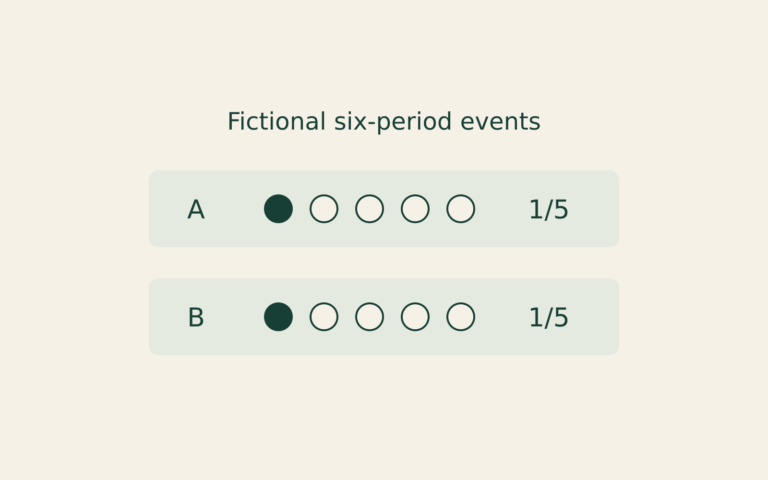
A smaller cumulative missed-payment count can reflect a shorter observation window. This fictional record exercise compares equal payment ages instead.
Rate Transmission
A rate announcement, a market yield and a contract reset describe different links between monetary policy and borrowing costs.