Loan Horizons
A smaller cumulative missed-payment count can reflect a shorter observation window. This fictional record exercise compares equal payment ages instead.
Estimated reading time: 2 minutes
A smaller cumulative missed-payment count can reflect a shorter observation window. This fictional record exercise compares equal payment ages instead.
Fix the event and the clock
Take ten invented loans at a June 30, 2026 extraction. The five A loans first had a scheduled monthly payment in January 2025; the five B loans started in January 2026. Each monthly payment is due by month-end. Count only whether the first missed scheduled payment has occurred, not the number of missed payments or the unpaid balance. Select six-period and twelve-period questions before inspecting outcomes.
At extraction, A supplies eighteen observed payment periods and B six. Table entries are payment-month positions; “None” means no observed miss.
| Loan | First miss | Observed through |
|---|---|---|
| A1 | 3 | 18 |
| A2 | 10 | 18 |
| A3 | 15 | 18 |
| A4 | None | 18 |
| A5 | None | 18 |
| B1 | 3 | 6 |
| B2 | None | 6 |
| B3 | None | 6 |
| B4 | None | 6 |
| B5 | None | 6 |
Change the horizon, not the records
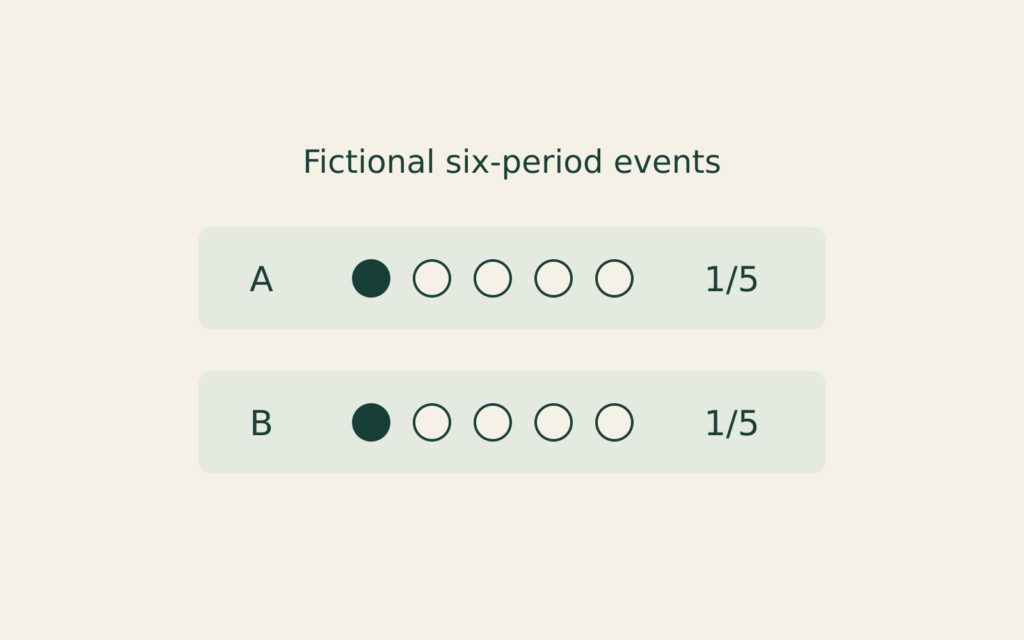
At extraction, A has three first misses among five loans, while B has one among five. Those are 60% and 20%, but the windows are eighteen and six periods. At the common six-period horizon, only A1 and B1 count: both groups have one first miss among five, or 20%.
At twelve periods, A1 and A2 count, producing 2/5. A3’s month-15 miss is known at extraction but lies outside that target. B1 already supplies a positive twelve-period outcome because its first miss occurred at month 3. B2–B5 do not supply negative twelve-period outcomes: each has only six observed periods.
Elapsed age does not replace observation
Separately, suppose A5 becomes unobservable after month 5 with no recorded miss. Its calendar age remains eighteen periods, but it no longer establishes an event-free six-period outcome.
NIST’s reliability handbook distinguishes event times from observation ending without an event.
Recognize the age label in published data
A November 24, 2025 FEDS Note presents cumulative auto-loan delinquency by origination vintage. Its accessible Figure 4 labels rows “quarters since origination.” That is a real example of an elapsed-age axis, not the source of our invented observations. Our first-missed-payment event is not that publication’s delinquency measure.
Equal six-period fractions answer this stipulated record question. They do not establish equal borrower quality or predict either group’s future performance.
Deferred Compensation
A deferred-compensation statement and payroll form can describe different rights and events.
Rate Transmission
A rate announcement, a market yield and a contract reset describe different links between monetary policy and borrowing costs.
Energy Evidence
Before treating an improvement proposal’s projected energy savings as payment money, identify what its supporting evidence actually measures.