Cash-Out Refinancing: Which Debt Qualifies as Home Acquisition Debt?
Trace a fictional refinance to the old principal, qualifying home improvements and personal spending before deciding what the debt classification shows.
Estimated reading time: 3 minutes
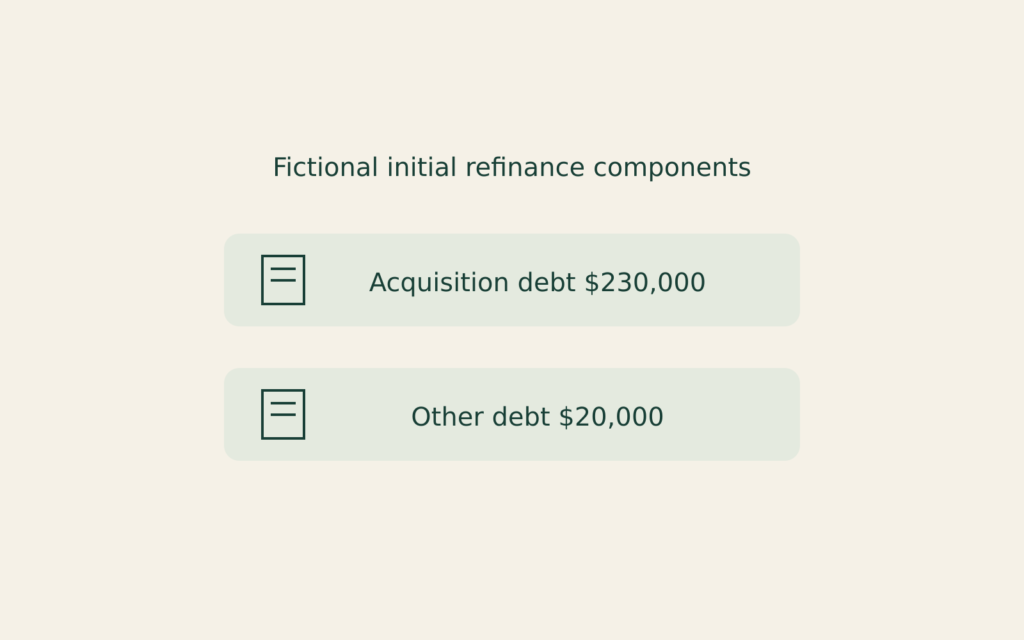
A refinance balance does not automatically equal home acquisition debt for federal tax purposes. In the fictional 2025 example below, a $250,000 refinance produces a $230,000 acquisition-debt component. The remaining $20,000 financed a personal car.
The useful question is where the proceeds went. Start by separating the old principal from additional borrowing, then trace the additional borrowing to its documented use. This guide explains that initial classification, not the final amount of deductible interest.
What the refinancing rule actually tests
IRS Publication 936 for 2025, under “Refinanced home acquisition debt,” treats secured refinancing of acquisition debt as acquisition debt only up to the old mortgage principal balance immediately before refinancing. Additional borrowing that is not used to buy, build or substantially improve a qualified home is not acquisition debt. The publication also explains the requirements for the home, security and applicable debt limits.
That makes the old payoff statement and the use of the new money different pieces of evidence. A larger new mortgage does not, by itself, show that every borrowed dollar has the same tax classification.
A $250,000 refinance, allocated dollar by dollar
Assume the borrower refinances in 2025. Their only home is an entirely personal-use main home bought in 2020, and the new loan is secured by that home. The verified remaining acquisition-debt principal is $200,000. The borrower directs $30,000 to completed qualifying substantial improvements to that home and $20,000 to a personal car.
Assume documented direct uses, no fees, other borrowing or qualifying expenditures, and no special purchase or construction timing treatment. The home and improvement cost exceeds the borrowing. Evaluate this allocation before any principal repayments.
| Use of proceeds | Amount | Acquisition-debt component in this example |
|---|---|---|
| Replace verified old acquisition principal | $200,000 | $200,000 |
| Qualifying substantial improvements to the secured home | $30,000 | $30,000 |
| Personal car | $20,000 | $0 |
| Total new principal | $250,000 | $230,000 |
The reconciliation is $200,000 + $30,000 + $20,000 = $250,000. The acquisition-debt component is $200,000 + $30,000 = $230,000. Keeping the car component visible prevents the new loan balance from being mistaken for the qualifying component.
Why this is not a 92% deduction rule
Dividing $230,000 by $250,000 gives 92%, but this is only a description of the initial principal allocation. It does not establish a fixed percentage of interest that the borrower may deduct. Repayment allocation, average balances, deduction limits and the other requirements in Publication 936 still need their own analysis.
A refinancing decision also has a separate cost question. Our refinance break-even calculator compares entered refinancing costs and savings; it does not decide tax deductibility.
Build a usable proceeds record
- Identify the old principal. Keep the statement that establishes principal immediately before refinancing, rather than treating every item in a payoff quote as principal.
- Reconcile the new borrowing. Match the closing records and transfers to the total new principal.
- Keep evidence for each additional use. Separate the improvement records from the car payment and other personal spending. Note the amounts and dates.
- Flag facts outside the example. Fees, repayments, multiple homes, mixed uses or special timing questions require a more complete application of the publication.
Use this as a classification worksheet beside the actual loan records. It does not determine an individual return, tax bill or deduction. The source used here is the 2025 edition of Publication 936; a different tax year needs its applicable guidance.
HELOC Balances and Mortgage Ratios
Compare drawn balances with committed credit.
Mortgage Payments Below Interest
Trace cash paid and debt remaining.
Refinancing: Remaining Mortgage Points
Track previously deducted and remaining points.