Unused Credit Fees and Utilization
Compare drawn and undrawn costs.
Estimated reading time: 1 minute
Midwest BankCentre explains that some banks charge for unused credit. A lower borrowing rate alone therefore cannot rank offers.
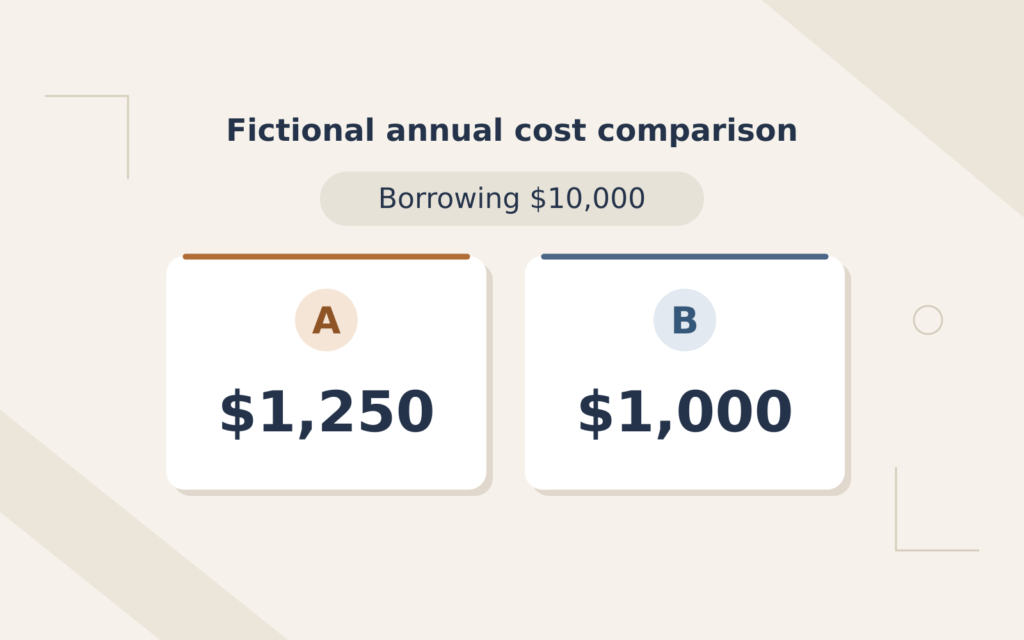
Fictional comparison: two $100,000 commitments last one full year. Each permits the same constant borrowing throughout. Interest and fees are paid separately at year-end, without compounding, other charges or rate changes.
A charges 8% annually on borrowed principal plus 0.5% on commitment minus borrowing. B charges 10% on borrowed principal, with no unused fee. These are invented terms, not bank offers.
At $10,000 borrowed, A costs $800+$450=$1,250; B costs $1,000. At $40,000 borrowed, A costs $3,200+$300=$3,500; B costs $4,000.
With D denoting borrowed dollars, the tie solves 0.08D + 0.005(100,000−D) = 0.10D: D=$20,000, costing $2,000 under either offer. Lower utilization favors B; higher favors A within this model.
These figures exclude principal repayment. Borrowing extra merely to avoid the unused fee increases A’s cost. Compare your actual expected usage, fee base, payment dates and draw conditions before choosing.
Dental Plans and Non-Duplication
Calculate the secondary payment.
Rent-to-Own: Remaining Purchase Costs
Compare future outlay and available cash.