Water Rate Blocks
Allocate usage reductions.
Estimated reading time: 1 minute
EPA explains that increasing-block water rates charge successive usage blocks at higher unit prices. Utilities may combine fixed and volume-based charges.
Fictional monthly schedule: $20 fixed charge; first 3,000 gallons at $2 per 1,000; next 3,000 at $4 per 1,000; usage above 6,000 at $6 per 1,000. Assume unchanged rates and billing periods, with no other charges.
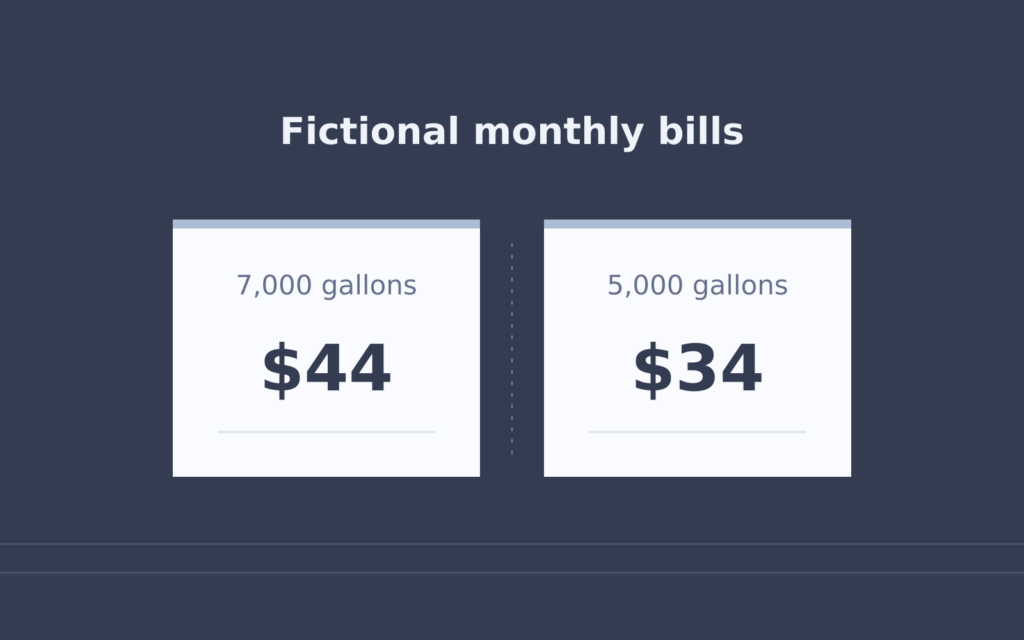
At 7,000 gallons, the bill is $20 + (3 × $2) + (3 × $4) + (1 × $6) = $44. Only 1,000 gallons receive the highest rate.
At 5,000 gallons, it is $20 + (3 × $2) + (2 × $4) = $34. The 2,000-gallon reduction saves $10: $6 from the highest block and $4 from the next block.
Multiplying all 2,000 saved gallons by the highest rate would predict $12, overstating savings. The fixed $20 remains.
Before budgeting a conservation project, apply your schedule to both usage scenarios. Check units, sewer charges, seasonal rates and fees separately. This example neither predicts achievable water savings nor recommends reducing essential water use.