Reverse Split Records
Reconcile fractional cash.
Estimated reading time: 1 minute
A reverse split changes the share count; fractional-share treatment determines what remains as shares or cash.
Investor.gov explains that ten old shares become one in a one-for-ten reverse split. Some arrangements cash out fractions, and subsequent trading prices can fall.
Reconcile a fictional statement
Start with 237 shares valued at $4 each: $948. Assume a one-for-ten split and specified terms paying $40 per new-share equivalent for fractions, with no fees or taxes.
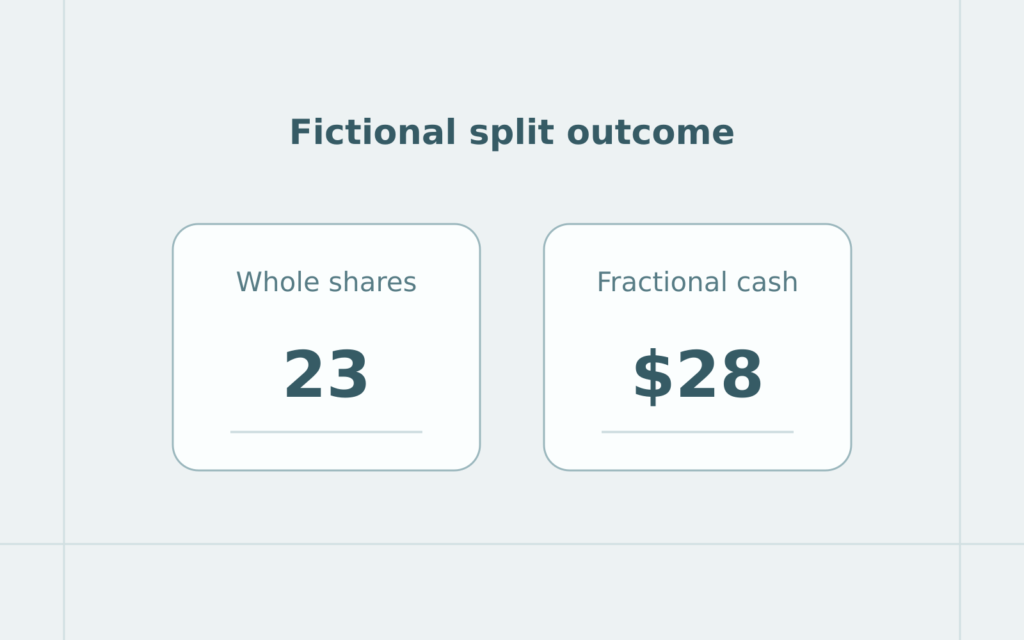
237 ÷ 10 = 23.7. The record becomes 23 whole shares plus cash for 0.7 share: 0.7 × $40 = $28.
At an illustrative $40 post-split market price, shares are worth $920; adding $28 cash reconciles to $948. Counting 23.7 shares plus the cash would double-count the fraction.
If the market price later falls to $36, the shares are worth $828. With the unchanged $28 cash, total value is $856—$92 less.
Verify the ratio, fractional treatment, actual cash pricing and payment status. The assumed cash price is not guaranteed; this is not a tax-basis calculation or investment recommendation.