Closed-End Fund Discounts
Separate two prices.
Estimated reading time: 1 minute
A closed-end fund’s rising net asset value does not guarantee a rising share price.
Investor.gov explains that publicly traded closed-end funds can trade below net asset value (NAV). Buying at a discount does not ensure you can later sell without one.
Track both prices
Fictional purchase: 100 shares at $18 each, while NAV is $20 per share. The discount is ($20 − $18) ÷ $20 = 10%; purchase cost is $1,800.
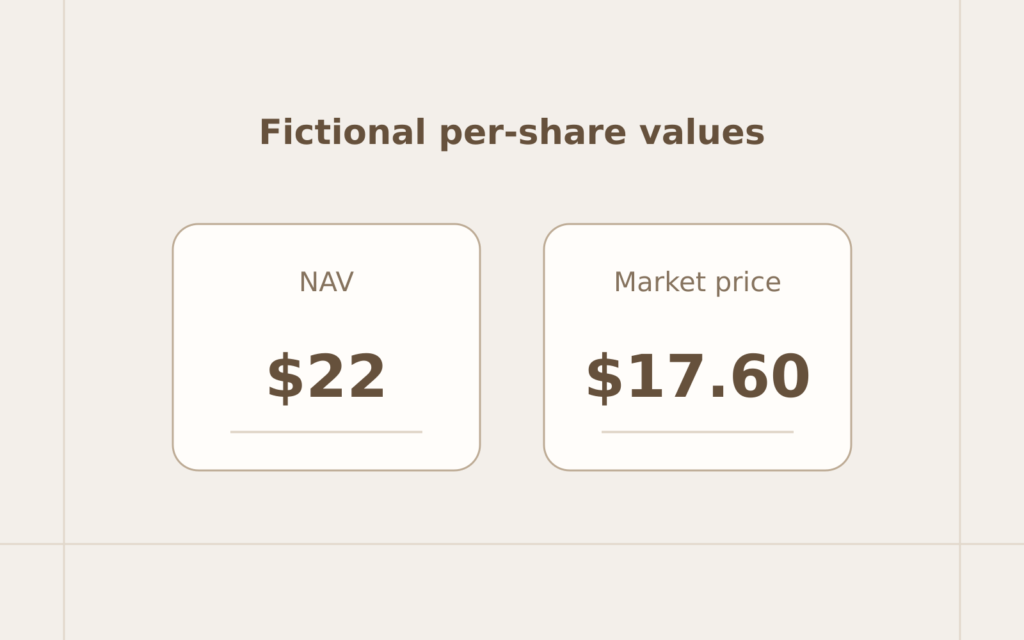
Later, NAV rises to $22, but the discount widens to 20%. Market price becomes $22 × 80% = $17.60. The holding’s market value is $1,760, down $40, or approximately 2.22%, despite NAV rising 10%.
For comparison, an unchanged 10% discount would imply $19.80 per share and $1,980 market value. Neither discount path is a forecast.
These examples assume no distributions, subsequent trades, transaction fees or taxes. They measure market value, not guaranteed sale proceeds. Match NAV and market-price dates, and review distributions and expenses separately before interpreting performance.