Inventory Turns and Averaging
Keep every observation.
Estimated reading time: 1 minute
APQC’s inventory-turns definition divides annual cost of goods sold by average month-end total inventory. Its denominator includes raw materials, work-in-process and finished goods.
Keep all twelve observations
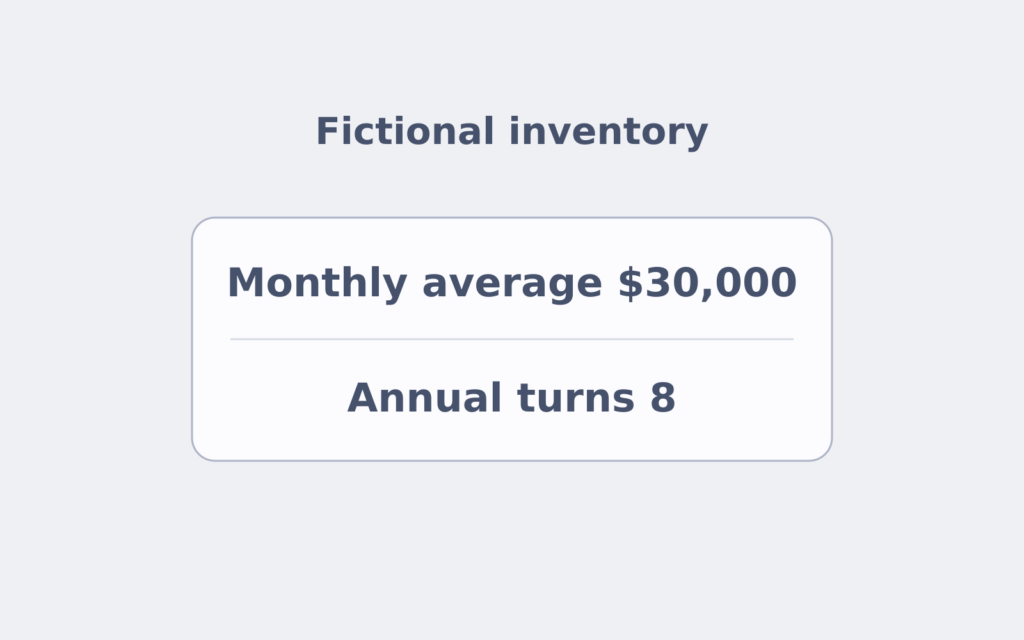
A fictional business has $240,000 annual cost of goods sold. Total inventory at cost is $20,000 at each of nine month-ends and $60,000 at each of the other three. The final month is one of the $20,000 observations.
The twelve balances sum to 9 × $20,000 + 3 × $60,000 = $360,000. Their average is $30,000. Annual turns are $240,000 ÷ $30,000 = 8.
Substituting the $20,000 year-end balance produces 12 turns—50% above 8—without changing any sales or stock activity. It is not the stated measure.
Read the definition before comparing
Retain the twelve dated balances, valuation basis and matching annual cost figure. A different averaging convention needs explicit labeling; neither result proves cash available for repayment. Month-end observations also miss movements within each month. This calculation diagnoses the denominator, not an optimal stock level or a borrowing recommendation.


