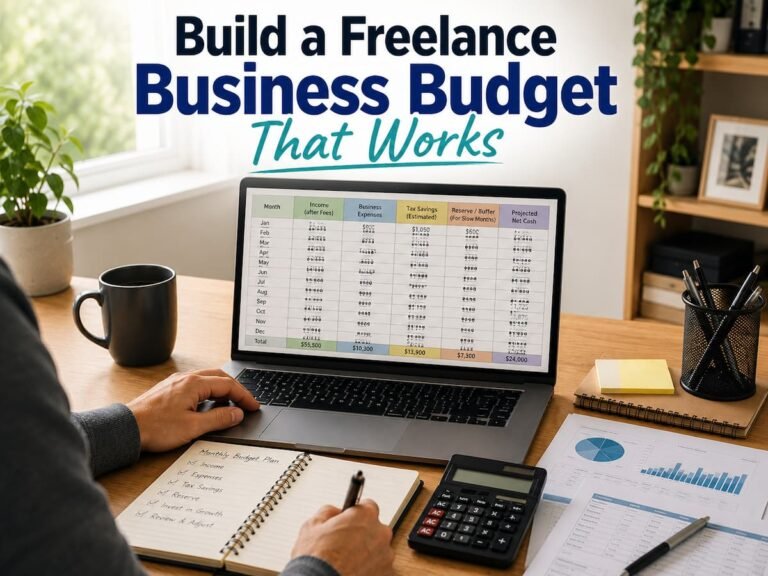

How to Create a Freelancer Cash Flow Forecast: A Beginner’s Guide
A cash flow prediction makes the timing clearer. Asking when you expect funds to actually reach your account allows you to compare that to anticipated expenditures rather than just asking how much money you expect to earn this year. Because of this, you can more easily anticipate impending cash shortages. Find out how to construct a basic cash flow forecast for a freelancer, how to anticipate unexpected income, how to handle sluggish periods, how to account for delayed payments, how to prepare for taxes, and how to keep your forecast practical without making it become a tedious accounting exercise.
The Truth Behind a Freelancer’s Cash Flow Forecast
A cash flow forecast is an estimate of the money you expect to receive and spend over a certain time. For a freelancer, timing is crucial. For instance, just because you have a $3,000 project doesn’t imply you’ll have an additional $3,000 lying around right now. The month you expect to receive the payment, not the month you start the project, is where the money belongs in the forecast if the client pays 30 days after delivery.
Your starting cash balance is the standard starting point for any basic prediction. Then, add up all of the anticipated cash inflows and deduct all of the anticipated cash outflows. Your anticipated cash balance at the end of the day is the outcome. That final sum is used as the beginning balance for the subsequent period.
| Forecast Item | Example | Why It Matters |
|---|---|---|
| Opening cash | $4,000 | Shows how much cash is available at the start. |
| Cash received | $5,500 | Shows the money expected to enter the account. |
| Cash paid out | $3,800 | Shows expected business and personal cash demands. |
| Closing cash | $5,700 | This shows the projected cash position at the end. |
The key point is that a cash flow forecast is not the same as a profit calculation. A freelancer can appear profitable on paper and still experience a cash shortage if clients pay slowly or large bills arrive before customer payments. The forecast gives you a practical view of whether you are likely to have enough cash available when you need it.
Why Cash Flow Forecasting Matters for Freelancers
Traditional jobs offer stable salaries and schedules. Freelancers rarely have that privilege. Project availability, customer payment terms, seasonal demand, and task completion and invoicing speed may affect your income. Thus, cash flow planning is crucial. Imagine a freelance designer expecting $6,000 in April. Three clients have approved projects, which is promising. One client pays in May, another pays after 45 days, and the third pays when the project is finished. The freelancer expects $6,000, but just a portion may arrive in April.
Forecasts show this discrepancy before bills are due. This information can help you decide whether to accept another project, delay a non-essential purchase, follow up on an overdue invoice, or increase your cash reserve. Imagine a cash flow prediction as an early warning system. Not accurately predicting the future is its major job. It provides visibility to help you make better decisions before emergencies. A forecast can also relieve freelancers with irregular income from worrying about their next payment. You cannot control all payment dates, but you may plan for uncertainty.
Select a Forecasting Period
Decide how far ahead to forecast before entering numbers. Many freelancers start with a rolling 12-month forecast, which accounts for seasonal changes, annual expenses, and slow periods. Looking only at annual totals can hide short-term cash issues. Monthly forecasting sometimes strikes a balance between detail and simplicity. If your income is unexpected or you fear a cash deficit, analyse the following four to eight weeks in detail.
| Forecast Period | Best Use |
|---|---|
| Weekly | Managing immediate bills and payment timing. |
| Monthly | Planning regular freelancer cash flow. |
| 12 months | Preparing for seasonal income and annual expenses. |
| 24 months | Longer-term planning when your business is established. |
For a beginner, a monthly forecast covering the next 12 months is usually a sensible starting point. You can make the first two or three months more detailed if payment timing is a concern. The goal is to create something you will actually maintain, not a complicated spreadsheet that becomes outdated after one week.
Start With Your Current Cash Position
Get an accurate picture of your cash before forecasting. Check your freelance account balances and record the amount accessible for business activities. Avoid counting money previously allocated. If you have $5,000 in a business account but $1,500 is reserved for a tax payment next month, treating the full $5,000 as freely available may be misleading.
It organizes cash into useful categories. You may have operating cash, tax money, and emergency or slow-down funds. Separating these numbers helps simplify your forecast, but the structure depends on your situation. Opening balances should not reflect expected client payments. Record just available cash. Place future payments in the appropriate timeframe based on your expectations. Bad idea: Starting the forecast with your bank balance and adding every unpaid invoice. When clients have extended or unpredictable payment terms, this approach can make your cash position appear healthier than it is.
Estimate Freelancer Income Realistically
Income is the hardest part of a freelancer’s cash flow projection because it changes quickly. Dividing predicted income by certainty is safest. The best starting point is confirmed projects. These assignments have a formal payment date and agreement. Next, your work may involve ongoing client interactions or contracts. Finally, there may be projects you want but haven’t secured.
Don’t trust all three categories equally. Including a confirmed project in your forecast is reasonable. Possible projects should be removed from the primary prediction or placed under an optimistic scenario. For instance, a freelance writer could earn this in June:
| Income Source | Amount | Confidence |
|---|---|---|
| Signed project | $2,000 | High |
| Recurring client work | $1,200 | Medium to high |
| Proposal awaiting approval | $1,500 | Low to medium |
The freelancer should avoid assuming that the full $4,700 will definitely arrive in June. A more cautious forecast may include the signed project and a conservative estimate of recurring work while excluding the proposal from the expected scenario. It is also helpful to review your past income. If you earned $30,000 last year, do not automatically divide that amount by 12 and assume you will receive $2,500 every month. Look at the actual pattern. Some months may have been strong while others were quiet. Historical patterns can help you create more realistic expectations.
Account for Payment Timing and Delays
Payment timing is one of the most important details in a freelancer’s cash flow forecast. Revenue and cash received are not always recorded at the same time. A client may approve a $2,000 project in January, but you may not receive payment until February or March. For each major expected payment, please estimate when the money will actually arrive in your account. Consider the client’s payment terms, your usual invoicing process, approval delays, weekends, holidays, and your completion date.
If a client normally pays 30 days after receiving an invoice, do not assume that sending the invoice today means the money will arrive tomorrow. Your forecast should reflect the actual payment cycle as closely as possible.
Expert tip: When payment timing is uncertain, use a conservative date in your main forecast. If the money arrives earlier, that is a positive surprise. If you assume the earliest possible date and the payment arrives late, your forecast may fail when you need it most.
Map Out Fixed and Variable Expenses
After estimating incoming cash, list the money you expect to spend. Start with expenses that occur regularly and are relatively easy to predict. These might include internet service, software subscriptions, accounting fees, insurance, office rent, or professional memberships. Then identify variable expenses. These may include advertising, equipment repairs, travel, subcontractors, professional training, or project-specific costs. Variable expenses are harder to predict, so reviewing your past spending can help you create reasonable estimates.
| Expense Type | Examples | Forecast Approach |
|---|---|---|
| Fixed | Software, internet, rent | Use known recurring amounts. |
| Variable | Travel, supplies, marketing | Estimate using past spending. |
| Irregular | Equipment replacement, annual fees | Schedule the expected payment month. |
| Project-related | Freelancers, printing, materials | Match costs to the relevant project. |
One frequently overlooked issue is the difference between business expenses and personal living costs. If your freelance income is your main source of household income, your personal budget also affects how much cash you need to withdraw from the business. You do not necessarily need to combine every personal expense into the business forecast, but you should understand how much money you need to transfer from freelance earnings to cover your life. Separating business cash flow from personal spending can make both sides easier to manage.
Plan for Taxes and Other Irregular Costs
As a freelancer, you pay bills monthly, meaning taxes can significantly impact your cash flow. Tax payment schedules vary based on your location and working style—occurring periodically, annually, or at other intervals. Do not blindly rely on general percentages found in online articles; consult local tax laws. A qualified tax advisor or the tax authorities can explain your tax obligations.
When creating your budget, factor in anticipated tax expenses for the months in which you receive income. You should also include easily overlooked annual expenses, such as insurance renewals, domain registration fees, accounting service costs, professional association memberships, and equipment replacement costs. Reviewing last year’s calendar and bank statements can be helpful; identify any one-off or major expenses. While these items might not appear in your monthly budget, they can still affect your cash flow.
What to Do If Your Forecast Shows Cash Shortage
Although a projected negative balance is concerning, it is precisely one of the main reasons for creating a budget forecast. Spotting issues early often opens up more potential solutions. First, determine whether the cash shortfall stems from planning issues or income problems. If you anticipate a €4,000 client payment next month, the issue may be temporary. If income consistently falls short of expenses, you will need to make more significant changes. We can follow up on outstanding invoices, adjust plans for non-essential purchases, review subscriptions, boost short-term sales, or renegotiate project milestones and down payments.
Additionally, consider whether costs can be cut without compromising quality. Avoid making judgments based on optimistic expectations of future revenue; unapproved projects do not guarantee cash flow. Do not take on costly commitments simply because it has been a particularly strong month. Prioritize preparing for anticipated liquidity shortfalls. Review your assumptions, identify the underlying causes, and determine how to improve the timing and amount of cash flow payments.
Accurate Long-term Forecasts
Cash flow forecasts are only useful if they reflect reality. A draft is merely an estimate, not the final version. Update forecasts as invoices, projects, and expenses change. For many freelancers, a simple weekly check suffices. Compare cash inflows against expectations. Check which expenses are over or under budget. Reschedule overdue payments to more realistic dates. Add new projects and remove inactive ones.
Compare forecasts with actual results at the end of the month. Understanding which assumptions were too optimistic or too conservative helps improve future forecasts. If you expect clients to pay within 15 days but they typically take 30 days or longer, your forecast should reflect this. Our goal is to ensure forecasts are realistic, not necessarily to aim for improvements. Another effective approach is to list outstanding invoices separately. Cash flow forecasts should focus on when you expect to receive funds, whereas an invoice tracking system helps you monitor which clients still owe money and when you need to follow up. These tools can work together, but they serve different purposes.
Avoid Mistakes
Initial forecasts often contain the same errors. The most common mistake is assuming that all projects will proceed according to plan. Your forecasts as a freelancer should reflect uncertainty rather than hide it. Ignoring irregular expenses is another mistake. Annual renewals, tax payments, equipment purchases, and professional service fees can disrupt your cash flow, whereas monthly subscription costs are easy to remember.
Some freelancers confuse profit with cash. Even profitable projects can lead to a cash shortage if you have to cover expenses before receiving payment from clients. Finally, many people create an excellent spreadsheet but forget to update it. A simple weekly forecast is usually better than a detailed one that is out of date.
| Mistake | Better Approach |
|---|---|
| Counting unpaid invoices as available cash | Forecast cash based on realistic payment dates. |
| Assuming every proposal becomes a project | Separate confirmed work from potential income. |
| Ignoring taxes | Schedule expected tax payments in the correct periods. |
| Forgetting annual expenses | Review the previous year’s bank transactions. |
| Using only one scenario | Compare expected results with realistic downside conditions. |
| Never updating the forecast | Review actual results regularly and adjust assumptions. |
A clear forecast should also be easy to explain. If you cannot understand why a number appears in your spreadsheet, please consider simplifying it. Your forecasting system should support better decisions, not create additional administrative work.
FAQs
1. What if my freelance income fluctuates from month to month?
Many freelancers experience income instability, which is normal. Instead of trying to predict your monthly income precisely, it is better to make conservative estimates and prepare for various scenarios. Base your income projections on confirmed projects and actual, regular work. Only include potential projects in your calculations once they are confirmed. Furthermore, review your past earnings to see which times of the year were more or less profitable.
2. What is the difference between cash flow forecasting and budgeting?
There is no difference. Budgeting typically accounts for planned income and expenses over a specific period, whereas cash flow forecasting focuses more on expected income and expenses. This difference in timing is crucial for freelancers. You might have enough income to cover your annual expenses yet face short-term cash flow issues because clients are late paying large invoices.
3. What is the best tool for a freelancer to create a cash flow forecast?
A spreadsheet is usually the simplest tool. You can set up monthly columns and rows to track your opening balance, expected income, expenses, taxes, and closing balance. The best tool is one that you understand and can update regularly. As your business grows more complex, accounting or financial management software may offer more functionality. You do not need expensive software to create preliminary cash flow forecasts.
4. How often should I review my cash flow forecasts?
For many freelancers, simple weekly reviews and more comprehensive monthly reports are invaluable. You may need to review them more frequently during busy periods, when projects undergo significant changes, or when your financial situation is uncertain. It is important to compare actual results with your assumptions and adjust forecasts for the coming months as circumstances change.
5. How large should a freelancer’s emergency fund be?
There is no single answer that applies to every freelancer. Your ideal reserve depends on the stability of your income, how quickly you find new work, your basic expenses, and whether you have other sources of income. If you are a freelancer with a fluctuating income, you may need a larger buffer than freelancers with a stable, long-term income. Create a cash flow forecast and determine how much money you need to bridge a reasonable period outside of peak season.
Conclusion
You don’t need to be a financial expert to create a cash flow forecast for freelancers. The key is understanding your current financial position, as well as when you expect to receive income and incur expenses. Once you understand these three factors, you can make decisions with greater confidence.
Start by creating a simple monthly forecast for the next 12 months. Use confirmed income figures wherever possible. Be cautious regarding uncertain projects. Record income only for the months when you actually expect to receive it. Include recurring expenses, taxes, annual costs, equipment expenses, and other non-fixed costs that you might easily overlook in your forecasts.
Most importantly, keep your forecasts up to date. A cash flow forecast is not intended to predict every detail with absolute precision. It is a planning tool that helps you spot problems early, prepare for periods of lower income, and avoid confusing future earnings with your current cash position. Even a simple spreadsheet, if reviewed regularly, can give you better insight into your finances as a freelancer and help you plan your next steps more wisely.