Advance Cash Reconciliation
Separate earned revenue.
Estimated reading time: 1 minute
Cornell’s accounting guidance distinguishes advance cash from earned revenue: future services remain owed.
Fictional business: a customer pays $1,200 upfront for twelve months of equal service. Assume the accounting treatment recognizes $100 revenue after each month’s service is completed. No other transactions, taxes or adjustments apply except the costs below.
Initially, cash increases $1,200 and deferred revenue—a liability—increases $1,200. No revenue has yet been earned.
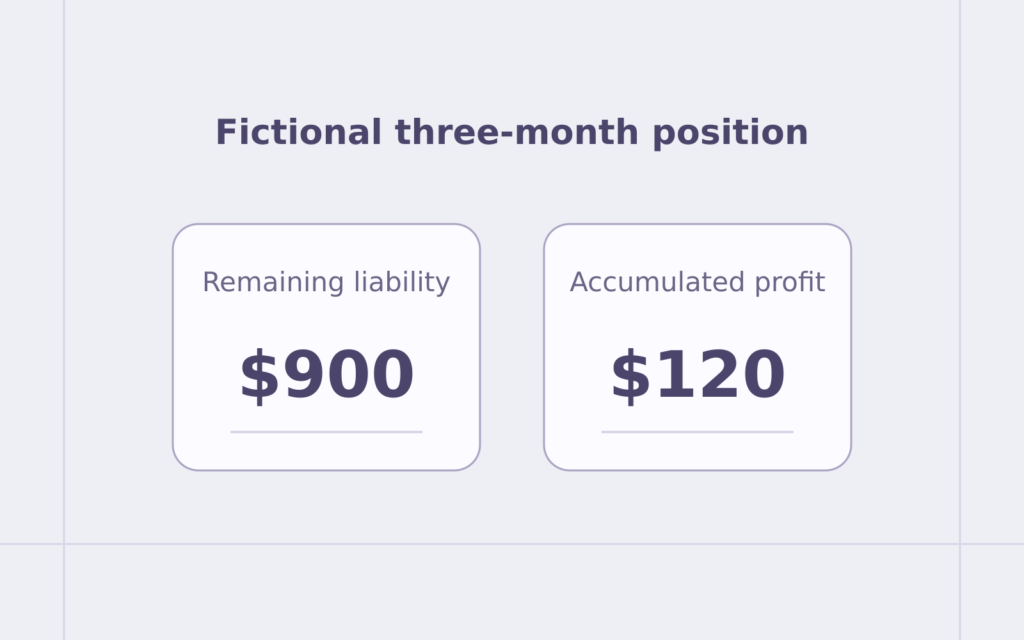
After three completed months, recognized revenue is $300 and the remaining liability is $900. Recognizing the $300 does not bring in another $300 cash.
Assume service costs of $60 monthly are expensed and paid immediately. Costs total $180, leaving $1,020 cash and $120 profit: $300 minus $180. The position reconciles: $1,020 cash equals $900 liability plus $120 accumulated profit.
The $900 obligation is not automatically a $900 refund payable or a $900 delivery-cost estimate. Actual contracts and accounting rules determine treatment. Before using advance cash for debt payments, map remaining service costs and payment dates; the bank balance alone is not earned profit.