Business Casualty Loss Measures
Distinguish damage outcomes.
Estimated reading time: 1 minute
IRS Topic 515 distinguishes partial damage from complete destruction when measuring a business casualty loss.
Two alternative outcomes
Fictional freestanding machine is used exclusively in business, separately accounted for, not inventory or in a general asset account. Its verified adjusted tax basis is $6,000; prefire fair market value is $4,000. A sudden accidental fire qualifies as a casualty.
Each alternative assumes a timely insurance claim, final $1,000 reimbursement and no other reimbursement expected. These are alternatives, not two losses.
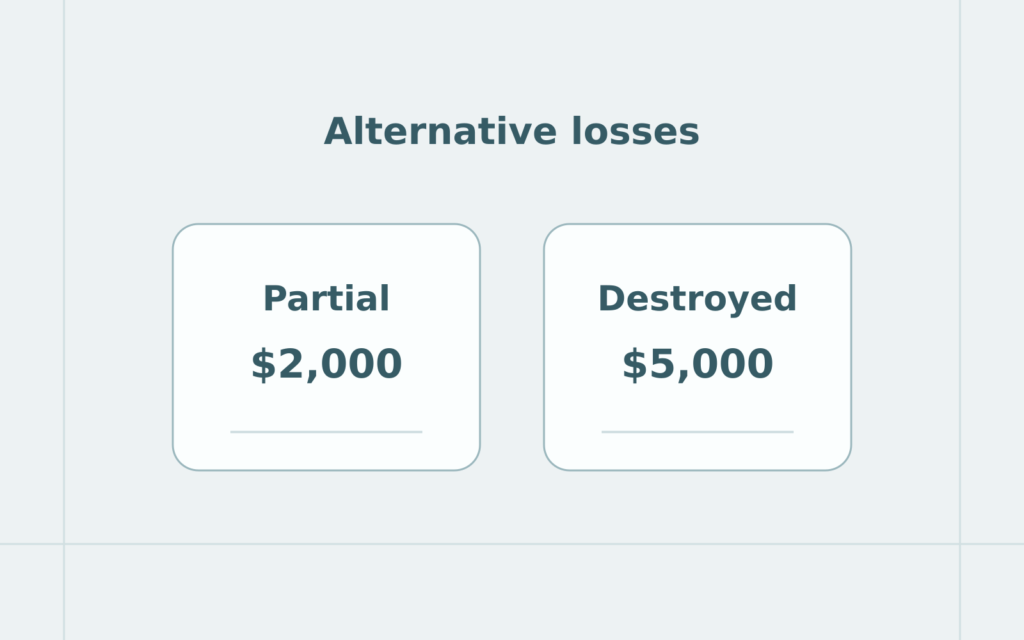
- Partial damage: supported postfire value is $1,000. The decline is $4,000 − $1,000 = $3,000. Take the smaller of $6,000 basis and $3,000 decline, then subtract reimbursement: $3,000 − $1,000 = $2,000.
- Complete destruction: salvage value is zero. Use adjusted basis rather than the market-value decline: $6,000 − $0 − $1,000 = $5,000.
Label the result
These are loss amounts, not insurance entitlements, replacement budgets or tax savings. Keep basis, damage appraisal and reimbursement records separate. Final deduction treatment requires further review; personal-use property follows different rules.