Compare monthly obligations with gross income and test a proposed new payment.
The interactive form requires JavaScript. The worked example, formulas and source links below remain available.
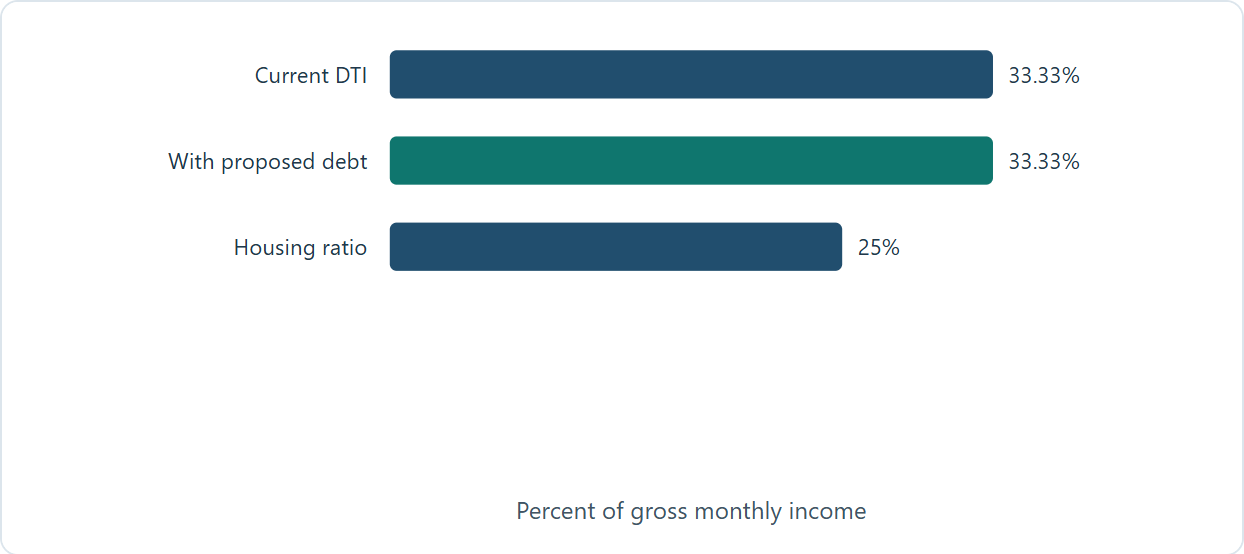
Debt to income calculator: default example chart
On this page
Debt to income: what debt-to-income ratio measures
Your debt-to-income ratio, or DTI, compares recurring monthly debt obligations with gross monthly income. The result is a percentage. A DTI of 33.33% means the entered debt payments equal approximately one-third of the entered income before taxes and other deductions. It doesn’t mean one-third of take-home pay, and it doesn’t measure every household expense.
The CFPB’s explanation of DTI defines the calculation as monthly debt payments divided by gross monthly income. Lenders use DTI when evaluating borrowing applications, but requirements and the treatment of particular income or debts can differ. This calculator provides a transparent estimate; it doesn’t determine whether a particular lender will approve a loan.
Use the result to understand how an additional payment changes your obligations, compare scenarios, and prepare questions for a lender. Then review your actual take-home budget separately. A ratio can look manageable while housing, childcare, medical costs, or other necessary expenses leave little money available.
How to enter income and debt payments
Gross monthly income: enter income before payroll taxes and other deductions. If you receive a regular annual salary, dividing that salary by 12 gives a monthly equivalent. A $72,000 annual gross salary corresponds to $6,000 monthly for this calculation. Don’t use a net paycheck and label the resulting ratio as a standard gross-income DTI.
Monthly housing payment: enter the recurring housing amount appropriate to the scenario and the lender’s calculation. For a proposed mortgage, confirm which taxes, insurance, association dues, and other housing obligations are included. For an existing mortgage, avoid entering only principal and interest if the relevant calculation calls for a broader housing expense.
Other monthly debt payments: enter obligations apart from the housing payment already entered. These may include auto loans, student loans, credit-card minimums, and other required payments. Use monthly required amounts rather than total account balances. Don’t count the same mortgage or loan payment in both the housing and other-debt fields.
Proposed new payment: enter a payment you want to add to the scenario. If a new loan will replace an old obligation, remove the old payment from the appropriate field before adding the new payment. Counting both would overstate the intended post-transaction obligations.
The calculation behind the percentage
Current DTI equals (monthly housing payment + other monthly debt payments) ÷ gross monthly income × 100. The after-new-payment result adds the proposed payment to the numerator. The housing ratio, shown separately, equals the housing payment divided by gross monthly income and multiplied by 100.
Keeping these figures separate helps show whether a change comes from housing, other debts, or income. For instance, adding a car payment affects total DTI but doesn’t change the housing ratio if housing and income stay the same. A reduction in income raises both ratios when payment amounts remain unchanged.
A zero income input can’t produce a meaningful percentage through division. The calculator should ask for a positive gross income instead of showing infinity or a misleading 0%. Zero debts with positive income produce a 0% DTI, but that doesn’t mean the household has no living expenses or automatically qualifies for new credit.
Debt to income example: $2,000 of debt payments on $6,000 income
Consider a hypothetical borrower with $6,000 gross monthly income. The entered housing payment is $1,500. Other required monthly payments are $250 for an auto loan, $150 for a student loan, and $100 in credit-card minimums. Other debts therefore total $500, and all entered monthly obligations total $2,000.
| Item | Monthly amount |
|---|---|
| Gross income | $6,000 |
| Housing payment | $1,500 |
| Other debt payments | $500 |
| Total entered obligations | $2,000 |
| Total DTI | 33.33% |
| Housing ratio | 25.00% |
The total calculation is $2,000 ÷ $6,000 × 100. The housing calculation is $1,500 ÷ $6,000 × 100. These percentages describe the entered scenario; they do not place the borrower into a universal approval or denial category.
If the borrower adds a $500 monthly debt payment without removing another obligation, total payments rise to $2,500 and DTI rises to approximately 41.67%. The housing ratio stays at 25% because neither housing nor income changed. This side-by-side view is useful when estimating the effect of a proposed purchase.
Convert income consistently and allow for uncertainty
For consistent weekly income, multiplying a weekly gross amount by 52 and dividing by 12 gives an average monthly equivalent. For biweekly income, use 26 pay periods per year; for twice-monthly income, use 24. Confusing biweekly and twice-monthly pay creates a different annual total.
These conversions are mathematical averages, not a lender’s determination of qualifying income. Commission, overtime, bonus, self-employment, seasonal, or recently changed income may require documentation and a different assessment. Ask the lender how it calculates the income figure for the specific product.
To see sensitivity, keep the $2,000 monthly obligation total but lower gross income from $6,000 to $5,000. DTI becomes 40%. That scenario shows the effect of an income change without predicting that it will occur. It can help you understand the consequences of reduced hours, a leave period, or variable earnings.
DTI isn’t a complete affordability budget
Gross income isn’t the money deposited after taxes, retirement contributions, insurance, and other deductions. DTI also doesn’t list every cost of living. Groceries, utilities, necessary transportation, childcare, and irregular bills may absorb a substantial share of the money remaining after debt payments.
Build a separate monthly budget using take-home income and actual expenses. Include savings for predictable annual costs and a reserve for unexpected events. The emergency fund calculator estimates a reserve from essential expenses and a chosen coverage period.
For a home purchase, compare the complete housing payment with your budget. The mortgage payment calculator separates principal and interest from entered taxes, insurance, mortgage insurance, and HOA dues. Repairs, utilities, and maintenance need separate consideration even if they are outside the lender’s DTI calculation.
Use scenarios to understand changes in the ratio
There are two mathematical ways to lower DTI: reduce the included recurring debt payments or increase the qualifying income used in the denominator. The calculator helps quantify a proposed change, but it doesn’t assume a lender will accept every income source or immediately recognize a payment reduction.
In the example, reducing other debt payments by $200 lowers total obligations from $2,000 to $1,800. With income unchanged at $6,000, DTI becomes 30%. Increasing income from $6,000 to $6,500 while keeping $2,000 obligations produces approximately 30.77%. Each result follows from its specific inputs.
A lower required payment can also result from extending a loan term. That may reduce DTI while increasing total interest, so the ratio alone doesn’t determine whether the change is beneficial. Use the loan payment calculator to examine monthly payments and total interest together.
Common input mistakes to avoid
Don’t enter a $10,000 loan balance as though it were a $10,000 monthly payment. DTI uses recurring payment obligations. Likewise, don’t add the full credit-card balance to the numerator when the relevant calculation asks for the required monthly payment.
Don’t add rent and a proposed mortgage as permanent simultaneous obligations if the transaction actually replaces the rent and the lender’s method treats it that way. Conversely, don’t remove an existing obligation merely because you hope to repay it later. Model the actual intended transaction and check the documentation requirements.
Finally, keep income periods aligned. Monthly debts divided by annual income produce an artificially low ratio. Annualizing both sides would produce the same mathematical ratio, but mixing periods wouldn’t. The CFPB debt-to-income worksheet provides a structured way to list amounts and check the calculation.
Model a replacement loan without double counting
Suppose the example household’s $500 other-debt total includes a $250 auto payment that will be fully replaced by a $300 payment. The revised other-debt amount is $550, not $800: subtract the old $250 and add the new $300. Total obligations become $2,050, producing a DTI of about 34.17% on $6,000 gross income.
This is a planning scenario only. A lender may need evidence that the original obligation will be paid off and may apply its own treatment before closing. Record which payment is being removed and why, so the estimate can be reconciled with the application.
Debt to income questions
What is a good DTI?
There’s no single ratio that guarantees approval across lenders and loan programs. Requirements depend on the product and other factors. A lower ratio generally means a smaller share of the entered gross income is committed to the entered debt payments, but your spending needs still matter.
Should I include taxes withheld from my paycheck as debt?
This calculator uses gross income before payroll deductions and recurring debt obligations in the numerator. Ordinary withholding isn’t a loan payment. Separate the lender-style ratio from a take-home budget, where taxes and deductions affect the money actually available to spend.
Does a higher credit limit reduce DTI?
Not by itself. DTI compares required payments with income; the unused size of a credit limit isn’t a direct input. If a payment obligation changes, update that payment. Credit utilization is a separate comparison between revolving balances and available revolving credit.
Can I combine household income?
You can model combined income and debts consistently for planning. Whether a lender can use a particular person’s income depends on the application, documentation, and product. Don’t add another person’s income while omitting obligations that must also be included in the relevant calculation.
Why does the lender’s ratio differ from mine?
The lender may use a different qualifying income amount or different treatment of housing, student loans, support obligations, or debts being paid off. Ask for the included amounts and compare them line by line. The calculator can’t resolve underwriting rules from a percentage alone.
Questions or corrections?
Send a question or report an issue with a published page.