Cash Conversion Cycle: Same Total, Different Drivers
Read the components before treating an unchanged cycle as unchanged operations.
Estimated reading time: 5 minutes
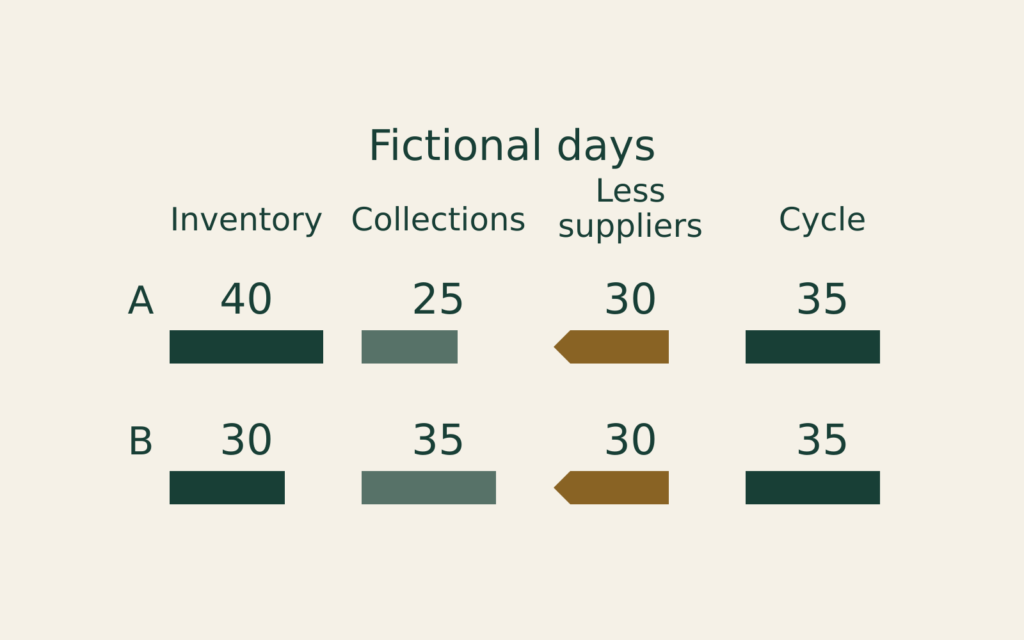
Compare the components
APQC’s definition combines inventory days and customer-collection days, then subtracts supplier-payment days.
These fictional inputs are supplied, not calculated from actual accounts. Consistent definitions apply throughout.
| Component | A | B |
|---|---|---|
| Inventory | 40 | 30 |
| Collections | 25 | 35 |
| Suppliers | 30 | 30 |
| Cycle | 35 | 35 |
Add inventory and collections; subtract suppliers. The unchanged total conceals a shift between inventory and collections. It doesn’t establish that either case has enough cash for its next payment.
Check how the inputs were calculated
Intuit’s guide averages beginning and ending balances. Inventory days divide average inventory by cost of goods sold; collection days divide average receivables by credit sales; supplier-payment days divide average payables by cost of goods sold. Multiply each quotient by the period’s day count.
Check the reporting period, averaging method and sales basis. Don’t silently substitute an ending balance for an average or total sales for credit sales. Preserve the preparer’s stated definitions and any exclusions.
A shorter result isn’t permission to pay late
ACCA’s working-capital teaching guide explains the operating trade-offs behind these measures. Longer customer credit can help sales but postpones receipts. Supplier-payment delays can cost discounts or provoke demands for cash on delivery. Industry practices and the nature of production also affect the cycle.
Consequently, a proposed change deserves its own question. Would lower inventory still support promised orders? Would tighter customer terms affect sales? Has a supplier actually agreed to a later payment, or does the spreadsheet merely assume one? The metric doesn’t amend an invoice or supply contract.
A negative cycle can occur when customers pay before suppliers must be paid. That describes an operating pattern, not a universal target. Compare similar business models rather than treating a supermarket and a manufacturer as interchangeable.
This source is general accounting education, not U.S. lending law. Its discussion helps interpret a result; it doesn’t establish a borrower’s contractual rights, a safe minimum stock level or an instruction to withhold payment.
Investigate collections without assigning blame
The National Association of Credit Management’s white paper warns that days sales outstanding can be influenced by sales and other activity outside the receivables department. Used alone, it doesn’t fairly describe that department’s performance. The paper discusses complementary measures, including past-due percentages, invoice accuracy and collection effectiveness, among other diagnostic tools.
For the business owner, this suggests a more precise follow-up than demanding that staff simply lower a number. Ask whether the change reflects different customer terms, a change in sales, or genuinely slower payments. Look at the overdue portion separately from invoices that are still within their agreed terms.
Choose a complementary measure to answer a defined question. An invoice-accuracy measure can help investigate billing quality; an aging breakdown can help locate overdue balances. Neither makes the cycle itself a customer-by-customer payment forecast.
Before using invoice accuracy, specify which invoices are included and what qualifies as accurate. Record those criteria alongside the result. This is diagnostic guidance, not a finding that any customer or employee caused a problem.
Keep the cash-flow statement separate
The SEC’s financial-statement guide distinguishes a balance sheet’s position at a date from cash movements over a period. Its cash-flow explanation separates operating, investing and financing activities. Equipment purchases and bank borrowing therefore belong in the broader cash story.
This matters when someone presents the cycle as a complete explanation for a bank balance. Ask separately what cash operations generated or used, what long-term assets were bought or sold, and what financing cash entered or left. An operating metric can’t substitute for those records.
Don’t relabel loan proceeds as customer collections. Financing cash is a separate record, not proof of improved collections.
The SEC guide is an introductory explanation, not a tailored accounting classification opinion. For unfamiliar transactions, ask the accountant which statement and supporting record explain the movement rather than forcing it into an inventory, customer or supplier-days category.
Translate the diagnosis into a dated cash question
Bank of America’s working-capital guidance recommends forecasting receipts and payments to locate the widest cash gap. Seasonality, growth and changed customers can alter future needs.
For a borrowing discussion, move from the dashboard to the actual calendar: which customer receipts are expected before the next supplier, payroll and other required payments? Check whether the apparent need is temporary or persists beyond the operating cycle.
For the financing conversation, describe when the cash need first appears and when later receipts might close it. Distinguish a seasonal gap from an operating plan that remains short. A positive forecast depends on its assumptions; it isn’t a lender commitment or evidence that funds are already available.
This educational comparison doesn’t select financing, determine an adequate reserve or promise approval. A lender’s actual terms and the business’s verified cash commitments remain separate from the metric.


