College Aid Offers: A Two-Packet Practice Exercise
Try four prompts with fictional packets, then open the worked answers. Change one entry and test what an unreadable entry prevents you from concluding.

Try the comparison before reading the answers
Which packet comes out ahead? Write down your guess, then test it twice. This invented exercise asks you to calculate two different outputs, change one entry and work through a packet with missing information.
The reading key
C: cost of attendance. G: grants and scholarships. L: loans. W: work-study. N: estimated net price for this period; N = C − G.
Loans require repayment.
Federal work-study requires eligibility, securing a job and earning the money; income isn’t guaranteed and awards may vary yearly.
N isn’t a bill, cash due now, debt total or full-program cost. The entry sum below isn’t guaranteed funding. Neither ranking selects a school for you.
Definitions and formula: Federal Student Aid dictionary. Work-study qualification: Federal Student Aid offer guide. These references support the reading key, not the invented figures below.
Your invented practice packet
All figures are fictional U.S. dollars. Both packets cover September–May with identical enrollment and living arrangements. For this exercise, C includes every modeled expense and G is confirmed and fixed except in the fresh, incomplete B3 packet. No other money, charges, conditions or later years are modeled. These assumptions establish no real eligibility.
| Entry | A | B |
|---|---|---|
| C | $28,000 | $33,000 |
| G | $10,000 | $17,000 |
| L | $10,000 | $2,500 |
| W | $3,000 | $1,000 |
Four prompts
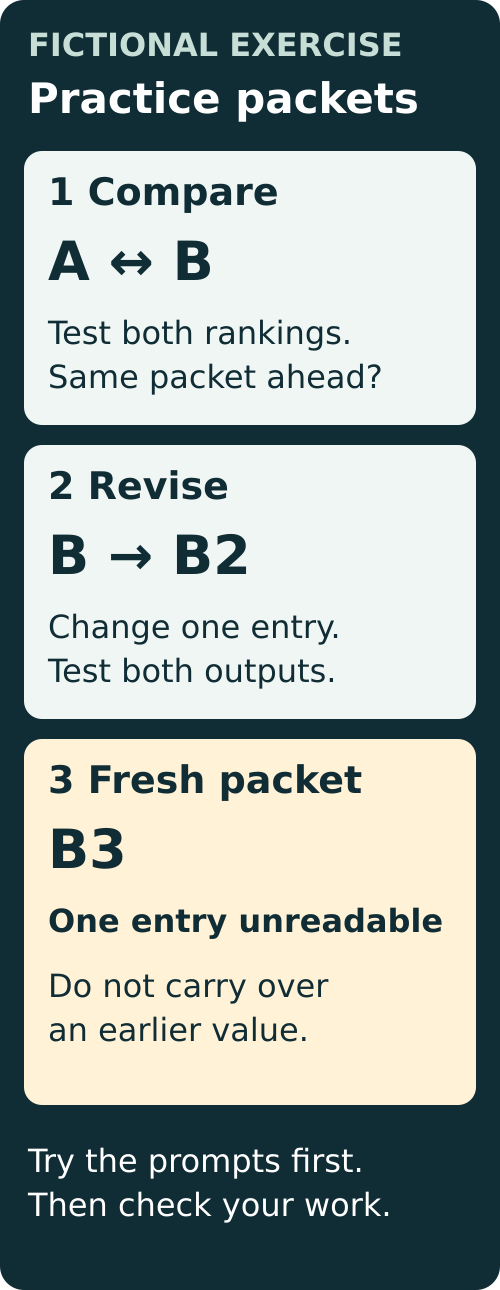
- Calculate N for A and B using the reading key. Show both subtraction lines. Which result is smaller, and by how much?
- Separately add G + L + W for each packet. Call this arithmetic output T. Which result is larger? Does the same packet lead both comparisons?
- Create B2 from B: add $6,000 to L only. Recalculate both outputs. Identify the output that changes and the size of that change.
- Treat B3 as a fresh, incomplete packet: C = $33,000; G = unreadable; L = $2,500; W = $1,000. Do not carry forward the former G entry. Which outputs and A/B3 rankings are unsupported? Write the missing entry instead of substituting zero.
Open the worked answers
Check your work
- N for A: $28,000 − $10,000 = $18,000. For B: $33,000 − $17,000 = $16,000. B’s result is $2,000 smaller.
- T for A: $10,000 + $10,000 + $3,000 = $23,000. For B: $17,000 + $2,500 + $1,000 = $20,500. A’s result is $2,500 larger. The two comparisons point to different packets.
- B2 has L = $8,500. Its N remains $16,000; its T becomes $17,000 + $8,500 + $1,000 = $26,500. Only T changes, increasing by $6,000. With B2, the same packet now has the smaller first output and larger second output.
- B3: missing G. Both N and T are unknown, so neither A/B3 ranking is supported by this packet. A’s own outputs remain $18,000 and $23,000. A remembered number from B is not evidence for the fresh B3 packet.
If you chose an answer before calculating, compare your first guess with your written steps. If B2 changed both of your outputs, inspect which entries each operation uses. If B3 produced a number, check whether you silently supplied the unreadable entry.

Auto Service Contract: Clause Exercise
Auto service contract practice: Seven cases. Two rule sets. One changed measurement. Work through an invented packet and check each answer.

Before You Compare 401(k) Access: Three Document Checks
Use three situation-specific cards to organize documents and prepare questions before comparing 401(k) access.

College Withdrawal Bill: Reconcile the School Account
Use three school records and a fictional $1,340 example to trace each adjustment, check a changed balance and organize questions for the right office.