Condo Special Assessment: Lump Sum or Payment Plan?
Compare a fictional condo assessment using cash after closing, monthly surplus and the unpaid balance. A planned reserve draw changes the result.

A $600 discount can be the cheaper choice and still leave less cash than you want. In this fictional condo purchase, paying an assessment immediately leaves $8,600, below the buyer’s chosen $10,000 cash floor. The payment plan keeps more cash available but requires $500 a month against $400 of monthly surplus.
Neither option passes both of this household’s selected tests. That does not mean the buyer cannot pay. Drawing $100 a month from existing reserves would fund the installments and leave $17,600 after 24 months, assuming no other changes. The question is whether the household accepts that planned reserve draw.
Start with cash that is actually available
These invented terms isolate the decision; they are not an association offer or a forecast:
- The buyer is responsible for one $12,000 assessment in this example.
- A payment of $11,400 at month 0 fully satisfies it. Alternatively, the buyer can pay 24 monthly installments of $500, starting one month later.
- There are no added charges in this on-time example. Installments still cost $600 more in total than the discounted payment.
- The buyer has $20,000 of usable liquid cash after closing, moving and all other planned initial spending. Do not subtract those expenses again.
- The $400 monthly surplus is after mortgage payments, taxes, insurance, regular condo dues, household expenses and other commitments, but before this assessment.
The buyer chooses two tests: keep at least $10,000 in liquid cash throughout, and cover assessment installments from monthly surplus without withdrawing reserves. These are personal spending rules, not lender requirements or universal emergency-fund standards.
Compare the same obligation, with two separate tests
| Measure | Lump sum | Installments |
|---|---|---|
| Assessment payment at month 0 | $11,400 | $0 |
| Cash immediately afterward | $8,600 | $20,000 |
| Monthly assessment payment, months 1–24 | $0 | $500 |
| Total assessment payments | $11,400 | $12,000 |
| Initial $10,000 cash-floor test | Fails by $1,400 | Passes |
| $400 income-only payment test | Passes | Fails by $100 a month |
The discount is $600, or 5% of the $12,000 assessment. That is a difference in total payments, not an annual interest rate. Conversely, the plan’s $20,000 initial cash balance comes with $12,000 still payable; it is not all free for other spending.
Track the cash and the unpaid assessment together
For a fair 24-month comparison, add the same $400 surplus to each option every month, then subtract that month’s assessment payment. Cash earns nothing. The model excludes surprises, new assessments, taxes on investment returns, sale and refinancing.
| Month | Lump-sum cash | Lump-sum assessment left | Plan cash | Plan assessment left |
|---|---|---|---|---|
| 0 | $8,600 | $0 | $20,000 | $12,000 |
| 4 | $10,200 | $0 | $19,600 | $10,000 |
| 12 | $13,400 | $0 | $18,800 | $6,000 |
| 24 | $18,200 | $0 | $17,600 | $0 |
The lump-sum path first gets back above the selected floor at month 4. That recovery does not erase its initial breach. The installment path uses $2,400 of starting reserves over two years and stays above the floor throughout. It fails only the household’s separate income-only test in this model, not a mathematical ability-to-pay test.
At month 24 both assessments are paid off. The lump-sum path has $600 more cash, exactly its payment saving. This comparison does not value investment opportunities or the flexibility of keeping cash earlier.
What would make an option fit?
Each change below is a separate hypothetical negotiation, not an available offer.
- Keep the lump sum and the floor: $20,000 minus $10,000 leaves $10,000 available. The buyer needs $1,400 more usable cash or a verified $1,400 reduction in the buyer-funded payment. A seller payment works in this calculation only if the buyer actually pays $10,000 and the assessment is fully satisfied. A general closing-cost credit cannot simply be substituted without checking its effect on these figures.
- Keep 24 payments: $400 × 24 supports $9,600. A $2,400 contribution or reduction fits only if the association agrees to reduce each installment to $400. Covering the final installments alone would leave earlier $500 payments above the monthly ceiling.
- Change the term: $12,000 ÷ $400 requires 30 payments with zero added charges. The association would have to approve that schedule. Any added charge changes the calculation.
Do not combine these alternatives or count the same contribution twice. Keeping the original plan and deliberately spending $100 of reserves each month is another household choice, but it changes the income-only rule rather than making the original plan pass it.
Replace the invented terms with written records
Fannie Mae’s condo-buying guidance encourages buyers to ask about special assessments and association documents. For your own comparison, obtain:
- The unit’s assessment notice, purpose, total allocation, amount paid and remaining balance.
- The discount deadline, full-payoff amount, installment dates, charges and prepayment terms.
- Signed purchase terms and a closing professional’s review of who pays, under applicable law.
- Written sale or transfer treatment, including any acceleration or release.
- Regular dues, scheduled increases and other known assessments.
Verify that any negotiated contribution preserves the discount and produces the intended settlement figures and payment schedule.
Paying the bill does not establish project eligibility
For mortgages delivered to Fannie Mae, lenders review special assessments; unresolved critical repairs can make a project ineligible. A payment receipt does not prove repairs are complete or establish loan approval. Ask the lender about the project review and obtain repair and inspection records separately. This is a Fannie Mae boundary, not a rule for every mortgage program. See Selling Guide B4-2.1-03, Ineligible Projects (dated August 5, 2026; checked October 20, 2026).
Florida-only document example
Under 2026 Florida Statutes §718.116(8)(a)8, a condominium unit’s estoppel certificate itemizes amounts owed and specified amounts scheduled during its effective period. A current unit-specific record can help check your inputs; it does not predict every future assessment. This Florida example does not determine liability elsewhere. Checked October 20, 2026.
Your decision line: write down cash immediately after payment, the monthly reserve draw if any, and the assessment still owed at your comparison date. Then identify the precise term that must change—or the household rule you consciously choose to change.
California Supplemental Property Tax: Check the Bill, Payment and Cash
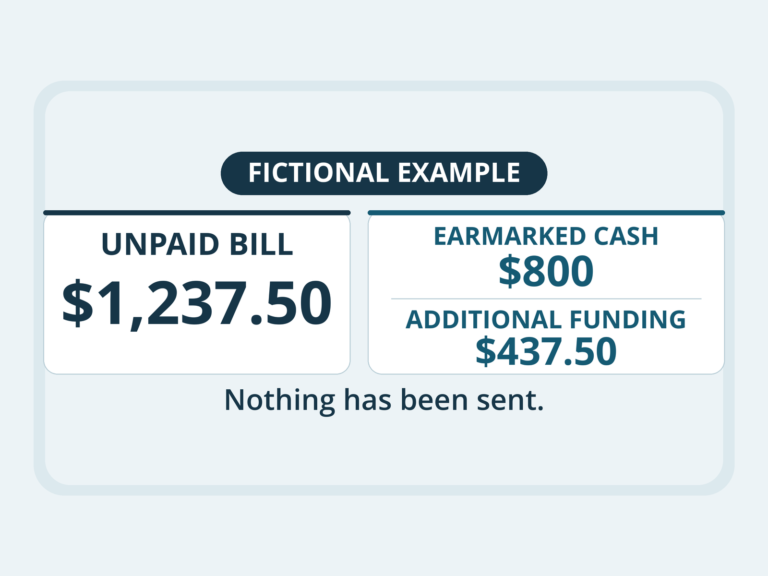
Organize one California supplemental property tax bill, its payment evidence and the cash earmarked for it. A fictional example shows why a funding gap…
Title Insurance Quotes: Compare Policies, Services and Payers
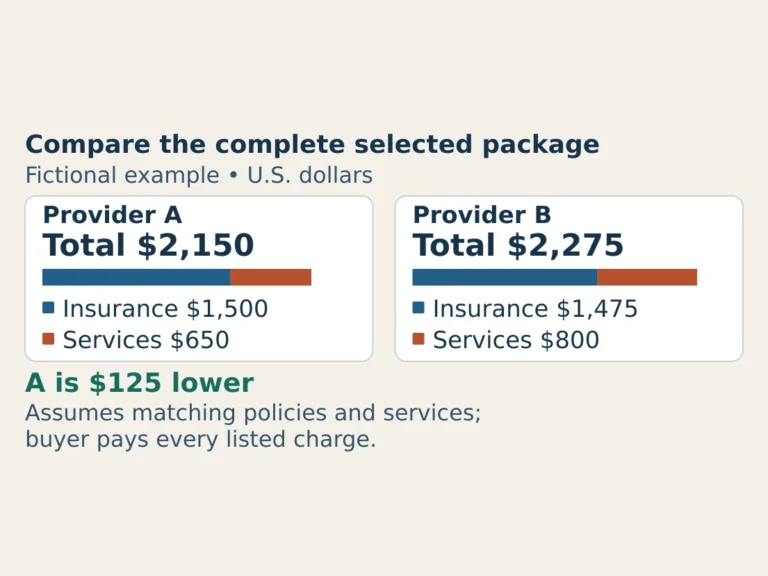
Compare fictional $2,150 and $2,275 title packages using matched coverage, complete service charges and a separate payer worksheet.

Flood Insurance Quote: Test Two Deductibles Against Your Cash Reserve
Test fictional flood quotes against a $6,000 reserve: $180 in annual savings comes with $3,000 more building deductible exposure.