Construction Loan Draws: Find Your First Cash Shortfall
A dated construction-loan example shows how a two-month delay creates an October cash shortfall, even when the original plan leaves money at payoff.
A construction budget needs a date for the first cash shortfall. In the fictional worksheet below, $25,000 covers selected bills through a September 1, 2027 payoff and leaves $2,217.32. Move that payoff to November 1 without changing the advances, and the same cash runs short on October 1, a month before the loan is paid off.
The October 1 shortage is $1,482.68. By the delayed payoff, the cumulative extra cash needed reaches $5,904.76. Those two numbers answer different questions: how much is missing at the first unpaid bill, and how much is missing over the rest of the modeled period.
Use this example to build a dated construction-loan cash worksheet from your own documents. All amounts are US dollars. The rate, fees, rent, dates and financing arrangements are invented inputs, not a loan offer or estimates of typical charges.
The CFPB describes staged advances as a typical feature of construction loans. Appendix D allows certain disclosure estimates when draw amounts or timing are unknown. The calculation below is an original planning exercise using specified dates; it does not calculate regulatory disclosures.
Keep the project advances and household cash separate
This example follows two separate records. The construction balance records money advanced for project invoices. The dedicated cash account starts with $25,000 and pays only construction interest, five draw fees and temporary rent. Counting an invoice in both records would overstate the cash needed.
- Construction commitment: $315,000, with no principal outstanding on February 1, 2027. This amount is not presented as the total project price.
- Interest assumption: a fixed 8.40% annual rate, calculated each day on funded principal using a 365-day denominator. A draw earns interest from its draw date; the construction payoff date earns none.
- Rounding: add the unrounded daily interest for each calendar month, then round that monthly total to cents, half up. The model does not round each day’s interest.
- Payment dates: monthly interest is paid from cash on the following month’s fifth. At payoff, the final unpaid month is settled that day, replacing its normal fifth-day payment.
- Draw fees: $145 paid from cash on each of five draw dates. None is added to the loan balance.
- Temporary rent: $1,850 paid on the first, from February through the month before payoff. There is no rent payment in the payoff month in this example.
- Cash and principal: no cash additions, earnings or construction-principal installments. Interest is paid separately, with no financed interest or compounding.
- Contract deadline: December 1, 2027. All modeled payoffs precede it. No extension fee or rate adjustment is included; that choice says nothing about an actual lender’s terms.
The $315,000 principal requires its own exit funding. Every case assumes a separately approved $315,000 permanent loan funds on the stated payoff date and pays off construction principal dollar for dollar. Approval and timely funding are premises, not results of this worksheet. If that funding is unavailable, the full $315,000 remains a separate problem even if the carrying-cash column is positive. New-financing fees and later mortgage payments are excluded.
Start with dated advances, then calculate interest
In the scheduled case, each advance immediately pays a matching project invoice. The dedicated cash account therefore pays the draw fee, but does not pay that invoice again. The scheduled construction payoff is September 1, 2027.
On a small screen, swipe the table sideways to see all columns. Keyboard users can focus the table area and use the arrow keys.
| Draw date | Advance | Principal after draw |
|---|---|---|
| February 3, 2027 | $48,000.00 | $48,000.00 |
| March 12, 2027 | $67,000.00 | $115,000.00 |
| April 21, 2027 | $82,000.00 | $197,000.00 |
| June 7, 2027 | $73,000.00 | $270,000.00 |
| August 16, 2027 | $45,000.00 | $315,000.00 |
March shows why the dates matter. The balance is $48,000 for March 1–11, then $115,000 for March 12–31. Under this example’s interest rule, March interest is:
[($48,000 × 11 days) + ($115,000 × 20 days)] × 8.40% ÷ 365 = $650.83, after rounding the monthly total.
That interest is paid on April 5. Putting $650.83 into March’s cash-payment column would move the money need to the wrong month. Keep an accrual column and a separate payment-date column.
Test two different versions of the same delay
Both stress cases move completion and construction payoff to November 1. Their project-payment timing differs:
- Completion delayed: all five advances and matching invoices keep their original dates. The full $315,000 is outstanding from August 16 through October 31.
- Final invoice and draw delayed: the last $45,000 advance and its matching invoice/payment move from August 16 to October 16. Assume no earlier cash payment, interim borrowing, late charge, price increase or other added charge. The $145 final draw fee also moves to October 16. All earlier advances stay unchanged.
The second case is a hypothetical change to the inputs. It does not establish that a contractor would wait, that a lender would release funds on that date, or that postponing payment is a workable strategy. If payment is due earlier, that earlier obligation needs its own funding entry and the numbers below must be rebuilt.
On a small screen, swipe the table sideways to see all columns. Keyboard users can focus the table area and use the arrow keys.
| Accrual month | Scheduled exit | Completion delayed | Final invoice and draw delayed |
|---|---|---|---|
| February 2027 | $287.21 | $287.21 | $287.21 |
| March 2027 | $650.83 | $650.83 | $650.83 |
| April 2027 | $982.68 | $982.68 | $982.68 |
| May 2027 | $1,405.45 | $1,405.45 | $1,405.45 |
| June 2027 | $1,763.31 | $1,763.31 | $1,763.31 |
| July 2027 | $1,926.25 | $1,926.25 | $1,926.25 |
| August 2027 | $2,091.95 | $2,091.95 | $1,926.25 |
| September 2027 | Construction loan paid off | $2,174.79 | $1,864.11 |
| October 2027 | Construction loan paid off | $2,247.29 | $2,091.95 |
The two delayed cases have $631.72 of difference in rounded construction interest. The invoice-delay case keeps $45,000 out of the construction balance for an additional 61 days. Both cases still carry two more rent payments than the scheduled case. A lower August interest amount does not resolve the later cash shortage.
Compare selected bills through each payoff date
Read the scope before comparing totals: these columns end on different dates. After September 1, the scheduled household would have its own permanent-financing and occupancy costs, which this worksheet does not calculate. The differences below are additional selected construction-period cash outflows, not total economic losses or net savings.
On a small screen, swipe the table sideways to see all columns. Keyboard users can focus the table area and use the arrow keys.
| Measure | Scheduled exit | Completion delayed | Final invoice and draw delayed |
|---|---|---|---|
| Construction payoff | September 1, 2027 | November 1, 2027 | November 1, 2027 |
| Construction interest | $9,107.68 | $13,529.76 | $12,898.04 |
| Cash-paid draw fees | $725.00 | $725.00 | $725.00 |
| Temporary rent | $12,950.00 | $16,650.00 | $16,650.00 |
| Selected cash outflows | $22,782.68 | $30,904.76 | $30,273.04 |
| Position versus $25,000 cash | Cash left $2,217.32 | Unfunded $5,904.76 | Unfunded $5,273.04 |
| Extra selected outflows versus scheduled exit | Baseline | $8,122.08 | $7,490.36 |
| First unfunded event | None in this model | October 1 rent | October 1 rent |
For the completion delay, the $8,122.08 increase in selected outflows consists of $4,422.08 more construction interest and $3,700 more temporary rent. The starting plan’s $2,217.32 cushion absorbs part of that increase, leaving $5,904.76 unfunded. Do not add the full $8,122.08 to the already calculated $5,904.76 gap; that would count the same change twice.
For the invoice-and-draw delay, the corresponding increase is $7,490.36: $3,790.36 more construction interest and the same $3,700 of additional rent. After using the scheduled cushion, the unfunded amount is $5,273.04.
Find the first bill the cash cannot cover
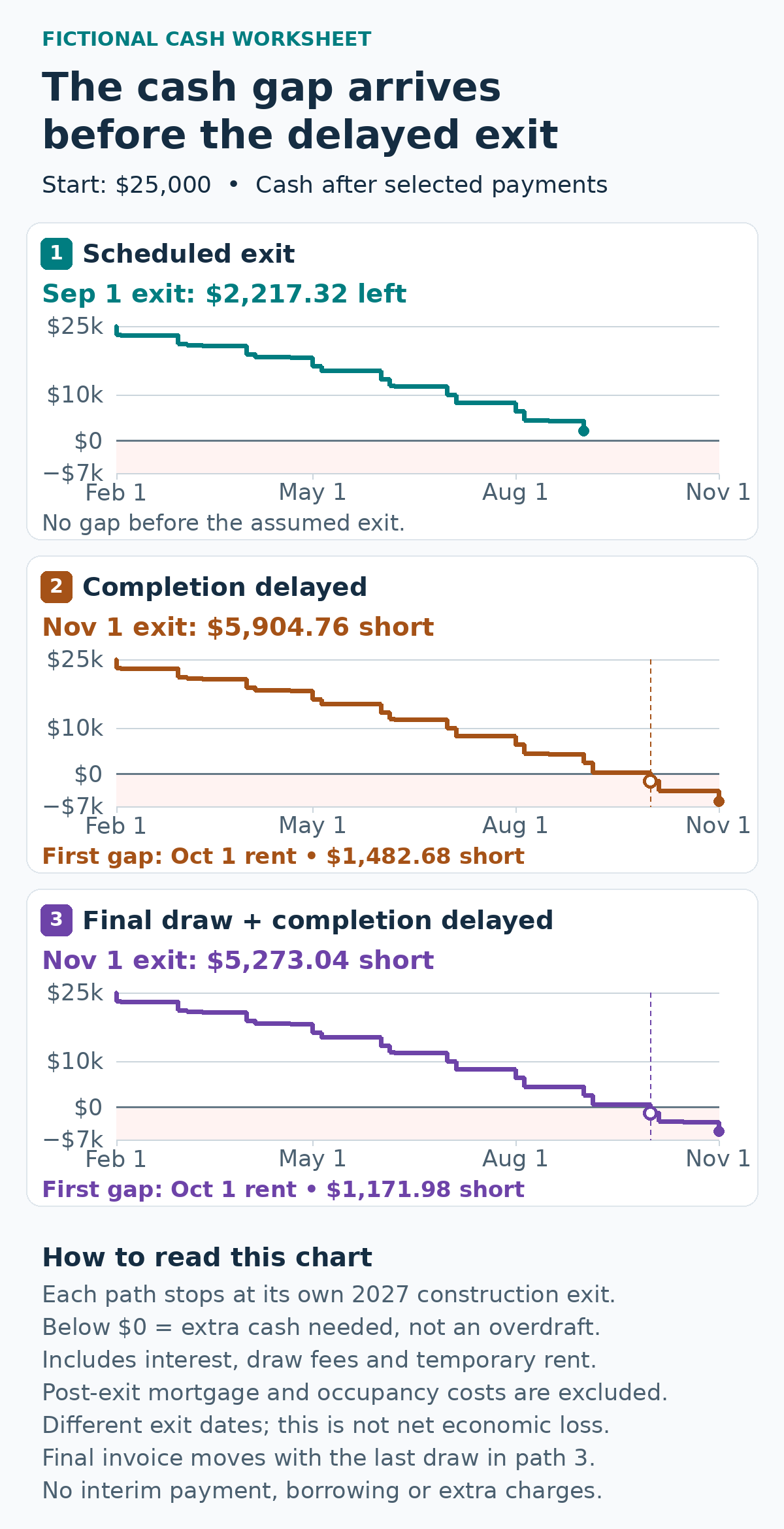
The total gap is useful, but the event ledger sets the deadline. After September 5, the completion-delay case has only $367.32 left. The invoice-delay case has $678.02. Neither covers the $1,850 rent due October 1.
On a small screen, swipe the table sideways to see all columns. Keyboard users can focus the table area and use the arrow keys.
| Checkpoint | Completion delayed | Final invoice and draw delayed |
|---|---|---|
| Aug 31, 2027 — After August cash payments | Cash left $4,309.27 | Cash left $4,454.27 |
| Sep 1, 2027 — September rent | Cash left $2,459.27 | Cash left $2,604.27 |
| Sep 5, 2027 — August interest paid | Cash left $367.32 | Cash left $678.02 |
| Oct 1, 2027 — October rent | Unfunded $1,482.68 | Unfunded $1,171.98 |
| Oct 5, 2027 — September interest paid | Unfunded $3,657.47 | Unfunded $3,036.09 |
| Oct 16, 2027 — Final draw fee in invoice-delay case | Unfunded $3,657.47 | Unfunded $3,181.09 |
| Nov 1, 2027 — Final interest settled at payoff | Unfunded $5,904.76 | Unfunded $5,273.04 |
“Unfunded” means money still has to be found to pay the modeled bills. It is not an assumed overdraft or an available credit line. After the first gap, the table continues adding obligations to show the cumulative requirement; it does not claim those bills have been paid.
In the completion-delay case, $1,482.68 needs to be available by October 1 to cover that first shortage. With no other additions, the cumulative additional funding requirement reaches $3,657.47 by October 5 and $5,904.76 at the November 1 payoff. In the invoice-delay case, it reaches $1,171.98, $3,036.09 and $5,273.04 at those same checkpoints, with the final $145 fee falling between the latter two.
If these were your verified inputs, October 1 would be the first funding deadline to address. The worksheet has not chosen a funding source or shown that borrowing more would be affordable. Any proposed cash addition belongs in the ledger on the date it will actually be available.
Collect these contract inputs before using the method
Ask the relevant lender, contractor and housing provider for the details that apply to your arrangement. Keep the written answer or document reference beside each entry, so an assumption is easy to distinguish from a confirmed term.
- Every project payment: what is due, to whom, and on what date? Which payment is covered by each advance, and is any amount due before the advance arrives?
- Advance timing: what documents, approvals or other conditions must be satisfied before each release? What date can you reasonably enter for cash availability?
- Interest basis: what balance earns interest, at what rate, with what day-count denominator, date-inclusion rules and rounding method? If the rate can change, what changes it and when?
- Interest payment schedule: when is each bill due, and what is settled at payoff? Will you pay from cash, or does the actual arrangement finance any interest?
- Fees and other charges: which are paid from cash, which are financed, and when? What charges or conditions would apply to a changed schedule?
- Temporary housing: what are the actual payment dates, notice requirements and final rental obligations? Is an overlap or partial month payable?
- Deadline and exit funds: what is the construction maturity date, what would a delay require, and what evidence supports the amount and timing of principal-payoff funding? Include any exit fees separately.
- Available household cash: how much is genuinely dedicated to this purpose after other commitments, and which additions have a confirmed date? Keep uncertain additions visibly separate.
Build the cash ledger in date order: opening dedicated cash, confirmed cash additions, then each cash-paid bill. Recalculate the position after every event. Once the scheduled version reconciles, change the affected dates and charges for a stress case. If a project invoice moves, document what happens to its payment as well as its loan advance.
What this example leaves out
The worksheet excludes down payment or equity, land purchase, construction overruns, property taxes, insurance, utilities, moving costs, other debts, new-financing fees, subsequent mortgage principal and interest, and any extension conditions. It is a selected carrying-cash test, not a complete project budget, an affordability decision or evidence of loan approval.
Its calculations have been checked for the three specified schedules. Different payoff dates within a month, financed charges, changing rates, a failed permanent loan or different rent terms require a revised model. The $25,000 starting amount and the resulting gaps do not establish a recommended reserve for another household.
The useful output to take into a planning conversation is a dated list: the first uncovered bill, the amount missing then, the later cumulative need, and the separately confirmed plan for construction principal. Update that list whenever a payment or funding date changes.
Mortgage Charge Questions: Choose the Record That Answers Them
Match a questionable mortgage charge to account detail, service records or adjustments with a worked property-inspection example and a two-part index.

Partial Mortgage Payment: Track Money Held in Suspense
Follow a fictional $1,100 and $700 mortgage payment trail, compare dated records, and build a precise question about an unexplained entry.

Minnesota Contract for Deed: Check the Seller, Title and Balloon
Before signing a Minnesota contract for deed, organize seller, disclosure and title evidence, then test a fictional balloon-payment ledger.