Corrected Closing Disclosure: Track Each Version
Organize changed files, compare selected entries and keep unanswered questions visible.

Estimated reading time: 8 minutes
A corrected closing disclosure needs two separate checks: what changed in the transaction, and whether that change affects the waiting period. Keep each version and the lender’s timing explanation together.
Corrected Closing Disclosure: does the wait restart?
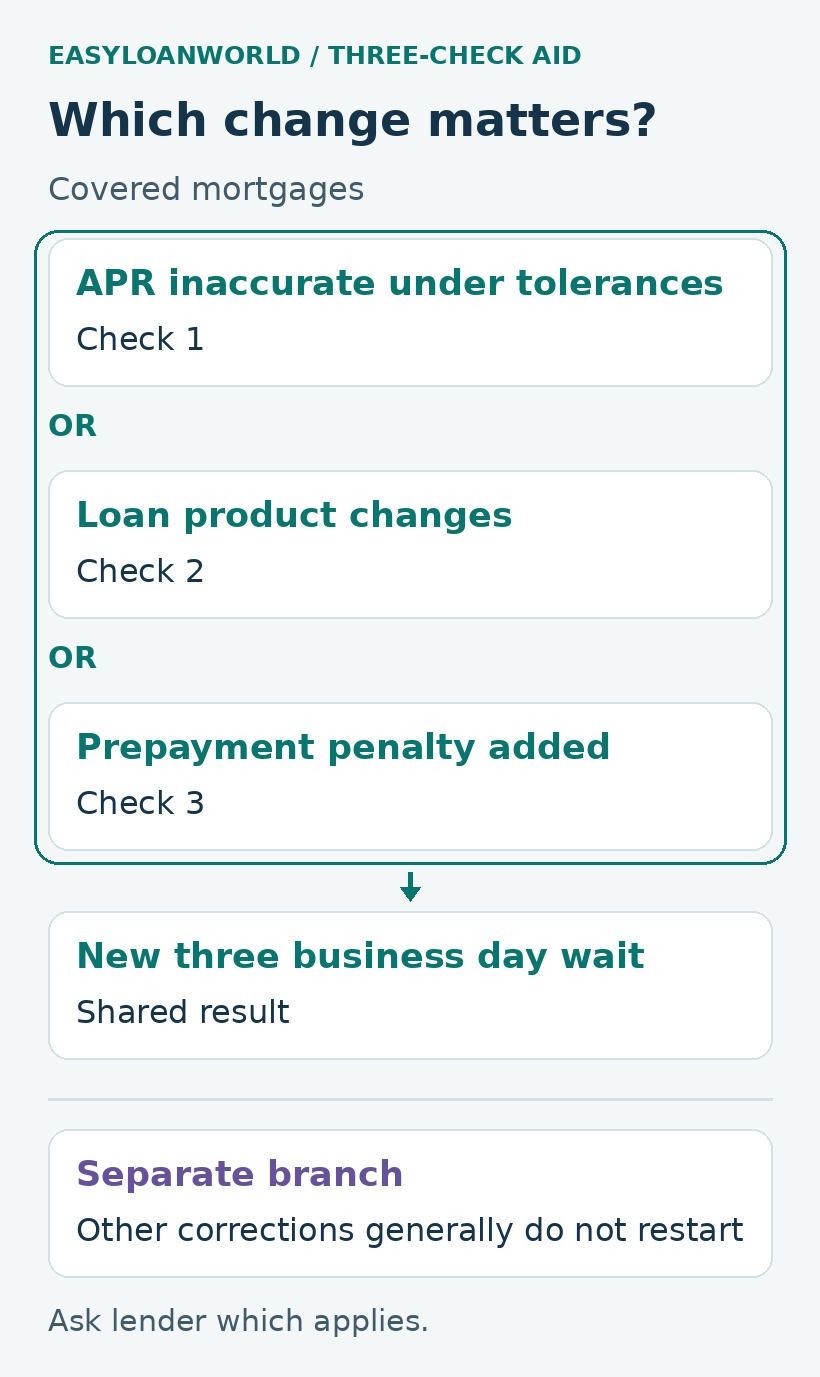
Covered mortgages require initial disclosure receipt at least three business days before consummation. A new wait applies when:
- The annual percentage rate (APR) becomes inaccurate under regulatory tolerances.
- The disclosed loan product changes.
- A prepayment penalty is added.
Other changes generally require correction by consummation without restarting. A changed APR alone isn’t the legal test. Ask the lender which trigger applies. CFPB correction guidance.
Find the changed line
Purchase form:
- Page 1: Product; Prepayment Penalty.
- Page 2: Application Fee (A); Lender Credits (J).
- Page 5: APR.
Start with the field named in the lender’s correction explanation. Compare the old and new entries rather than searching only for a different final total.
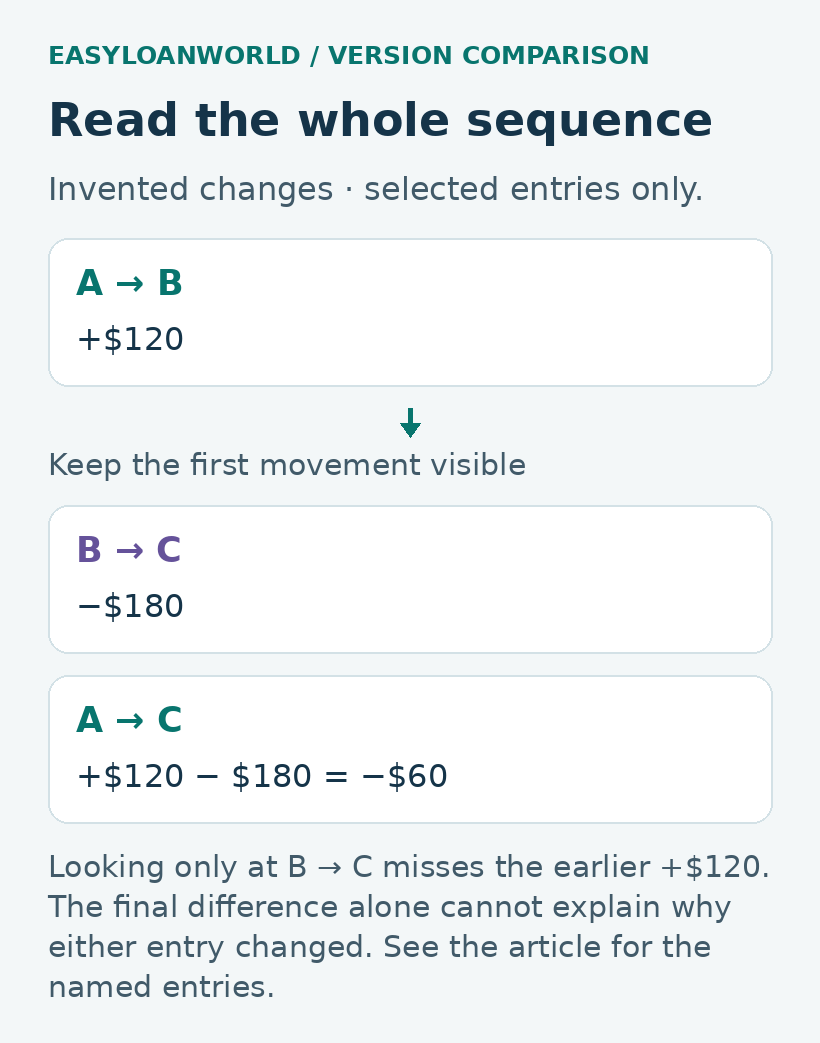
Here’s a fictional comparison of an application fee and a general lender credit. It isn’t a complete disclosure or a claim that either amount is allowable. Version A shows $280 and $200; B shows $400 and $200; C shows $400 and $380, respectively.
From A to C, the charge increases $120 and the credit increases $180. The selected net effect is $60 less. But the version history matters: B changed the charge; C changed the credit. Ask why each changed and whether the newest copy reflects the actual agreement. Don’t treat an unexplained amount as acceptable merely because another entry offsets it.
For the complete purchase calculation, follow our cash-to-close worksheet. This small comparison only identifies what to question in the correction.
Corrected Closing Disclosure: build a version register
Give each received version a label and date. Keep the actual file rather than replacing it with the newest copy. A register should identify what changed, who explained it and which version the timing answer covers.
The original A, B and C are selected-line teaching records, not complete forms. A review of a real disclosure should compare the relevant entries and retain the rest of the transaction context.
If the lender sends a revised version, ask which earlier one it replaces and whether any other entries changed. An email saying updated doesn’t identify the full change history by itself.
Keep a response linked to its version. A timing explanation about B shouldn’t automatically be treated as the answer for a later C with different changes.
Reconcile the selected charge and credit
For Version A, the selected application-fee-minus-credit calculation is $280 − $200 = $80. For B, $400 − $200 = $200. For C, $400 − $380 = $20.
These selected net figures aren’t complete cash-to-close amounts. They omit every other line, deposit, credit and adjustment outside the small exercise.
From A to B, the selected net rises $120. From B to C, it falls $180. Together, those movements produce a $60 decrease from A to C.
Looking only at the latest $180 reduction would conceal the earlier increase. Looking only at the final $20 would conceal both changed entries and their separate explanations.
Corrected Closing Disclosure: add a fourth version carefully
For an independent extension of the selected-line example, suppose Version D shows a $450 fee and $410 general lender credit. Its selected net is $40.
Compared with C, the fee rises $50 while the credit rises $30. The selected net therefore rises $20. Compared with A’s $80, it’s still $40 lower.
The answer depends on which versions are being compared. Record both labels beside every difference instead of saying only that closing costs went up or down.
This extension doesn’t establish whether the changed fee or credit is permitted or agreed. Ask the lender for each explanation even where the combined selected amount is lower than in an earlier version.
Separate dollar movement from the waiting-period test
The fee-and-credit arithmetic identifies changed amounts. It doesn’t determine whether one of the three waiting-period triggers occurred.
A larger or smaller final cash figure isn’t itself the complete legal test. Likewise, a changed APR shouldn’t automatically be labeled inaccurate without the applicable tolerance analysis.
For the actual correction, ask which of the three listed triggers, if any, applies and what supports that conclusion. Retain the lender’s answer with the relevant disclosure version.
This guide doesn’t independently calculate an APR, evaluate every regulatory tolerance or determine a violation remedy. The selected-line exercise supplies none of the full cash-flow inputs for such an assessment.
Keep issue, delivery and receipt dates distinct
A date printed on a form, the date it was sent and the date of actual or presumed receipt can describe different events. The waiting-period discussion below uses the relevant receipt information.
For a fictional document file, a form is dated one day and emailed the next. Those two dates alone don’t establish the applicable confirmed receipt date or final consummation date.
Ask the lender which receipt evidence or delivery presumption it used. Don’t substitute the earliest visible date simply because it produces an earlier count.
The original Friday example expressly assumes confirmed receipt and no holiday or restart. Removing one of those assumptions creates a different timing question, even if the form’s printed date stays the same.
Use the specified business-day definition
The rule described below counts Saturday but excludes Sunday and specified legal public holidays. A lender’s office-opening schedule isn’t a substitute for that definition.
In the original example, receipt is Friday, October 23, 2026. The three counted days are Saturday the 24th, Monday the 26th and Tuesday the 27th.
Keep that sequence with its assumptions instead of copying Tuesday as a general answer for every Friday disclosure. A different holiday, receipt fact, corrected version or trigger can require a different review.
The exercise’s earliest date under that calculation alone is also not a guarantee the transaction can close then. Underwriting, documents and other actual conditions may remain unresolved.
Don’t let an offset hide an unexplained change
A lender credit may offset a fee numerically while the reason for the fee remains unanswered. Preserve the question about each changed line rather than treating the smaller selected net as approval of both entries.
Similarly, a version that restates a loan product or penalty term can require attention even if the selected fee-and-credit total is unchanged. Review the actual corrected entries, not only the final dollar total.
If the explanation refers to an agreement you don’t recognize, ask for the supporting record. Keep the uncertainty visible instead of rewriting the older version to match the latest one.
The worksheet doesn’t direct acceptance of the disclosure, waive a right or determine a particular fee’s legality. It organizes the questions for the lender and appropriate transaction advisers.
Finish with a traceable correction record
A completed register should connect each version to the changed entries, explanation, applicable timing answer and receipt support. Record which version is currently intended for the transaction.
For a complete cash calculation, reconcile the full disclosure through the linked cash-to-close worksheet. The selected $80, $200, $20 and $40 figures here can’t replace that total.
Keep planned signing, consummation and payment dates labeled as the events they actually describe. Ask about an unclear date instead of assuming they are interchangeable in the timing rule.
A useful corrected Closing Disclosure review makes both the money changes and timing assumptions understandable. It doesn’t turn a teaching calendar into a booking instruction or an unresolved transaction into a confirmed closing.
Corrected Closing Disclosure: an unchanged selected net can hide changes
For one more independent version comparison, assume Version E shows a $500 application fee and $480 general lender credit. Its selected net is $20, matching C’s $400 fee and $380 credit.
The matching net conceals a $100 increase in each component. A reader checking only the $20 would miss both changed lines.
This doesn’t determine that either change is permitted or that a waiting-period trigger occurred. It shows why the version register needs the components and explanations, not only a selected subtotal.
Retain C and E as distinct records. Ask why the fee and credit changed and which complete disclosure and timing explanation currently govern the transaction.
Which date starts the count?
Saturdays count; Sundays and specified legal public holidays don’t. Non-personal delivery generally uses presumed receipt three business days later unless earlier receipt is evidenced. Confirm the lender’s receipt date and consummation date. Timing rule.
Example: confirmed receipt Friday, October 23, 2026; no holiday or restart. Count Saturday, Monday, Tuesday. Tuesday 27 is earliest under this calculation alone.
For an emailed replacement, ask: “Which version does your timing answer cover, and what supports the receipt date you used?” Don’t book nonrefundable arrangements from this example. Your actual transaction may have other unresolved conditions.
U.S. education, checked October 19, 2026; not individualized legal or financial advice. This guide concerns ordinary covered home-purchase mortgages, not exceptions, waivers or violation remedies.
For the earlier offer comparison, use the Loan Estimate comparison worksheet to keep loan assumptions, fees and credits aligned.
Featured photo: Illustrative photograph. Sasun Bughdaryan / Unsplash. Used under the Unsplash license.

One Mortgage Form, Two Borrowers
Match each person’s share.