Profitable Business, Falling Cash: Reconcile the Difference
An invented one-month example reconciles net income, customer receipts, supplier payments, equipment, debt and an owner distribution to the closing cash balance.
Estimated reading time: 10 minutes
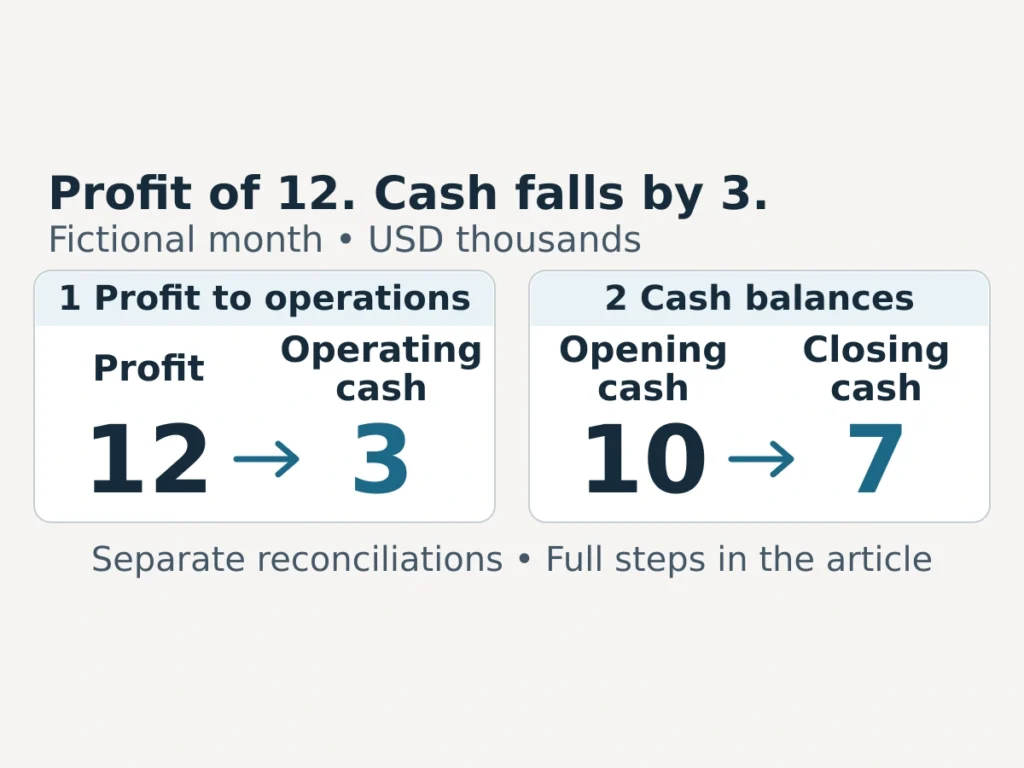
A profit versus cash reconciliation explains how a profitable business can end a month with less money. Here, $12,000 profit becomes $3,000 operating cash after noncash and operating-balance adjustments. Equipment and financing flows use a net $6,000, leaving a $3,000 cash decline.
Profit versus cash: the worked business example
Transactions reconcile $10,000 opening cash to $7,000 closing cash; no balancing plug is inserted.
For the shortest route through the example, read the profit-to-operating-cash table, then the opening-to-closing cash table. Use the independent receipts and payments check to test the first result. The assumptions below apply to all three.
All amounts are invented. Every table uses USD thousands, so 12 means $12,000. The example covers one completed month and one unrestricted, reconciled business-wide cash total. It’s an arithmetic exercise, not a set of actual accounts.
Account treatments and cash-flow groupings are stipulated for this invented company. This exercise isn’t an audit, tax calculation or demonstration of financial-reporting-framework compliance, and provides no tax-method guidance.
The boundaries of this example
- All 50 of revenue is earned credit sales. Customers pay all 8 of opening receivables and 33 of this month’s sales. There are no returns, discounts, write-offs, allowances, customer deposits, deferred revenue, sales taxes, factoring or currency movements.
- All 27 of inventory purchases are on supplier credit. Trade payables contain only those inventory purchases. There’s no shrinkage, write-down, production overhead or depreciation included in inventory cost.
- The 12 of other operating expense is fully paid. It includes any ordinary owner salary once. Prepaid expenses, accrued payroll and other operating accruals don’t change.
- Interest expense of 1 and stipulated entity income-tax expense of 2 are both paid in full. Interest and tax payables are zero at both dates; there are no tax receivables, refunds or deferred taxes. The assumed tax amount supplies no tax rate or entity-choice guidance.
- Depreciation of 3 is the only noncash expense. Equipment costing 8 is purchased for cash. There are no disposals, impairments, leases, equipment payables or noncash asset acquisitions.
- The business receives 5 of new loan cash and separately pays 2 of principal. There are no withheld fees or other financing costs. Principal excludes the 1 of interest.
- The owner receives a separate distribution of 1, in addition to any salary already inside operating expense. Contributed capital stays unchanged.
- No other cash flows, omitted transfers, restricted-cash movements or cash-equivalent reclassifications occur.
1. Establish the month’s accrual profit
The income statement records 50 of revenue and 38 of expenses, leaving 12 of net income. Its expense total includes inventory cost recognized as goods are sold and the month’s depreciation. It doesn’t include the equipment purchase, principal repayment or separate owner distribution.
| Item | Amount |
|---|---|
| Revenue from credit sales | 50 |
| Less: cost of goods sold | 20 |
| Gross profit | 30 |
| Less: other operating expense | 12 |
| Less: depreciation | 3 |
| Operating profit | 15 |
| Less: interest expense | 1 |
| Profit before the stipulated entity income tax | 14 |
| Less: stipulated entity income-tax expense | 2 |
| Net income | 12 |
These are accrual figures for the month. To find the cash result, the next steps use the opening and closing balances and the actual modeled receipts and payments.
2. Put both balance sheets beside the income statement
Cash is only one account that changes. Receivables rise by 9, inventory rises by 7, and inventory payables rise by 4. The business also buys equipment, borrows, repays principal and distributes cash to its owner.
| Account | Opening | Closing |
|---|---|---|
| Cash | 10 | 7 |
| Accounts receivable | 8 | 17 |
| Inventory | 10 | 17 |
| Equipment at gross cost | 30 | 38 |
| Less: accumulated depreciation | 10 | 13 |
| Equipment, net | 20 | 25 |
| Total assets, using net equipment once | 48 | 66 |
| Trade accounts payable: inventory only | 6 | 10 |
| Interest payable | 0 | 0 |
| Income tax payable | 0 | 0 |
| Other accrued liabilities | 0 | 0 |
| Debt principal outstanding | 18 | 21 |
| Contributed capital | 15 | 15 |
| Retained earnings | 9 | 20 |
| Total equity | 24 | 35 |
| Total liabilities and equity | 48 | 66 |
Total assets use net equipment—20 opening and 25 closing—not gross and net equipment added together. Total equity likewise includes contributed capital and retained earnings; don’t add the subtotal again.
3. Profit versus cash: reconcile operating cash
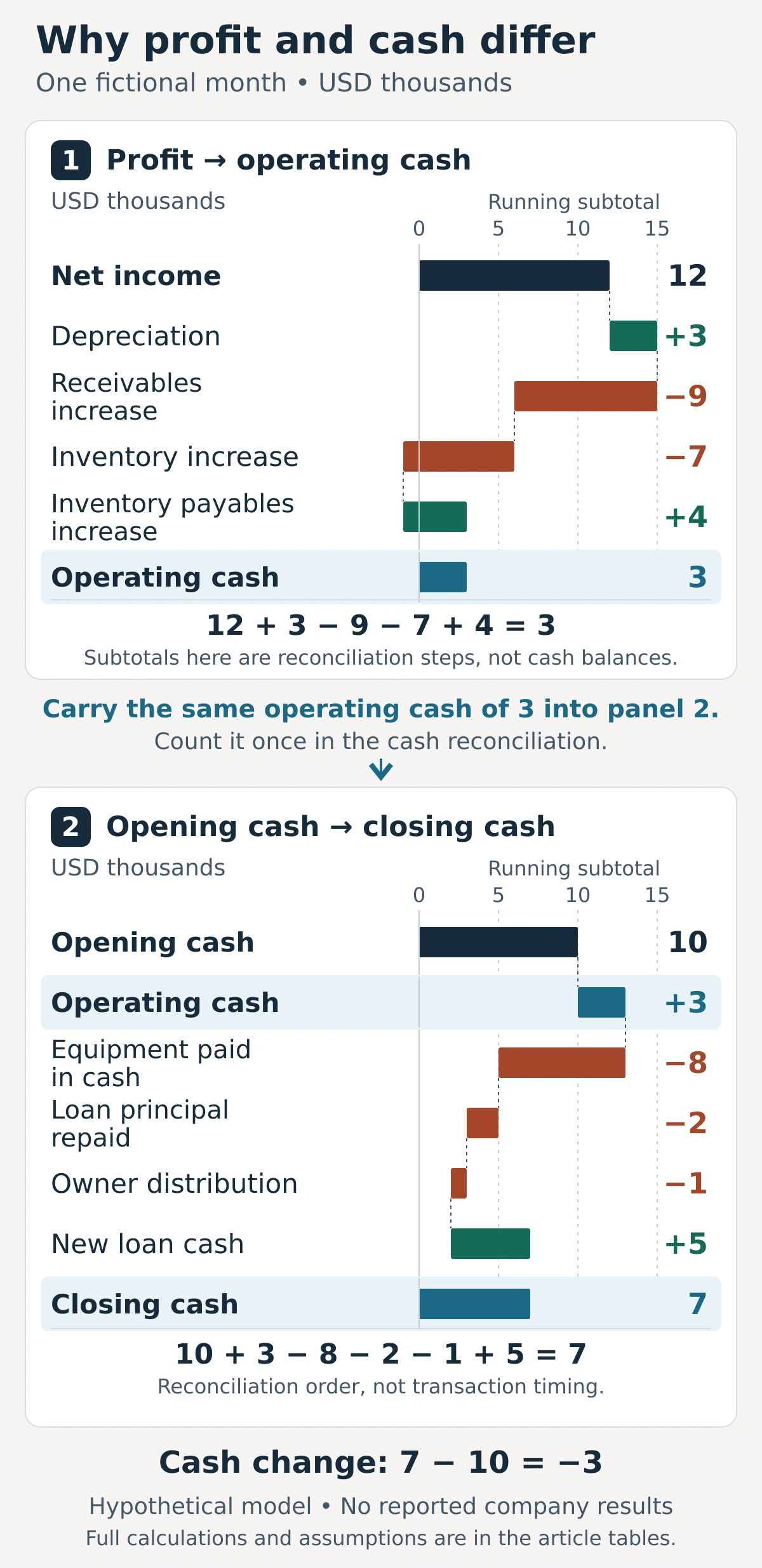
Start with the 12 of net income. Add back the 3 of depreciation because this modeled expense has no cash payment. Then account for the movements in receivables, inventory and inventory payables.
| Step | Effect | Calculation |
|---|---|---|
| Start with net income | 12 | From the income statement |
| Add depreciation | +3 | Expense without a cash payment in this model |
| Subtract the increase in receivables | −9 | 17 closing − 8 opening = 9 |
| Subtract the increase in inventory | −7 | 17 closing − 10 opening = 7 |
| Add the increase in inventory payables | +4 | 10 closing − 6 opening = 4 |
| Operating cash | 3 | 12 + 3 − 9 − 7 + 4 = 3 |
The receivables adjustment is 9, the net increase, rather than the closing balance of 17. The business collects 8 from its opening invoices plus 33 from the month’s 50 of new sales. Total customer cash is therefore 41, which is 9 below the 50 of revenue.
The inventory and payables adjustments work together. Purchases of 27 exceed the 20 of cost of goods sold by 7. Yet supplier cash payments are 23 because payables increase by 4. The combined adjustment is −7 + 4 = −3: supplier payments exceed this month’s cost of goods sold by 3.
At the intermediate step, net income plus depreciation is 15. That is not the finished operating-cash subtotal: the three operating-balance movements reduce it by a net 12, leaving 3.
Interest of 1 and stipulated entity income tax of 2 have already reduced net income and are paid in the same amounts. Their payable balances do not move, so this example needs no adjustment for either item. They are not added back here or deducted a second time later.
4. Prove operating cash again from receipts and payments
The second route doesn’t start with profit. It reconstructs the cash received from customers and the cash paid to suppliers, then deducts the other cash operating payments.
| Amount to derive | Opening and closing balance calculation | Result |
|---|---|---|
| Customer receipts | 8 opening receivables + 50 credit sales − 17 closing receivables | 41 |
| Inventory purchases on credit | 20 cost of goods sold + 17 closing inventory − 10 opening inventory | 27 |
| Supplier payments | 6 opening payables + 27 credit purchases − 10 closing payables | 23 |
Receipts are 8 from opening invoices plus 33 from current sales. Supplier payments are 6 for opening payables plus 17 for current purchases; 10 of current purchases remains payable.
| Receipt or payment | Cash effect |
|---|---|
| Customer receipts | +41 |
| Payments to inventory suppliers | −23 |
| Other operating payments | −12 |
| Interest paid | −1 |
| Stipulated entity income tax paid | −2 |
| Operating cash | 3 |
Customer receipts of 41 less cash operating payments of 38 leave 3. This independently matches the indirect reconciliation.
Both expense and cash-payment totals happen to equal 38. Their components differ: depreciation is noncash, while supplier payments reflect payables and inventory movement. This equality is coincidental; use the separate tables rather than substituting one total for the other.
5. Profit versus cash after equipment and financing
Operating cash of 3 is only part of this month’s story. The equipment purchase uses 8. New borrowing brings in 5, while principal repayment uses 2 and the separate owner distribution uses 1.
| Cash item | Amount or movement |
|---|---|
| Opening cash | 10 |
| Operating cash generated | +3 |
| Investing: equipment paid in cash | −8 |
| Financing: new debt received in cash | +5 |
| Financing: debt principal repaid | −2 |
| Financing: separate owner distribution | −1 |
| Net cash change | −3 |
| Closing cash: opening cash plus net change | 7 |
Cash changes by 3 − 8 + 5 − 2 − 1 = −3, ending at 10 − 3 = 7. Net investing cash is −8 and net financing cash +2; retain their individual flows.
Borrowing of 5 is an actual receipt, not an unexplained balancing plug. Keep the separate equipment payment of 8 visible despite both occurring in the same month.
The principal repayment of 2 reduces debt and cash without entering this model’s income statement. Interest of 1 is already included in the operating-cash subtotal. The owner distribution of 1 also sits outside net income and reduces equity. It is separate from any salary included once in the 12 of operating expense.
6. Check that debt, equipment and equity also close
For the profit versus cash check, reconcile debt, equipment and equity as well. The roll-forwards connect transactions to the closing balance sheet.
| Account | Roll-forward | Closing amount |
|---|---|---|
| Debt principal | 18 opening + 5 new borrowing − 2 principal repaid | 21 |
| Equipment at gross cost | 30 opening + 8 cash-paid additions | 38 |
| Accumulated depreciation | 10 opening + 3 depreciation | 13 |
| Equipment, net | 20 opening + 8 additions − 3 depreciation | 25 |
| Retained earnings | 9 opening + 12 net income − 1 distribution | 20 |
| Total equity | 24 opening + 12 net income − 1 distribution | 35 |
Finally, closing assets are 7 cash + 17 receivables + 17 inventory + 25 net equipment = 66. Closing liabilities and equity are 10 inventory payables + 21 debt + 35 equity = 66. Opening assets and opening liabilities plus equity both total 48.
The profit versus cash difference is reconciled: income of 12, operating cash of 3 and net equipment/financing outflows of 6 produce a cash decline of 3. Retained earnings rise by 11 after the distribution. Each movement has its own reconciliation.
Turn the explanation into the next record check
The reconciliation identifies questions to investigate; it doesn’t choose a business action for you. For a real business, work with your bookkeeper or accountant to match these questions to the actual accounts:
- Receivables: Which invoices make up the increase, when are they due, and which receipts have arrived after month-end? The example’s increase of 9 isn’t evidence that all 17 of closing receivables are overdue.
- Inventory and suppliers: Which purchases and unpaid supplier invoices explain the balances? Avoid treating inventory growth and the related supplier payments as independent cash costs to add again.
- Equipment and debt: Do the equipment invoice, actual loan deposit and principal/interest allocation match the separate entries? The new borrowing of 5 and equipment purchase of 8 should remain visible individually.
- Owner payments: Has salary already been counted within operating expense, and is a separate distribution supported by its own record? Don’t use the same payment in both places.
These are record requests, not findings of accounting errors. The recordkeeping reference below explains supporting documentation.
This completed-month example establishes only where its cash went. It doesn’t determine how much the business should borrow, whether the remaining 7 is an adequate reserve, or whether future payments are affordable. A forward-looking cash plan needs actual expected receipt and payment dates; this reconciliation doesn’t supply them.
For a separate balance-date question, the working capital calculator compares classified current assets and liabilities. This example doesn’t say how much of its debt of 21 is current, so don’t enter all of it as short-term debt by default. For a separate constant-monthly-flow scenario, use the cash runway calculator with explicit future assumptions. It doesn’t infer those assumptions from profit or establish cash availability between month-ends.
Related reading
For a related question, read Business Bank Reconciliation: Explain the Gap Without Counting Cash Twice and One Customer Pays Late: Stress-Test Cash and Credit Availability Together.
For separate guidance about organizing business records, read IRS Publication 583. The fictional accounting treatments and values above remain assumptions of this exercise.