Extra Mortgage Payments: Monthly Additions vs. Annual Lump Sums
Compare fictional monthly and annual extra-payment calendars at equal cash checkpoints, with exact payment numbers and conditional payoff results.

Estimated reading time: 8 minutes
Extra mortgage payments depend on timing as well as the annual amount. Compare monthly additions and lump sums using the same loan, equal-cash checkpoints and confirmed instructions for applying money to principal.
“Pay $2,400 extra each year” leaves an important question unanswered: when does that money reach the mortgage? Twelve $200 additions, a lump sum after payment 12 and a lump sum after payment 1 have the same annual extra budget but different timing. A fair comparison gives each path the same loan and checks balances on the same date.
Fannie Mae’s extra-payment guidance discusses periodic additional payments and directing them to principal. Before trying a plan, confirm the loan’s prepayment provisions and the servicer’s allocation instructions. Preserve savings for other needs; a smaller mortgage balance isn’t accessible cash in a savings account.
Extra mortgage payments: hold the loan inputs constant
Our fictional loan starts at $240,000 with a fixed nominal annual rate of 6% and 360 monthly installments. The monthly rate is 0.5%. Required principal and interest, or P&I, is $1,438.921260… per month, displayed as $1,438.92. Calculations keep full precision and round only displayed results.
The first installment occurs one full monthly period after the starting balance. Every extra payment posts immediately after that month’s regular installment, once that month’s interest has been calculated. The regular payment never falls. The model includes no fees, penalties, escrow, insurance, tax effects, savings earnings or investment returns. It assumes no missed payments or changes to the loan.
This is a timing experiment, not a current mortgage offer or a promise about a particular servicer. Its results apply only to the stated inputs and posting sequence.
Define the three extra-payment calendars
- Monthly: pay $200 extra after every installment while principal remains.
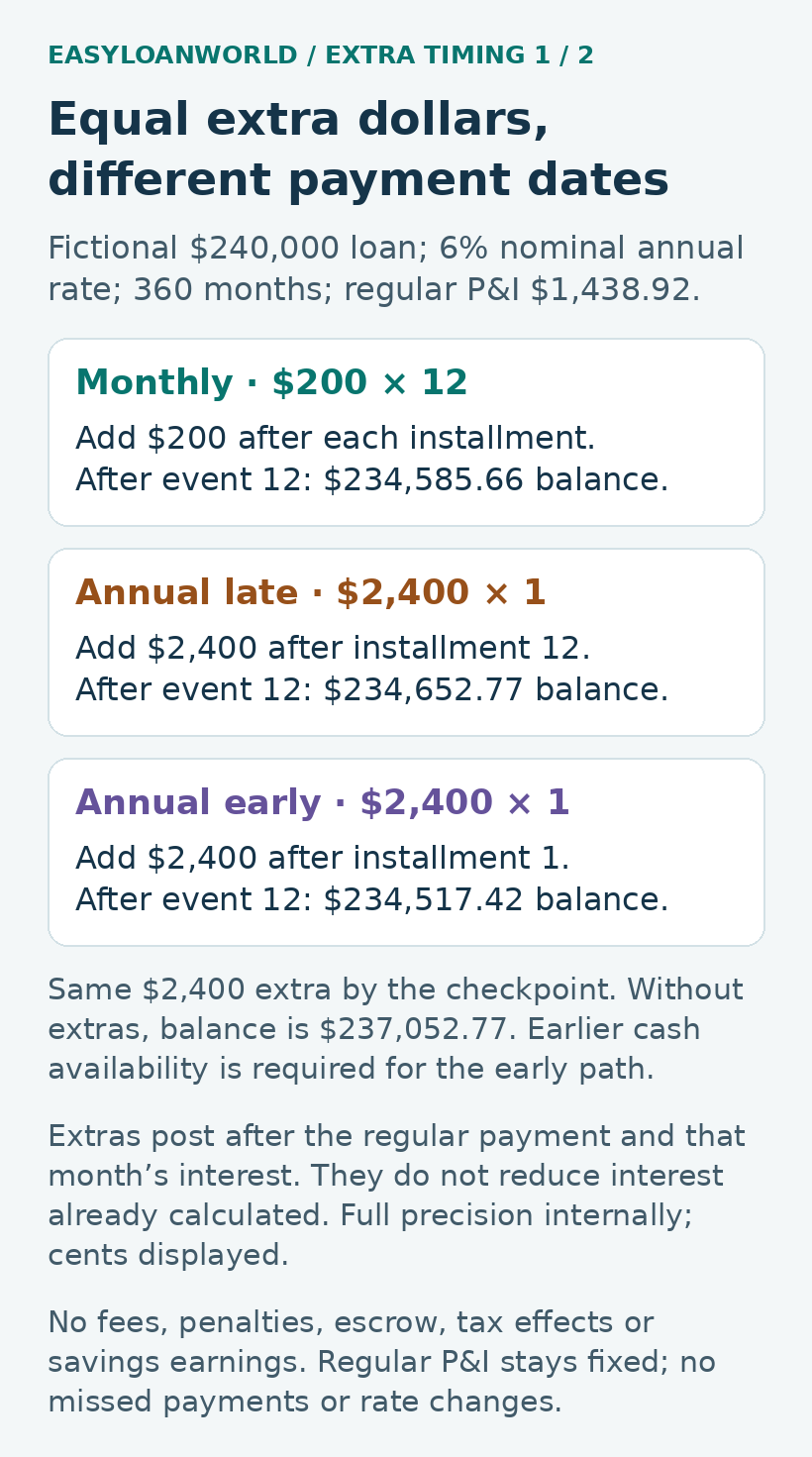
- Annual late: pay $2,400 extra after installments 12, 24, 36, 48, 60 and so on.
- Annual early: pay $2,400 extra after installments 1, 13, 25, 37, 49 and so on.
The early route begins at payment 1, not at model time zero. It requires the whole $2,400 to be available then. The late route could represent setting aside $200 each month and paying the accumulated amount after installment 12, but this model gives those savings no earnings.
Each route contributes $2,400 during every completed twelve-payment cycle before payoff. Someone who receives the money gradually can’t assume the early route is available merely because the annual totals match. Write the cash-availability date beside the payment date before comparing results.
Compare the first twelve payments
Immediately after installment 12 and any extra payment due at that event, remaining principal is:
- No extra payments: $237,052.77.
- Monthly additions: $234,585.66.
- Annual late lump sum: $234,652.77.
- Annual early lump sum: $234,517.42.
All three extra routes have contributed $2,400 by this checkpoint. The monthly route’s balance is $67.11 below the late route’s balance. The early route’s balance is lower still, but it required cash earlier. “Annual” alone therefore doesn’t tell you which timing produces the smaller balance.
Consider the first extra payment. The monthly route reduces principal by $200 after installment 1; the early route reduces it by $2,400 at that same event. Neither changes interest already calculated for month 1. Their lower balances enter the next month’s calculation. The late route makes no extra principal reduction until installment 12.
Extra mortgage payments: compare equal cash at payment 60
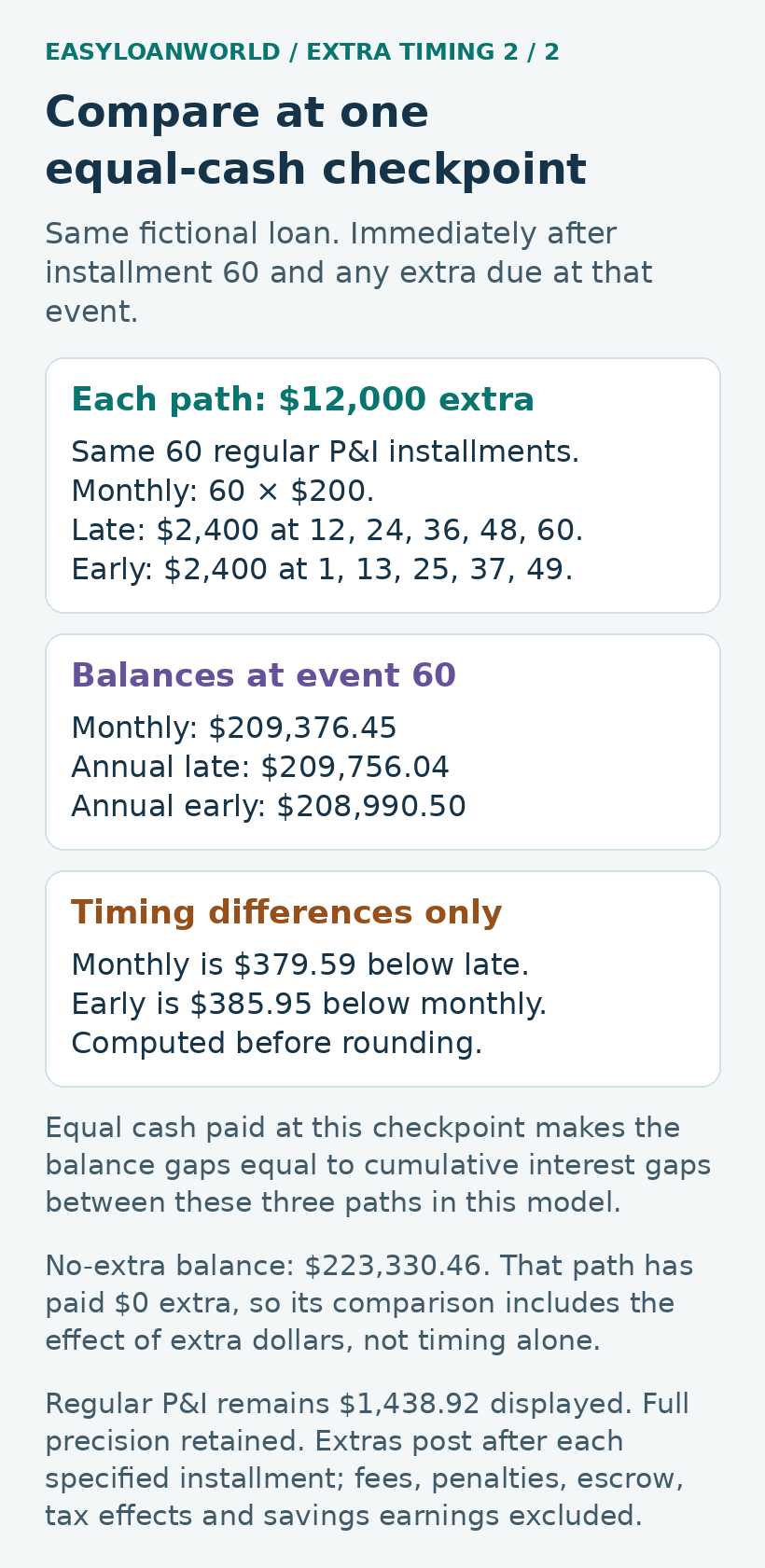
At installment 60, each extra route has paid exactly $12,000 of additional principal and the same 60 regular installments. Balances immediately after that event are:
- No extra payments: $223,330.46.
- Monthly additions: $209,376.45.
- Annual late lump sums: $209,756.04.
- Annual early lump sums: $208,990.50.
The monthly balance is $379.59 below annual late. Annual early is $385.95 below monthly. Differences are computed before rounding. Because cumulative cash paid is equal among the three extra routes at this checkpoint, those balance differences also equal their cumulative interest differences in this model.
This matched checkpoint isolates timing more clearly than comparing a balance after one route has made an extra payment with another route just before its payment. If you choose a different checkpoint, show cumulative extra dollars beside every balance. Otherwise, part of the apparent advantage may simply be more money paid so far.
Keep lifetime outcomes separate from the checkpoint
If the four paths continue unchanged until the balance is cleared, their modeled outcomes are:
- No extras: 360 installments and $278,011.65 total interest.
- Monthly: 265 installments and $192,926.32 interest; the final total payment is $251.10.
- Annual late: 267 installments and $195,923.79 interest; the final total payment is $370.74.
- Annual early: 263 installments and $189,910.10 interest; the final total payment is $112.73.
Compared with no extras, modeled interest avoided is $85,085.34 monthly, $82,087.86 annual late and $88,101.55 annual early. Those larger lifetime savings include the effect of paying extra at all. They aren’t solely the advantage of moving the same year’s payment earlier.
Each extra route happens to contribute $52,800 of explicit extra principal before its final small installment in this example. Equal lifetime extra totals aren’t guaranteed for other inputs. The calculation caps the final payment at remaining principal plus that period’s interest; it doesn’t keep charging full installments after the debt is cleared.
Extra mortgage payments: test the monthly route in the calculator
This extra-payment tool can reproduce the recurring monthly branch. Enter $240,000 current principal, a 6% contractual annual rate, 360 remaining months and $200 extra principal each month. Its scheduled payment should display $1,438.92 and its planned payment including the extra should display $1,638.92.
The expected payoff is 265 months, with modeled interest saved of $85,085.34 relative to the no-extra schedule. The additional result text should show $192,926.32 of interest with extra payments and a final $251.10 payment. These values belong to the full-precision fictional model.
Open the calculation table to inspect monthly balances. At payment 12, the extra-payment balance is $234,585.66; at payment 60, it is $209,376.45. Compare the baseline column at those same rows, not an adjacent row before or after an extra payment.
As a control, change the extra-monthly input to zero. The planned and scheduled payments should match, the modeled payoff should return to 360 months and interest saved should be zero. Restore $200 before comparing the recurring-extra results with the article.
Extra mortgage payments: keep annual lump sums outside these fields
The tool applies an equal extra amount with every installment. It has no field for an extra payment only after installments 12, 24 and later year-end events. Entering $2,400 as the extra-monthly amount would model $28,800 in a complete twelve-payment cycle, not the article’s $2,400 annual budget.
Likewise, entering $200 monthly doesn’t reproduce a $2,400 lump sum after payment 1. That earlier branch commits all the money before the remaining monthly additions occur. Use the explicitly dated annual schedules in the article rather than relabeling the recurring calculator output.
Record cumulative extra dollars with every checkpoint. Immediately after payment 1, the monthly and early-annual branches have paid different extras; immediately after payment 12, they have paid equal extras. That’s why the latter is a cleaner timing comparison under these assumptions.
For actual payments, confirm the amount applied to principal and keep the required installment separate. An estimate of faster payoff doesn’t establish a reduced required payment, a new due date or accessible savings. Reconcile the posted account record after using the servicer’s verified instructions.
The 265-payment result equals twenty-two years and one month of modeled monthly intervals. It isn’t a dated calendar payoff until the starting date, actual payment dates and contractual accrual method are supplied.
Turn the comparison into a dated plan
Record the amount actually available now, later cash amounts and their expected dates, and the regular payment that must continue. Choose a common checkpoint and record cumulative extra cash at that point. Keep potential fees and any savings earnings visible as omitted items rather than silently treating them as zero in a real decision.
Before sending money, ask how the extra amount will be applied and whether a penalty or fee affects your proposed payment. Afterward, verify the posted principal reduction. Leave enough accessible savings for your other needs; this calculation can’t choose that amount for you.
The useful conclusion is conditional: with the same loan, equal extra dollars and these posting assumptions, earlier principal reductions produce the lower matched-date balance. Whether you can use that timing depends on when your cash is available and what else it needs to cover.
Use the amortization-schedule guide to follow how an additional payment changes principal and the next period’s modeled interest.
Featured photo: An annual calendar illustrates comparing payment timing. Photo: Marissa Grootes / Unsplash. Used under the Unsplash license.

One Mortgage Form, Two Borrowers
Match each person’s share.