Farm Equipment Purchase Records
Check farm-equipment financing, auction requirements, hourly-cost assumptions, tax classification, insurance and warranty timing separately.
Estimated reading time: 5 minutes
Buying farm equipment means checking more than the machine. Read the financing channel and auction requirements alongside the hourly-cost assumptions, tax classification, insurance structure and warranty timing.
Identify who provides the operating loan
The Farm Service Agency’s operating-loan overview includes equipment among permitted purposes. It distinguishes direct operating loans provided by FSA from guaranteed operating loans issued by commercial lenders with an FSA guarantee. The agency’s name therefore doesn’t identify the same lender arrangement in every case.
FSA describes eligibility considerations including satisfactory credit history, repayment ability and inability to obtain credit elsewhere at reasonable rates and terms. Equipment appearing in the permitted-purpose list doesn’t establish that a particular applicant qualifies.
Its application description calls for detailed financial and production information and a comprehensive farm business plan. Those records explain the operation behind the requested equipment, rather than merely naming a tractor. The overview also distinguishes FSA-set direct-loan rates from guaranteed-loan rates negotiated between lender and borrower; it isn’t a personalized rate quote.
Separate the auction invoice from lien-release requirements
AgDirect’s auction-financing FAQ asks for an invoice identifying the auction date, sale price, year, make, model, full serial number, funding recipient and auction contact. That’s a transaction description, not the entire funding file.
The lender describes a buyer-and-seller lien search before documents are generated. Its published process distinguishes a seller’s blanket lien, for which a creditor-signed UCC-3 is prepared, from an asset-specific lien, for which funding goes to both creditor and seller.
Before releasing funds, it requires completed signed loan documents and applicable signed lien releases; additional information may be requested for the transaction. These are AgDirect’s stated requirements, not instructions to prepare a filing or decide legal priority yourself. Ask the lender which unresolved document belongs to which stage instead of treating an invoice as confirmation that all release conditions are satisfied.
Understand what an hourly ownership figure divides
Iowa State’s machinery-cost guide, updated March 2026, divides annual ownership cost by annual use hours. Its worksheet separates ownership costs from operating costs such as repairs, fuel, lubrication and labor.
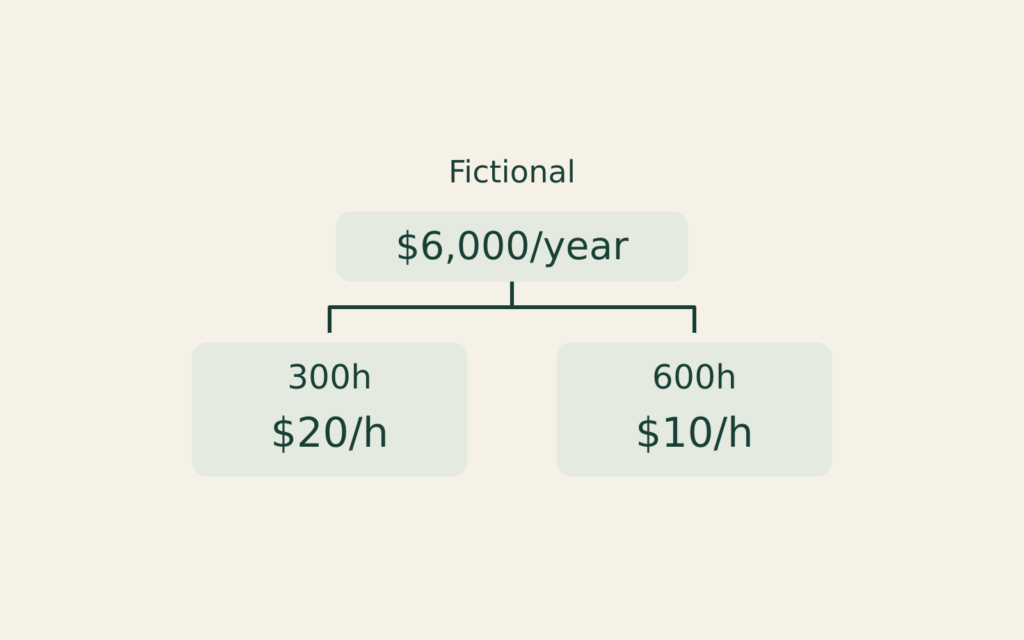
Consider a fictional machine with $6,000 in annual ownership cost. Holding that amount constant, compare two assumed usage levels:
| Annual hours | Ownership cost per hour |
|---|---|
| 300 | $6,000 ÷ 300 = $20 |
| 600 | $6,000 ÷ 600 = $10 |
The second figure is lower because the same annual amount is spread over more hours. Neither row reduces the stipulated $6,000 annual ownership cost. Neither includes the separately estimated operating costs or calculates a loan installment. This is an allocation illustration, not a recommendation to operate longer, a prediction of available work or a claim that doubling usage leaves every real expense unchanged.
Don’t substitute property appraisal for sales-tax qualification
The Texas Comptroller’s agricultural FAQ distinguishes sales-tax treatment from agricultural property appraisal. Land used for hunting leases, wildlife management or other nonagricultural purposes can have agricultural property-tax treatment without meeting the FAQ’s farm-or-ranch definition for sales-tax exemption.
For the tractor question, the agency explains that tractors generally are tangible personal property rather than motor vehicles for tax purposes. Its sales-tax exemption requires exclusive farm-or-ranch use producing agricultural products for sale in the normal course of business. It identifies an agricultural exemption certificate containing the purchaser’s ag/timber number.
That’s a Texas-specific classification and use test, not a nationwide exemption or a conclusion about your purchase. A property-appraisal designation alone doesn’t answer it. Keep the quoted tax treatment tied to the actual equipment and intended use when seeking clarification from the seller or a qualified tax professional.
Read individual values and blanket amounts differently
Nationwide’s farm-equipment page describes two structures: individual equipment listed separately with its own value, or blanket coverage up to a designated amount. A blanket description isn’t a statement that coverage has no limit.
Its named AgriChoice product includes categories beyond tractors, such as portable irrigation equipment, tools, supplies and GPS equipment. The page also describes borrowed machinery and rented or leased equipment among its features. Those are product-specific descriptions, not features that can be assumed in every farm policy.
The insurer states that the product is subject to underwriting review and approval, availability restrictions, deductibles, exclusions and conditions. Read the actual equipment schedule or blanket amount alongside those terms. The useful comparison is how the policy identifies the insured property and applicable amount, not whether a marketing page happens to show a machine resembling yours.
Distinguish warranty-purchase timing from financing timing
Kubota’s Orange Protection page says the extension can be purchased before the original Basic Warranty expires, with model and usage applicability to be checked with the dealer. Separately, it says financing through Kubota Credit Corporation USA is available when the extension is purchased at the same time as the tractor.
These are different timing conditions. A later opportunity to buy the extension doesn’t establish access to that same-time financing arrangement. The page describes extended Basic and Powertrain coverage, where applicable, under the original limited warranty’s conditions, inclusions and exclusions.
Coverage stays with the tractor or implement for the purchased duration, but separate hour limitations may apply. Listed exclusions include bucket teeth, cutting edges, tires and tracks. Read the applicable model’s actual warranty terms rather than interpreting “extended” as coverage for every component or unlimited operating hours.


